
Sole vs Joint Custody: Key Differences Every Parent Should Know
Sole custody gives one parent exclusive legal or physical authority over a child, while joint custody splits that authority between both parents. Judges across the country lean toward joint custody by default. Kids tend to do better with both parents actively in their lives, and most courts start from that assumption. Sole custody comes into play only when something specific makes shared responsibility unsafe, documented abuse, neglect, or a parent who simply can’t co-parent without constant conflict. Beyond that baseline, a judge weighs the child’s age, each household’s stability, how well the parents communicate, any violence in the family’s history, the distance between homes, and, once a child is old enough, what they actually want.
What Is Child Custody?

Child custody breaks down into two separate categories: legal custody and physical custody. Legal custody is the right to make the big calls, education, healthcare, religion. Physical custody is simpler: it’s just where the child sleeps most nights.
These two don’t have to line up. One parent can hold legal custody without ever having physical custody, and that split shows up constantly in real orders. Say a mother handles every school enrollment form and doctor’s visit (legal custody), but the child lives mainly with the father during the school week (physical custody). Nothing unusual about that. Every custody order in the United States (U.S.) treats the two categories separately, then labels each one sole or joint on its own.
What Is Sole Custody?
Sole custody means one parent holds exclusive authority over the child, either legally, physically, or both. It’s not a punishment, whatever it might feel like to the parent who doesn’t get it. Judges order it when the evidence points to one clear conclusion: the child’s safety or stability requires limiting the other parent’s role.
What actually pushes a case there? A documented history of domestic violence is the most common trigger. Active substance abuse that affects parenting is another. So is a parent who’s simply absent, unwilling to show up for the child in any consistent way. None of that means the other parent disappears from the picture entirely. A parent with sole physical custody in California, for instance, might still owe the other parent scheduled weekend visitation, supervised or not, depending on what the case record shows. Visitation gets cut off completely only when a judge decides contact itself would put the child at risk.
What Is Joint Custody?
Joint custody means both parents share legal authority, physical time with the child, or both. A 50/50 time split isn’t required, despite what a lot of parents assume going in. Texas courts, New York courts, and most others can order joint legal custody on its own, joint physical custody on its own, or a hybrid where one parent gets more overnight time while decision-making stays shared.
Under joint legal custody, both parents have to sign off on the major stuff: which pediatrician, which school district, whether a kid gets braces this year or next. Joint physical custody is about time, not decisions, and the split rarely lands at a perfect 50/50. It might run 60/40. It might run 70/30. One of the more common patterns nationwide is the 2-2-3 rotation, where the child moves between homes every two or three days on a repeating cycle.
Sole vs Joint Custody: Core Differences
Understanding sole vs joint custody starts with comparing how each type handles decision-making, living arrangements, and parental cooperation.
| Factor | Sole Custody | Joint Custody |
| Decision-making authority | One parent decides | Both parents decide together |
| Where the child lives | Primarily with one parent | Split between both homes |
| Communication requirement | Minimal between parents | High, ongoing coordination needed |
| When courts order it | Abuse, neglect, or extreme conflict | Default preference in most states |
| Non-custodial parent’s role | Visitation, usually scheduled | Active, ongoing parenting time |
| Child support impact | Often higher from non-custodial parent | Calculated based on time-share percentage |
This table only captures the general pattern. Every state applies its own statutes, and some, like Alabama and Florida, use different terminology such as “shared parental responsibility” instead of joint custody.
How Courts Decide Between Sole and Joint Custody
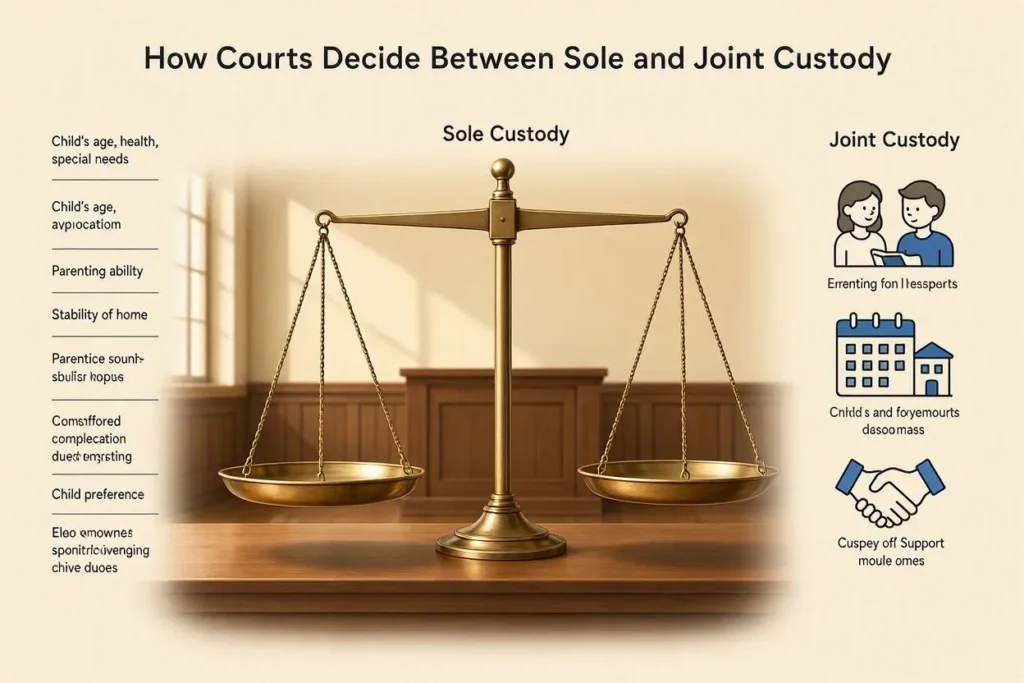
Courts decide custody by applying the “best interests of the child” standard, weighing several factors specific to the family’s circumstances. No single factor decides a case on its own, and no judge is working off a checklist that spits out an automatic answer. It’s a full-picture read of the family.
That said, the same handful of factors show up in nearly every state’s statute:
- The child’s age, health, and any special needs
- The emotional bond between the child and each parent
- Each parent’s ability to provide a stable, safe home
- Any documented history of domestic violence, abuse, or substance abuse
- The distance between the parents’ homes and how it affects school and daily routines
- The child’s own preference, if they’re mature enough to express a reasoned opinion
In a contested case, a judge might also bring in a custody evaluation. A psychologist or licensed evaluator sits down with both parents and the child, then submits a written recommendation to the court. It’s slow, often adding weeks or months to a case that’s already dragging on, but the recommendation tends to carry real weight in the final ruling.
Advantages and Disadvantages of Joint Custody
Joint custody works best when both parents can communicate and prioritize the child’s needs over personal conflict. Where that cooperation exists, the benefits are real. Where it doesn’t, the arrangement can grind a family down.
On the upside: children generally keep stronger relationships with both parents, and research on post-divorce outcomes consistently links that to better emotional adjustment. Neither parent gets stuck carrying the full weight of daily caregiving alone, either, which matters more than it sounds like on paper. Both stay involved in the decisions that actually shape a kid’s future, healthcare choices, school enrollment, all of it.
The downside is mostly logistics. Coordinating school pickups, medical appointments, and after-school activities across two households takes constant back-and-forth, and any gap in that communication turns into friction fast. Younger kids, especially those under six, can struggle with the frequent moves between homes. And when parents can’t agree on the basics, joint custody has a way of pulling them back into court again and again, with legal fees that can run into the thousands per filing.
Advantages and Disadvantages of Sole Custody
Sole custody works best when one parent needs full authority to protect the child from harm or instability. It solves a specific kind of problem well. It also creates a few of its own.
Stability is the strongest argument in its favor. One primary home means no shuffling between two households every few days, and decision-making moves fast because only one signature is needed on medical forms or school paperwork. Where a parent’s history includes substance abuse or violence, sole custody removes that risk from the child’s daily life directly, not as an afterthought.
But the tradeoffs are real. The custodial parent ends up shouldering nearly everything, day-to-day logistics, finances, the emotional load, largely alone. The other parent may feel pushed to the margins even with a regular visitation schedule in place. And if that parent-child bond weakens over the years, which does happen, rebuilding it later takes real, sustained effort on both sides.
Common Custody Schedules and Arrangements
Custody schedules vary by family, but a handful of patterns show up again and again in actual court orders. The 2-2-3 rotation is one of the most common: two days with one parent, two with the other, three back with the first, flipping each week. Some families prefer the alternating week schedule instead, a full seven days at each home before the switch. The 3-4-4-3 pattern splits the difference, mixing short and longer stretches so the child gets consistency without losing time with either parent. Less common, but gaining ground, is the “bird’s nest” arrangement, where the child stays put in one home and the parents are the ones who rotate in and out.
How far apart the parents live tends to decide which of these actually works. Within 10 to 15 miles, frequent switches don’t disrupt school attendance much. Once parents are farther apart, sometimes across state lines, the math changes, and longer blocks like school-year and summer splits cut down on how often the child is moving.
Can a Custody Order Be Modified Later?
Yes, a custody order can be modified after a significant change in circumstances. A minor disagreement won’t get a judge to reopen the case. The parent asking for the change has to show, with actual evidence, that the original order stopped serving the child’s best interests.
What counts as significant? A parent relocating for a new job is one common trigger. A child developing medical or educational needs the old arrangement can’t accommodate is another. So is proof that the current setup has become unsafe. There’s also a distance rule worth knowing: if a custodial parent plans to move more than 50 miles away, most states require formal notice to the other parent, and often court approval, before the move happens. From there, the judge weighs the same best-interest factors used the first time around, so the modification hearing plays out like a smaller version of the original custody case.
How Mediation Affects Custody Outcomes
Mediation resolves custody disputes without a trial by using a neutral third party to help parents reach an agreement. A lot of states actually require it before letting a contested custody case reach a judge, especially when both parents are asking for some version of shared custody anyway.
The mediator isn’t a decision-maker. Their job is keeping the conversation productive, helping both parents find common ground on scheduling, on who decides what, on how they’ll communicate going forward. Cost is one real reason it’s worth trying first: mediation often runs a few hundred dollars per session, compared to the thousands a contested trial can rack up in attorney fees. There’s a relationship payoff too. Parents who work out their own agreement through mediation tend to report fewer conflicts afterward, probably because they had a hand in writing the terms instead of having a schedule handed down to them.
Does Sole Custody End the Other Parent’s Rights?
No, sole custody does not automatically terminate the other parent’s parental rights. This is one of the more stubborn myths in family law, and it trips up a lot of parents going into a case. A parent who loses primary custody usually keeps visitation rights, still owes child support, and can come back later and petition for a modification if things change.
Ending parental rights takes a separate, formal legal process entirely. It generally happens one of three ways: a parent voluntarily gives up their rights, a court finds a parent unfit because of documented abuse or neglect, or a stepparent finalizes a legal adoption. Outside of those paths, losing custody doesn’t sever the legal bond between a parent and their child.
Common Misconceptions About Sole vs Joint Custody
A few myths keep circulating around this topic. Clearing them up matters, because parents walking into a custody case with the wrong assumptions tend to make worse decisions.
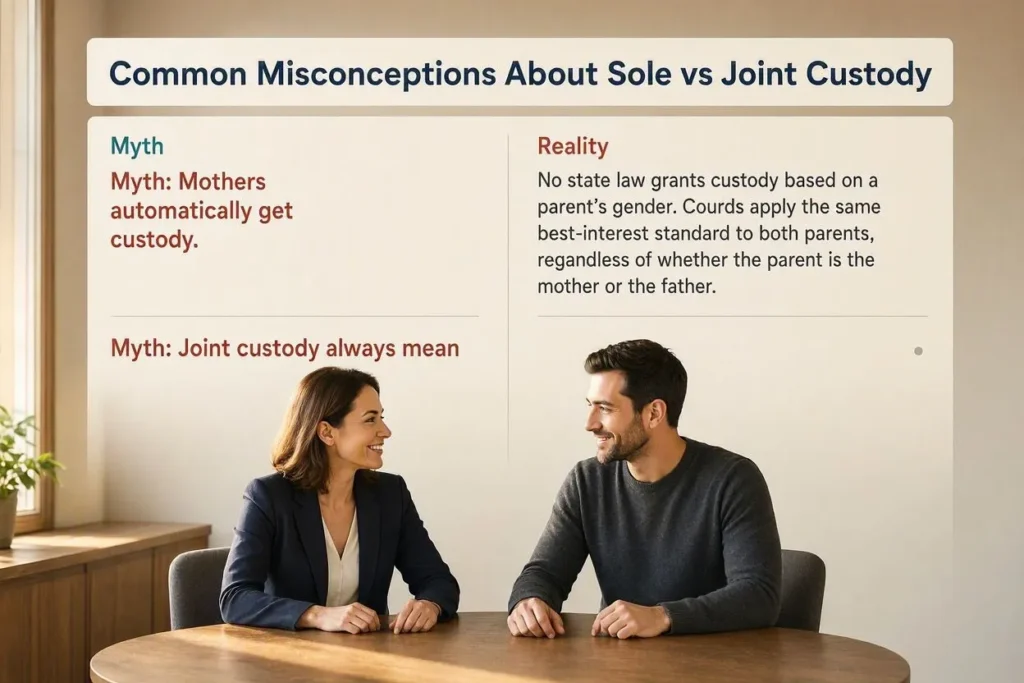
Myth: Mothers automatically get custody. No state law grants custody based on a parent’s gender. Courts apply the same best-interest standard to both parents, regardless of whether the parent is the mother or the father.
Myth: Joint custody always means an equal 50/50 split. Joint custody refers to shared authority, not a guaranteed even division of time. A joint custody order can still give one parent 60% of overnight stays.
Myth: Losing custody means losing all contact. Sole custody usually preserves visitation rights for the other parent. Courts restrict contact entirely only when they find a specific safety reason to do so.
Virtual Visitation and Interstate Custody Cases
Virtual visitation lets a parent maintain contact with a child through video calls when in-person visits aren’t practical. It comes up most often in long-distance moves and interstate custody cases, and it’s meant to supplement actual parenting time, not replace it.
Interstate cases bring up a separate question that has nothing to do with parenting: which state’s court even has authority to rule. That’s where the Uniform Child Custody Jurisdiction and Enforcement Act (UCCJEA) comes in. Adopted in some form by all 50 states, it hands jurisdiction to the child’s “home state,” generally wherever the child has lived for the past six months. Without a rule like that, two states could end up issuing conflicting custody orders for the same child at the same time. Nobody wins in that scenario, least of all the kid caught in the middle.
How to Prepare for a Custody Case
A few things genuinely move the needle for a parent heading into a custody dispute:
- Document parenting involvement, including school events, medical appointments, and daily caregiving routines
- Keep communication with the other parent respectful, even when the relationship is strained
- Avoid discussing the case or the other parent negatively in front of the child
- Consult a family law attorney early to understand state-specific custody laws
- Consider mediation before litigation to reduce cost and preserve a working co-parenting relationship
What judges actually notice is consistency. A parent who shows up to school conferences, keeps medical records in order, and manages to stay civil with the other parent tends to walk into court with a stronger case than one who spends their energy attacking the other side. In the end, the call on sole vs joint custody comes down to what the record actually shows about each parent’s role in the child’s day-to-day life. It has very little to do with who argues the loudest.
Conclusion
Choosing between sole and joint custody comes down to one question: what arrangement actually serves the child’s daily stability and long-term wellbeing. Courts don’t default to punishing either parent. They look at documented behavior, the child’s needs, and each parent’s demonstrated ability to provide a safe, consistent home. Parents who understand the legal distinctions in sole vs joint custody, prepare documentation early, and approach the process through mediation when possible tend to reach outcomes that hold up over time, both in court and in the years of co-parenting that follow.
FAQs

Amanda Brooks
Amanda Brooks leads JusticeInTown’s legal, justice, and community advocacy content division. She holds a background in legal research and public policy and specializes in topics related to civil rights, access to justice, legal awareness, and community issues. With years of experience researching legal and social justice topics, Amanda brings a careful, research-driven approach to complex legal information and public-interest issues. She is the primary author of JusticeInTown’s legal guides, justice-related resources, and community-focused content, helping readers better understand their rights, legal options, and the issues affecting their communities.
Related Posts