How Truck Accident Claims Work: Liability, Evidence & Payouts
Truck accident claims are personal injury lawsuits filed against a negligent commercial driver, the trucking company employing that driver, and its liability insurers, and they differ from car accident claims in three ways: federal safety regulations set the standard of care, several defendants can share liability, and the evidence proving negligence sits inside company systems that overwrite it on a schedule. Most of these cases settle. Getting a fair recovery out of them depends on work that starts within days of the crash, not months.
A loaded tractor-trailer weighs up to 80,000 pounds (36,287 kg). The car it hits weighs roughly 3,000 pounds (1,361 kg). That gap explains why more than 5,000 people die each year in large truck crashes in the United States, and why the majority of those killed were riding in the smaller vehicle.
What Are Truck Accident Claims?
Truck accident claims are civil tort actions seeking compensation from a commercial driver, the motor carrier employing that driver, and any other defendant whose negligence contributed to the crash. One wreck, several defendants. A two-car collision usually ends with a single driver and a single policy, while a trucking case can pull in the carrier, a trailer owner, a cargo loader, and a freight broker at once.
Federal law is what separates the two. The Federal Motor Carrier Safety Administration (FMCSA) regulates interstate carriers under 49 CFR Parts 300 to 399, setting rules on who may drive, how many hours, how equipment gets maintained, and what records the company keeps. Violate one and cause a crash, and the plaintiff gains a negligence argument that simply doesn’t exist in ordinary traffic cases. These claims reach semi-trucks and tractor-trailers plus dump trucks, tankers, box trucks, garbage trucks, and motorcoaches, and the federal framework generally applies whenever the vehicle required a commercial driver’s license (CDL).
Truck Accident Claims Are Personal Injury Cases, Not Insurance Disputes
Truck accident claims are tort claims, which means the injured plaintiff sues a negligent driver and trucking company and must prove that negligence in civil court. A liability insurer writes the check. The insurer is not who you sue. Most states bar naming the carrier’s insurance company in the complaint, so the driver and the motor carrier appear as defendants while the insurer quietly defends and indemnifies them.
That changes what decides your case. Policy language governs a first-party dispute with your own insurer, but a personal injury lawsuit turns on duty, breach, causation, and damages, proven with ELD records, maintenance files, and expert testimony. An adjuster’s offer is one opinion of value. A jury sets the real number, and plaintiffs who treat the first offer as the ceiling routinely settle for a fraction of what their damages support.
5 Reasons Truck Accident Claims Differ From Car Accident Claims
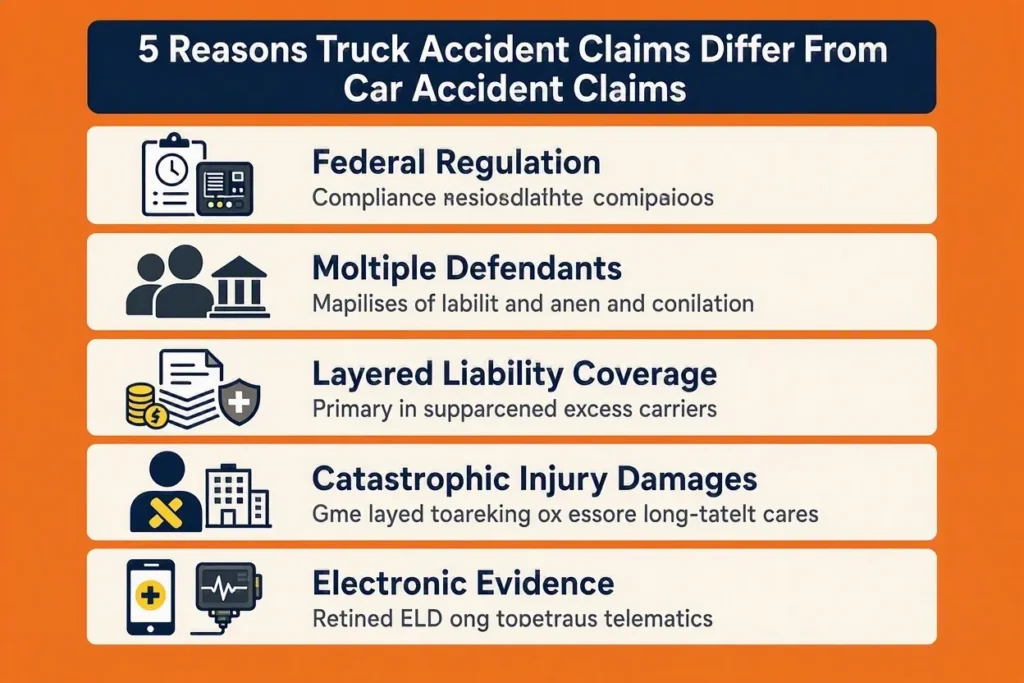
Truck accident claims differ from car accident claims because of federal regulation, multiple defendants, layered liability coverage, catastrophic injury damages, and electronic evidence held by the opposing party. Each difference changes litigation strategy.
- Regulation sets the standard of care. A trucker who drove 13 hours violated the hours-of-service (HOS) cap of 11 hours. That violation can establish negligence per se in many states, meaning the breach element is largely settled before counsel argues anything.
- Defendants multiply. One crash can produce claims against the driver, the carrier, a separate trailer owner, the shipper, a loading company, and a maintenance vendor.
- Coverage stacks. Federal law requires at least $750,000 in liability coverage for most non-hazardous freight, rising to $5,000,000 for certain hazardous materials. Large carriers commonly sit on excess and umbrella layers above that primary policy.
- Damages run higher. Catastrophic injury claims involving spinal cord damage, traumatic brain injury (TBI), and amputations support substantially larger damages awards than the soft-tissue claims that dominate ordinary collision litigation.
- Evidence lives on their servers. Electronic logging device (ELD) records, engine control module data, dispatch messages, and dashcam footage all sit in systems the defendant controls.
That last point drives everything else. A plaintiff can’t prove the first four without getting at the fifth.
The Burden of Proof in Truck Accident Claims
The plaintiff in a truck accident claim must prove negligence by a preponderance of the evidence, meaning the defendant’s fault is more likely true than not. Criminal proceedings against the driver have no bearing on that civil standard.
Four elements carry the burden:
- Duty. Every commercial driver owes other road users a duty of reasonable care, heightened by the FMCSRs governing licensed carriers.
- Breach. The defendant failed to meet that duty, whether by speeding, driving fatigued, or operating equipment the carrier never inspected.
- Causation. The breach produced the collision and the plaintiff’s injuries, both in fact and proximately.
- Damages. The plaintiff suffered actual loss, documented through medical records, wage evidence, and expert testimony.
Negligence per se collapses the second element. Where a defendant violated a safety regulation written to protect the class of people injured, many states treat breach as established and leave causation and damages for trial. Prosecutors declining to charge a driver changes none of this, because a criminal acquittal requires proof beyond a reasonable doubt while a civil plaintiff needs only the tipping of the scale.
What the Motor Carrier Does in the First 72 Hours
Large motor carriers dispatch a rapid response team to the crash scene within hours, often before the injured person leaves the hospital. Nobody warns victims about this, which is why so many claims start from behind.
The team typically includes a defense-side accident reconstructionist, a claims adjuster, and sometimes defense counsel. They photograph skid marks before rain washes them out, download the truck’s event data recorder (EDR), interview the driver while memory is fresh, and measure the roadway. One carrier’s investigator can be on scene in under four hours for a serious wreck.
Meanwhile the adjuster calls the injured party. The request sounds routine: a recorded statement, a medical authorization, a quick settlement to cover the ambulance bill. Sign the authorization and you’ve handed over your entire medical history, including every prior back complaint a defense expert will later blame for your symptoms.
The defense is building a file. A plaintiff should be too.
8 Parties Who Can Be Liable in Truck Accident Claims
Eight parties commonly face liability in truck accident claims: the driver, the motor carrier, the truck owner, the trailer owner, the cargo shipper, the loading company, the maintenance contractor, and a parts manufacturer. Which ones belong in the complaint depends on what the records show, not on whose name appears on the door of the cab.
| Party | Typical basis for liability |
| Truck driver | Speeding, fatigue, distraction, impairment, logbook falsification |
| Motor carrier | Negligent hiring, retention, supervision, or scheduling; vicarious liability for the driver |
| Truck or trailer owner | Failure to maintain equipment it owns and leases out |
| Freight broker | Negligent selection of a carrier with a documented violation history |
| Shipper | Misdescribing cargo weight or concealing hazardous contents |
| Loading company | Improper securement causing load shift, spill, or rollover |
| Maintenance contractor | Defective brake work, missed inspection, unrepaired defect |
| Parts manufacturer | Product liability for tire, brake, or coupling failure |
A broker sits in the chain more often than plaintiffs expect. Courts have allowed negligent selection claims against brokers, and a broker that assigned a load to a carrier with a documented violation history can be named as a defendant.
Vicarious Liability vs. Direct Negligence
Vicarious liability makes a carrier responsible for its driver’s conduct, while direct negligence makes the carrier responsible for its own conduct. Which theory survives decides how much evidence a jury ever sees. Respondeat superior holds the company liable simply because the driver acted within the scope of employment, but direct claims go after the company’s own decisions: negligent hiring for putting an unqualified applicant behind the wheel, negligent entrustment for handing keys to a driver it knew was unfit, negligent supervision for ignoring months of logbook violations.
Defendants know the difference. Many admit the agency relationship immediately, hoping to knock out the direct claims and keep the driver qualification file, the hiring notes, and the internal safety emails away from a jury. Several states allow that move. Other jurisdictions let both theories reach trial, and there the carrier’s own paperwork becomes the strongest exhibit the plaintiff has.
Federal Rules That Decide Fault in Truck Accident Claims
Four federal rule sets carry the most weight in truck accident claims: hours-of-service limits, vehicle maintenance standards, driver qualification requirements, and drug and alcohol testing protocols. Violating any of them creates documentary proof of a breach of duty.
Hours of service. Property-carrying drivers may drive a maximum of 11 hours after 10 consecutive hours off duty, and they cannot drive beyond the 14th hour after coming on duty. Passenger-carrying drivers face a 10-hour driving cap. ELDs record compliance automatically, so the data either exonerates the defendant or convicts him.
Maintenance. Under 49 CFR 396.3, carriers must systematically inspect, repair, and maintain every vehicle under their control and keep records proving they did. Brake violations remain among the most frequently cited defects in roadside inspections nationwide.
Driver qualification. Carriers must verify a driver’s license, road test, medical certification, and employment history, then keep a driver qualification file documenting all of it.
Testing. Pre-employment, random, post-accident, and reasonable-suspicion testing are all mandatory. A missed post-accident test is itself a violation.
Public safety scores add another layer. The FMCSA publishes Compliance, Safety, Accountability (CSA) data through its Safety Measurement System, letting counsel look up a defendant’s inspection and violation history by USDOT number before filing suit.
9 Records That Prove Fault, and How Long They Survive
Nine record categories prove negligence in truck accident claims, and federal retention rules keep some of them for as little as six months. Waiting a year to retain counsel means several of these are gone lawfully, with no penalty to the defendant.
| Record | Minimum federal retention |
| Records of duty status (driver logs) and supporting documents | 6 months |
| ELD data underlying those logs | 6 months |
| Vehicle maintenance and repair records | 1 year, plus 6 months after the vehicle leaves the carrier’s control |
| Annual inspection reports | 14 months |
| Accident register entries | 3 years |
| Driver qualification file | Duration of employment plus 3 years |
| Drug and alcohol test results | 1 to 5 years depending on result |
| EDR / engine control module data | No federal rule; often overwritten within days |
| Dashcam and yard camera footage | No federal rule; systems commonly loop every 30 to 90 days |
Read the bottom rows again. The two most persuasive exhibits in modern trucking litigation, black box data and video, carry no federal retention requirement at all. A telematics system can overwrite hard-braking data in under a week of continued driving.
How a Spoliation Letter Stops Record Destruction
A spoliation letter is written notice demanding that a defendant preserve specific evidence, and plaintiff’s counsel should send it within days of the crash. Serving one converts routine deletion into potentially sanctionable conduct.
The letter names categories rather than making a vague request: ELD data for the 30 days preceding the crash, the driver qualification file, all maintenance records for the tractor and trailer, dispatch communications, bills of lading, EDR downloads, and any video from cab-facing or road-facing cameras. Copies go to the carrier, its insurer, the trailer owner, and any tow yard holding the vehicle.
When a defendant destroys evidence after receiving that notice, courts in most jurisdictions can instruct the jury to presume the missing material would have harmed the defense. That adverse inference instruction has ended cases.
How Liability Coverage Compensates Truck Accident Claims
Truck accident claims get paid from a primary commercial auto liability policy first, then from excess and umbrella layers stacked above it once the primary limit exhausts. The federal minimum is a floor, never a ceiling on recoverable damages. Interstate carriers hauling non-hazardous freight must carry at least $750,000, hazardous materials transport requires $1,000,000 to $5,000,000 depending on the substance, and large fleets routinely sit on $10,000,000 or more through layered towers that a catastrophic case can climb one layer at a time.
Two coverage sources get overlooked. The MCS-90 endorsement, attached to a carrier’s policy as a condition of federal operating authority, forces the insurer to satisfy a judgment for public injury even where a policy exclusion would otherwise bar payment, leaving the insurer to chase reimbursement from its own insured afterward. Plaintiffs have collected on it after outright coverage denials. Your own policy counts too, since uninsured and underinsured motorist (UM/UIM) benefits, medical payments coverage, and personal injury protection (PIP) in no-fault states all pay out when the at-fault operator turns out to be an uninsured owner-operator.
The 6 Stages of a Truck Accident Personal Injury Lawsuit

A truck accident personal injury lawsuit runs through six stages: consultation, investigation, demand, negotiation, filing suit, and resolution. Most claims never reach the fifth.
- Consultation. An attorney reviews the crash facts, injuries, and available coverage, then explains the contingency fee terms in writing before the client commits.
- Investigation. Preservation letters go out, the crash report and 911 audio get pulled, witnesses are interviewed, and experts download vehicle data. Accident reconstruction begins here if liability is contested.
- Demand. Once treatment stabilizes, counsel assembles a demand package containing medical records, billing summaries, wage documentation, expert reports, and a settlement figure.
- Negotiation. Defense counsel and the adjuster respond, usually low. Rounds of counteroffers follow, sometimes ending in mediation before a neutral former judge.
- Filing suit. If talks stall, plaintiff’s counsel files a complaint in civil court and discovery opens. Depositions of the driver, the safety director, and the dispatcher often shift the case.
- Resolution. Settlement can land at any point, including during trial. Medical liens and health insurer subrogation claims get negotiated before funds disburse.
Timelines vary widely. Straightforward claims with clear liability resolve in 6 to 12 months. Catastrophic cases with disputed fault and several defendants run 2 to 4 years.
How Much Are Truck Accident Claims Worth?
Truck accident claim value depends on medical costs, lost earning capacity, permanence of injury, available liability limits, and the strength of the negligence evidence. No honest attorney quotes a number on the first call. Economic damages come straight off the paperwork: emergency treatment, surgery, rehabilitation, future care, lost wages, and diminished earning capacity, with a life care planner projecting decades of future medical need in permanent injury cases, an exhibit that frequently becomes the largest single line item. Non-economic damages cover pain, suffering, disfigurement, and loss of consortium, and while adjusters often open at a multiplier of roughly 1.5 to 5 times medical specials, juries are not bound by that math and routinely ignore it in severe cases.
Reckless conduct adds a third category. Falsified logbooks, a driver kept on the road after repeated violations, or impairment behind the wheel can all support punitive damages, which exist to punish rather than compensate. Published verdicts show what the ceiling looks like when catastrophic harm meets deep coverage: Georgia trucking firm Fried Goldberg reports $52 million for a teenager who suffered a brain injury when a tractor-trailer ran a stop sign, and $31 million in a wrongful death case involving a rear-end collision. Those are outliers, not benchmarks.
7 Factors That Reduce Truck Accident Claim Value
Seven factors consistently reduce the value of truck accident claims: treatment gaps, recorded statements, social media activity, undisclosed prior injuries, comparative fault, delayed reporting, and premature settlement. Defense counsel looks for every one of them.
- Treatment gaps. A 6-week break between appointments lets the defense argue the plaintiff recovered and then reinjured himself elsewhere.
- Recorded statements. Casual phrasing gets quoted back at deposition. “I’m doing okay” becomes evidence of full recovery.
- Social media. A photo at a wedding gets offered to a jury as proof that a back injury limited nothing.
- Undisclosed prior injuries. Hiding an old neck complaint destroys credibility. Disclosing it costs almost nothing, since aggravation of a preexisting condition remains compensable.
- Comparative fault. In modified comparative negligence states, a plaintiff found 51% or more responsible recovers nothing. At 30% fault, a $150,000 award drops to $105,000. Five jurisdictions still apply contributory negligence, barring recovery for any plaintiff fault at all.
- Delayed reporting. Waiting days to seek care hands the defense a causation argument it will press throughout the litigation.
- Premature settlement. Signing a release before maximum medical improvement forfeits every future claim arising from the same crash, permanently.
How Long You Have to File Truck Accident Claims
Filing deadlines for truck accident claims run from 1 to 6 years depending on the state, with claims against government entities requiring notice in as little as 60 to 180 days. Miss the statute of limitations and the court dismisses the lawsuit regardless of its merits.
| Deadline | Example states |
| 1 year | Tennessee |
| 2 years | Texas, Florida, Georgia, Oregon, California, Illinois |
| 3 years | Wisconsin, Maryland, New York, Massachusetts |
| 5 years | Missouri |
| 6 years | Maine, North Dakota |
Wrongful death limitation periods sometimes run separately from injury periods and may accrue at the date of death rather than the date of the crash. Minors receive tolling in most states, with Wisconsin allowing a claim until 2 years after the 18th birthday.
Government defendants change the math entirely. Oregon’s Tort Claims Act requires notice within 180 days for injury claims, and a municipal garbage truck or a state highway maintenance vehicle triggers that shorter window. Evidence retention deadlines are a separate problem from filing deadlines, and the 6-month log retention rule expires long before any statute of limitations does.
Wrongful Death Claims After a Fatal Truck Crash
Wrongful death claims after a fatal truck crash are brought by surviving spouses, children, and parents, or by the personal representative of the estate, depending on state law. Recoverable damages extend well beyond funeral costs.
Compensable losses typically include medical expenses incurred before death, funeral and burial costs, the decedent’s lost future earnings and benefits, loss of companionship and guidance, and in many states the survivors’ own mental anguish. A separate survival action can recover for the conscious pain the decedent experienced between impact and death.
Standing to sue varies by jurisdiction. Some states restrict the action to a court-appointed personal representative. Others let named family members file directly. Where a will exists, the executor frequently brings the claim for the benefit of the statutory beneficiaries.
When to Hire a Truck Accident Lawyer

Retain a truck accident lawyer within the first week if the crash caused hospitalization, permanent injury, or death, because evidence preservation cannot wait for the insurance process to play out. Almost all personal injury firms work on contingency, so the consultation costs nothing.
Ask specific questions before signing. What percentage of your practice involves commercial motor vehicle litigation? Have you tried a trucking case to verdict? Do you download EDR data with your own expert or rely on the defense download? Who advances case costs if we lose, and are fees calculated before or after medical liens get paid?
Firms that genuinely litigate trucking cases show it through published verdicts with case facts, involvement in continuing legal education, and familiarity with the FMCSRs by section number. Ones that don’t will discuss truck cases using car accident vocabulary.
Conclusion
Truck accident claims reward speed and punish delay. Within 6 months, the driver logs may be lawfully destroyed. Within 90 days, the video is probably looped over. Defense investigators were working the scene while the injured plaintiff was still in an emergency room, and the gap between those two starting points widens every week.
Three actions protect a claim: document medical care from day one, decline recorded statements until counsel is retained, and serve preservation notices on every company connected to that truck. The legal questions about comparative negligence, liability limits, and damages all get resolved eventually. The evidence questions get resolved by deletion.
Frequently Asked Questions

Amanda Brooks
Amanda Brooks leads JusticeInTown’s legal, justice, and community advocacy content division. She holds a background in legal research and public policy and specializes in topics related to civil rights, access to justice, legal awareness, and community issues. With years of experience researching legal and social justice topics, Amanda brings a careful, research-driven approach to complex legal information and public-interest issues. She is the primary author of JusticeInTown’s legal guides, justice-related resources, and community-focused content, helping readers better understand their rights, legal options, and the issues affecting their communities.
Related Posts