
Uncontested Divorce Guide: Illinois Steps, Costs & Requirements
An uncontested divorce lets two spouses end a marriage without a trial, because both sides already agree on property, support, and custody before the case reaches a judge. This guide walks through Illinois residency rules, Cook County filing costs, required forms, and the prove-up hearing that finalizes the case. A Cook County couple with no children and a signed settlement agreement can often wrap up their filing in under a month. The process rewards preparation, not legal experience.
What Is an Uncontested Divorce?
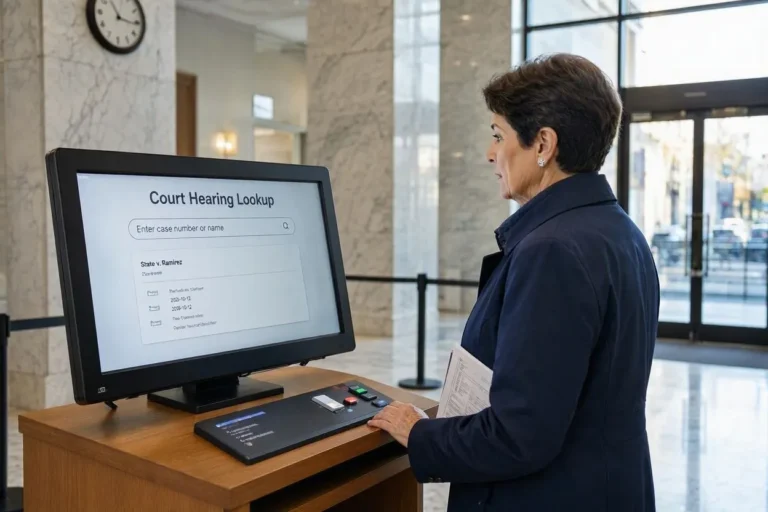
An uncontested divorce is a divorce case in which both spouses agree in writing to every issue before filing, including property division, debt allocation, custody, and support. No trial takes place, because there’s nothing left for a judge to decide except whether the agreement meets Illinois’ legal standards. Cook County’s prove-up hearing, the single court appearance required, usually lasts 15 to 20 minutes. A couple with a signed settlement agreement walks in already finished with the substantive part of their case. The judge confirms the deal instead of brokering one.
What’s the Difference Between an Uncontested and a Contested Divorce?

An uncontested divorce requires full agreement on every issue before filing, while a contested divorce sends at least one unresolved issue to a judge after discovery and hearings. Contested cases involve formal discovery, financial disclosures, depositions, and sometimes property appraisals, steps an uncontested case skips entirely. Two spouses can agree on every financial term and still land in the contested category if they disagree on custody of one child, until a judge or a signed agreement resolves that question.
Who Qualifies for an Uncontested Divorce in Illinois?
Any Illinois couple who agrees on every term of their divorce qualifies for an uncontested divorce, if one spouse has lived in the state for at least 90 days before filing. Illinois law adds one more condition: the couple can’t have another divorce case pending in Illinois or in any other state. Shorter marriages with no children and no real estate may also qualify for the Joint Simplified Dissolution of Marriage, a faster track built for straightforward splits. Two people married for 14 months, with no kids and combined assets under the statutory limit, could use this simplified track and skip several standard filing steps. Everything below assumes both spouses already agree on the major terms. A dispute over even one item shifts the case into contested territory.
What Are the Legal Grounds for Divorce in Illinois?
Illinois recognizes one ground for divorce: irreconcilable differences, a no-fault standard that doesn’t require either spouse to prove wrongdoing. Couples must show that their marriage has broken down irretrievably, either through six months of separation or a joint statement that reconciliation efforts have failed. Neither spouse needs to allege cruelty, abandonment, or adultery. A couple who separated within a single household for exactly six months, sharing a lease while living separate lives, satisfies this requirement without either party moving out.
Where Do You File for an Uncontested Divorce in Illinois?
Illinois divorce petitions get filed in the circuit court of the county where either spouse resides, and Cook County requires electronic filing through its own e-filing portal. Downstate counties follow the same residency rule but may still accept certain paper filings, depending on local court procedures. A spouse living in Cook County, while their partner lives in DuPage County, can file in either county and choose whichever courthouse suits their case.
How Much Does an Uncontested Divorce Cost in Cook County?
An uncontested divorce in Cook County costs $337 to file the initial petition, plus $206 if the other spouse waives formal service by filing an appearance. Attorney fees add to that baseline, though many family law firms charge a flat fee for uncontested cases rather than an hourly rate, since the paperwork is predictable and the court appearance stays brief. A case that stays uncontested from start to finish often requires fewer than 10 hours of attorney time, a fraction of what a contested divorce with discovery disputes and multiple hearings demands. Flat-fee arrangements protect filers from an open-ended bill, though the fee typically converts to hourly billing if the case turns contested partway through, since the scope of the attorney’s work changes once negotiation or a hearing dispute enters the picture.
What If You Can’t Afford the Filing Fee?
Illinois courts waive the filing fee for petitioners who can’t afford it, through a fee waiver application submitted directly to the clerk’s office. The application requires proof of income or participation in a public assistance program, reviewed by a judge before the case proceeds. A single parent earning under the federal poverty guideline for a household of two qualifies for this waiver in most Illinois counties, which removes the $337 cost entirely.
How Long Does an Uncontested Divorce Take in Illinois?
Most uncontested divorces in Illinois finish within two to eight weeks (14 to 56 days) after filing, once both spouses have signed the settlement agreement. Court schedules affect this window more than the legal work does, since the prove-up hearing depends on docket availability in the filing county. A judgment signed at the hearing ends the marriage immediately, with no waiting period afterward. One Cook County filer who submitted a complete petition, a signed Marital Settlement Agreement, and a filed appearance from her spouse got a prove-up date three weeks later and a signed judgment that same day.
What Documents Do You Need to File?
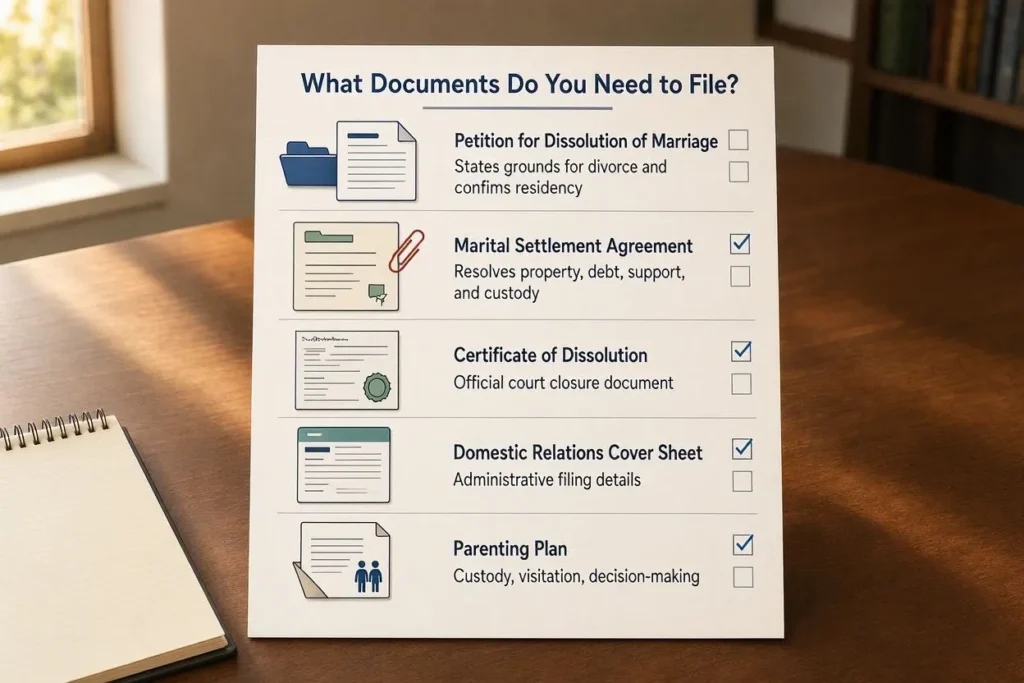
Filing an uncontested divorce in Illinois requires five core documents: a Petition for Dissolution of Marriage, a Marital Settlement Agreement, a Certificate of Dissolution, a Domestic Relations Cover Sheet, and a parenting plan if children are involved. Each form does its own job:
- Petition for Dissolution of Marriage. States the grounds for divorce and confirms residency.
- Marital Settlement Agreement, which resolves property, debt, support, and maintenance terms.
- Certificate of Dissolution: records the marriage date, separation date, and education level for state statistics.
- Domestic Relations Cover Sheet. Routes the case to the correct courtroom and judge.
- Parenting plan, required whenever the couple has minor children, outlining decision-making authority and a parenting time schedule
A missing signature on the Marital Settlement Agreement is the single most common reason Cook County clerks reject a filing on first submission. Filers who prepare all five documents together, rather than submitting the petition first and the settlement agreement later, avoid a second review cycle. A complete packet moves through the clerk’s initial review faster than a partial one. Staff won’t schedule a prove-up date until every required form is on file.
What Role Does Mediation Play in an Uncontested Divorce?
When spouses can’t settle every term on their own, mediation is often what gets them there: a neutral third party helps work through the disputed pieces before anyone files a petition. A trained mediator doesn’t represent either spouse and can’t give legal advice, which is different from an attorney who represents just one side of the case. Two spouses who disagree only on the holiday parenting schedule often resolve that single issue in one or two mediation sessions, keeping an otherwise agreed-upon case out of litigation. Mediation sessions typically run one to two hours each, and a couple with one disputed term rarely needs more than three sessions to close the gap. Once every term is settled, the mediator’s notes become the starting draft for the Marital Settlement Agreement, which cuts drafting time for whichever attorney finalizes the paperwork.
What Is a Marital Settlement Agreement?
A marital settlement agreement is the legal document that resolves every financial and parental issue in the divorce before the case reaches a judge. Seven items belong in a complete agreement: grounds for divorce, child custody terms, child support, a parenting time schedule, maintenance, property division, and allocation of debts and attorney’s fees. Spouses who agree on custody but disagree on one property item, say a shared boat worth $12,000, still have a contested divorce until that single term gets resolved. An uncontested case requires full agreement, not partial agreement.
How Is Child Support Calculated in Illinois?
Illinois calculates child support using the income shares model, which combines both parents’ gross incomes, applies a state-published support chart, and adjusts the result based on overnight parenting time. The Illinois Department of Healthcare and Family Services publishes the chart used in every case, which removes guesswork from the base number. Courts can add specific expenses on top of that base figure: health insurance premiums, uncovered medical costs, daycare, extracurricular fees, and school costs. Two parents earning a combined $8,000 monthly gross income, with one parent covering the child 60% of overnights, would see that split factored directly into the final support number.
How Is Maintenance (Alimony) Calculated?
Illinois calculates maintenance using a statutory formula: 30% of the paying spouse’s gross income minus 20% of the receiving spouse’s gross income, applied if the receiving spouse’s income stays below 40% of the couple’s combined gross income. Marriage length sets the payment duration, following a separate statutory schedule tied to years married. A spouse earning $90,000 a year paying maintenance to a spouse earning $40,000 a year would owe roughly $19,000 annually under the base formula, before a judge applies the duration schedule and confirms the income ceiling isn’t exceeded.
What Happens at the Prove-Up Hearing?
At the prove-up hearing, a judge reviews the Marital Settlement Agreement, asks both spouses questions under oath, and signs the final judgment if the agreement meets Illinois’ legal standards. The hearing lasts 15 to 20 minutes in most Cook County courtrooms. Questions typically cover the marriage date, residency, grounds for divorce, and confirmation that both spouses signed the settlement voluntarily. A spouse who confirms understanding the agreement’s terms without hesitation in the hearing transcript gives the judge grounds to approve the judgment on the spot.
When Is an Uncontested Divorce Not the Right Option?
An uncontested divorce doesn’t work when the spouses disagree on any term, when one spouse’s finances are unknown, or when a party needs immediate court intervention. A handful of situations take the uncontested option off the table:
- Disagreement on any settlement term, however small. Even one unresolved point sends the case into litigation.
- Unknown spousal finances, which means formal discovery is needed to uncover income, assets, or debts.
- An immediate need for child support or maintenance. An uncontested filing simply can’t move fast enough for that.
- Safety concerns that call for an order of protection, a separate process that usually moves faster anyway.
- A spouse hiding or transferring marital assets, which calls for an emergency court order instead.
Say a spouse suspects their partner moved $50,000 out of a joint account before filing. That needs formal discovery, not an uncontested settlement, and it converts the case into a contested one on its own.
Do You Need a Lawyer for an Uncontested Divorce?
No, Illinois law does not require an attorney for an uncontested divorce, though most filers still hire one to draft the settlement agreement correctly. Court clerks and judges can’t give legal advice under Illinois law, which leaves self-represented filers without guidance if a form gets rejected. A lawyer drafting one spouse’s paperwork represents only that spouse, even if the other spouse never hires separate counsel. That distinction matters if a dispute surfaces later over what the agreement means.
What Happens After an Uncontested Divorce Is Finalized?
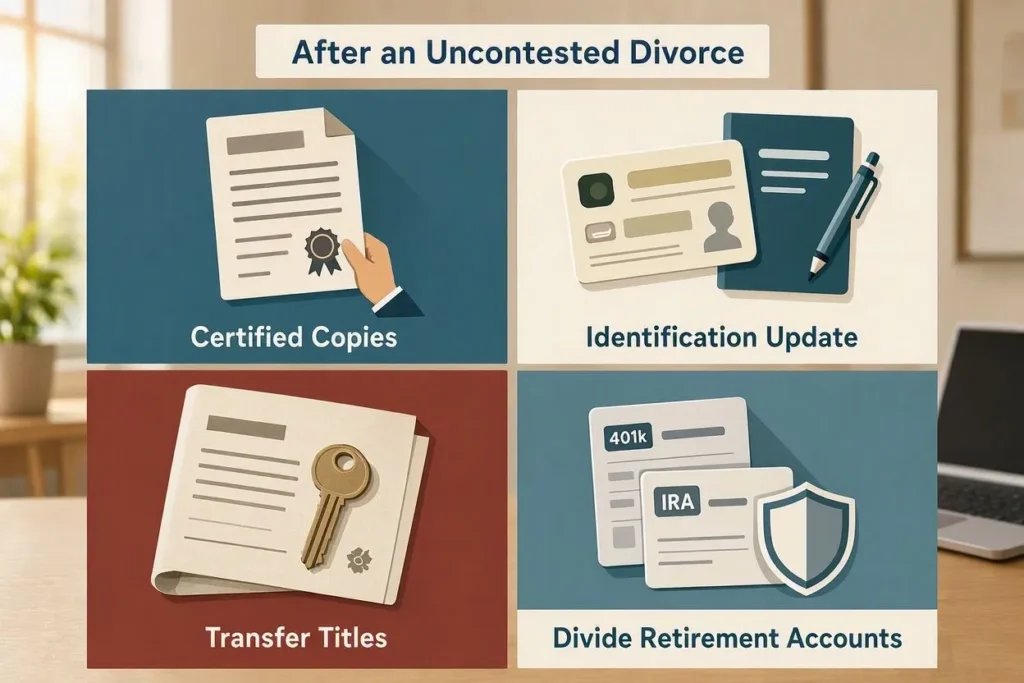
After the judgment is signed, four tasks typically follow within 30 days: obtaining certified copies of the judgment, updating identification documents, transferring property titles, and dividing retirement accounts. Each one protects a different part of the settlement:
- Certified copies of the divorce judgment. You’ll need these for name changes, account updates, and any future legal proceedings.
- Identification updates: driver’s license, Social Security card, and passport, if the judgment included a name change.
- Property title transfers, meaning deeds and vehicle titles get reassigned according to the settlement terms.
- Retirement account division. This one requires a Qualified Domestic Relations Order (QDRO), a separate court order that tells the plan administrator how to split the account.
A judgment awarding one spouse 50% of the other’s 401(k) doesn’t split that account by itself. The plan administrator won’t process it until a signed QDRO reaches their office. Name restoration follows a similar rule: a spouse who wants to resume a former name can request it directly in the divorce judgment, which avoids a separate name-change court case filed after the fact. Skipping that request during the prove-up hearing means filing an entirely new petition later, with its own fee and processing time.
Conclusion
From the $337 initial filing fee to the QDRO required for splitting a retirement account, the process has a predictable shape once both spouses agree. Couples who reach a complete settlement agreement, meet the 90-day residency requirement, and file through their county’s e-filing system typically finalize their case within two months of their first document submission. The prove-up hearing remains the only court appearance most filers ever need: a 15-to-20-minute confirmation of an agreement the couple reached months before walking into the courtroom.
FAQs

Amanda Brooks
Amanda Brooks leads JusticeInTown’s legal, justice, and community advocacy content division. She holds a background in legal research and public policy and specializes in topics related to civil rights, access to justice, legal awareness, and community issues. With years of experience researching legal and social justice topics, Amanda brings a careful, research-driven approach to complex legal information and public-interest issues. She is the primary author of JusticeInTown’s legal guides, justice-related resources, and community-focused content, helping readers better understand their rights, legal options, and the issues affecting their communities.
Related Posts