The uncontested divorce process lets 2 spouses end their marriage without a court battle — provided they agree on all major terms. Most uncontested divorces finalize in 61 days to 6 months, cost $200–$1,500 in filing fees, and require just 1 brief court hearing or none at all.
This guide covers every step: eligibility, required documents, state waiting periods, costs, and the 4 mistakes that convert an uncontested divorce into a contested one.
What the Uncontested Divorce Process Requires to Qualify
An uncontested divorce requires both spouses to agree on 5 core issues: property division, debt allocation, spousal support (alimony), child custody, and child support. A court will reject the filing if any of these 5 issues remains unresolved.
You also need to meet 2 threshold requirements before filing.
Residency Requirement: How Long You Must Live in the State
To file for divorce in any U.S. state, you or your spouse must meet that state’s residency requirement. Residency periods range from none (Alaska, South Dakota, Washington) to 6 months (California, Florida, New York). Texas requires 6 months in the state and 90 days in the county where you file.
File in the county where you or your spouse currently lives. Confirm the exact period with the county clerk before you draft any paperwork.
Mutual Consent: What Both Spouses Must Agree to Sign
Both spouses must sign the Marital Settlement Agreement [MSA] before the court schedules a final hearing. The MSA is a legally binding contract. It must cover all 5 core issues listed above. If 1 spouse refuses to sign, the divorce becomes contested and requires separate litigation.
Get the MSA drafted and reviewed by a family law attorney. Our team at JusticeInTown prepares MSAs for clients in all 50 states — visit legal document preparation for full details on how the drafting process works.
Uncontested Divorce Process: 7 Steps from Filing to Decree
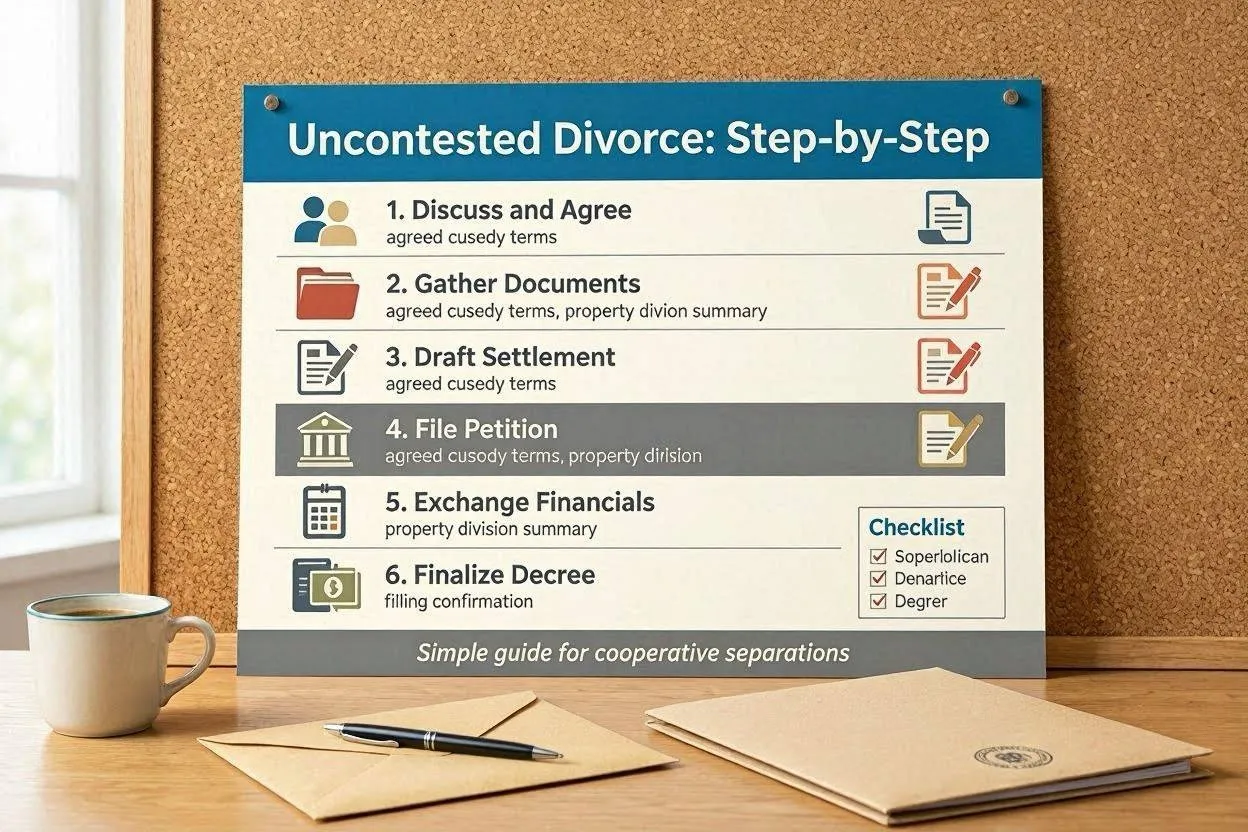
The uncontested divorce process follows 7 steps in all 50 U.S. states. The specific forms, filing fees, and court names vary by state, but this sequence remains consistent.
Step 1: Draft and Sign the Marital Settlement Agreement
To draft the MSA, list every marital asset, every debt, and every custody arrangement in writing. Both spouses sign the document in front of a notary. Courts reject MSAs that omit major assets — retirement accounts through a Qualified Domestic Relations Order [QDRO], pension plans, or jointly held businesses are the 3 most commonly missed items.
A QDRO is a separate court order that divides employer-sponsored retirement plans such as 401(k) accounts and pensions. Draft the QDRO alongside the MSA — not afterward.
Step 2: File the Divorce Petition with the County Clerk
To file the divorce petition, the petitioner (the spouse who initiates) submits a Petition for Divorce — sometimes called a Complaint for Divorce — to the county clerk’s office. Filing fees range from $100 (Wyoming) to $435 (California). Request a fee waiver by submitting an Affidavit of Indigency if you cannot afford the fee.
Attach the signed MSA to the petition. The clerk assigns a case number and stamps the petition. Keep a certified copy for your records.
Step 3: Serve the Divorce Papers on Your Spouse
To serve the divorce papers, deliver the filed petition to your spouse by 1 of 3 methods: personal delivery by a process server, certified mail (permitted in select states), or a signed Waiver of Service.
In an uncontested divorce, a Waiver of Service is the fastest method. Your spouse signs the waiver to confirm receipt and waive formal service. The waiver eliminates the cost of a process server ($50–$150 per attempt).
Step 4: Wait Out the Mandatory Waiting Period
After service, every state with a mandatory waiting period requires you to pause before the court schedules a final hearing. States with no waiting period include Idaho, Mississippi, and Rhode Island. California imposes the longest standard waiting period: 6 months (180 days) from the date the respondent receives the petition.
Use this period to gather financial documents: 2 years of tax returns, 3 months of bank statements, current mortgage or lease agreements, and vehicle titles.
Step 5: Attend the Final Divorce Hearing
To complete the final hearing, both spouses appear before a family court judge. The judge asks 3 types of questions: whether the marriage is irretrievably broken, whether both parties signed the MSA voluntarily, and whether child custody terms serve the child’s best interests.
Hearings for uncontested divorces typically last 10–30 minutes. Some states — including Texas, Ohio, and New Jersey — allow 1 spouse to appear without the other if the absent spouse filed a proper waiver.
Step 6: Receive the Final Divorce Decree
After the hearing, the judge signs the Final Divorce Decree. The decree dissolves the marriage and incorporates all terms from the MSA. Obtain 3 certified copies of the decree from the court clerk. You need certified copies to update bank accounts, change your name on a passport, and transfer vehicle titles.
Step 7: Update Legal Documents and Accounts Post-Decree
After the decree issues, update 9 types of accounts and documents: Social Security name records, driver’s license, passport, bank accounts, beneficiary designations on life insurance, beneficiary designations on retirement accounts, health insurance enrollment, property deeds, and vehicle titles.
File the QDRO with the plan administrator within 30 days of the decree to prevent tax penalties on retirement fund transfers.
The table below shows every task, its timing, the method used, and the difficulty level.
Task
When
Method
Difficulty
Confirm eligibility
Before filing
Review state residency rules
Low
Draft settlement agreement (MSA)
Before filing
Attorney review or online template
Medium
File divorce petition
Day 1
County clerk’s office or e-filing
Low
Serve your spouse
Within 5–30 days of filing
Process server or waiver of service
Low
Spouse files response/waiver
30–60 days after service
Court filing
Low
Attend final hearing (if required)
After waiting period
Appear in family court
Medium
Receive divorce decree
Varies by state (30–180 days)
Judge signs final judgment
Low
How Much the Uncontested Divorce Process Costs in 2026
The total cost of an uncontested divorce depends on 3 factors: state filing fees, whether you hire an attorney, and whether you use a mediator.
Court filing fees average $300–$400 across most U.S. states. Online divorce preparation services — such as LegalZoom and DivorceWriter — charge $150–$500 to prepare state-specific forms. If both spouses hire attorneys only to review the MSA (not litigate), attorney fees run $500–$2,000 total.
A fully litigated contested divorce costs $15,000–$50,000 per spouse on average, according to national family law surveys. Choosing the uncontested path saves an average of $28,000 in combined attorney fees.
If spouses disagree on any 1 issue during the process, the court may order divorce mediation before converting the case. Mediation costs $1,500–$5,000 for a full session. Review how divorce divorce mediation services work before your filing date to prepare for this possibility.
Uncontested Divorce Process with Children: 3 Additional Requirements
An uncontested divorce with minor children requires 3 additional documents beyond the standard MSA: a Parenting Plan, a Child Support Worksheet, and a Health Insurance Declaration.
How to Draft a Parenting Plan That Courts Accept
To draft a court-acceptable parenting plan, address 8 specific elements: physical custody schedule, legal custody decision-making, holiday rotation, school enrollment address, vacation policy, transportation responsibility, extracurricular cost sharing, and health insurance premiums.
Courts evaluate parenting plans against the “best interests of the child” standard established in each state’s family code. Plans that specify exact pickup times (e.g., 6:00 PM Fridays) experience 40% fewer post-decree custody disputes than plans with vague language like “reasonable visitation.”
Child Support Calculation: How Courts Set the Amount
Child support amounts come from state-mandated income-sharing guidelines. 2 parents with a combined gross monthly income of $10,000 in a 50/50 custody split in California pay approximately $1,100–$1,500 per month depending on each parent’s income share.
Deviating from the guideline amount requires written justification submitted to the court. Judges rarely approve below-guideline amounts without documented evidence of extraordinary expenses.
4 Mistakes That Convert an Uncontested Divorce to Contested
These 4 mistakes cause courts to reclassify an uncontested divorce as contested, adding 6–18 months and thousands of dollars to the process.
Omitting retirement accounts from the MSA: A missing QDRO causes courts to reopen property division, which triggers a contested hearing.
Leaving child support amounts blank: Courts require a specific dollar figure. Vague language such as “as agreed” fails judicial review in all 50 states.
Failing to disclose all assets: Both parties must disclose 100% of marital assets under oath. Concealment qualifies as fraud, voids the MSA, and restarts the process.
Signing the MSA without legal review when complex assets exist: Business ownership interests, military pension benefits, and stock options each require separate valuation. A missing valuation triggers a contested property hearing.
Do You Need a Lawyer for the Uncontested Divorce Process?
No state requires both spouses to retain attorneys for an uncontested divorce. You represent yourself as a pro se litigant — the court holds pro se filers to the same legal standard as attorneys.
Hire an attorney for these 4 situations: the marriage lasted more than 10 years (spousal support eligibility increases significantly), you or your spouse owns a business, the combined marital estate exceeds $250,000, or either party has a military pension.
An unbundled legal services arrangement — where an attorney reviews the MSA without representing you at trial — costs $500–$1,500 and catches the errors that cause most uncontested cases to fail. To speak with a licensed family law attorney before you file, visit find a family lawyer for a free initial consultation.
Uncontested Divorce Process vs. Default Divorce: Key Difference
A default divorce and an uncontested divorce both produce a divorce decree without courtroom argument, but the path differs.
A default divorce occurs when the respondent fails to file any response to the petition within the state’s deadline — typically 20–30 days. The petitioner submits a motion for default, and the court grants the divorce based solely on the petitioner’s terms.
An uncontested divorce requires active agreement from both spouses via a signed MSA. A default divorce gives the non-responding spouse no say over property division, custody, or support terms. A non-responding spouse in a default divorce retains the right to file a motion to set aside the default judgment within 6–12 months of entry in most states.
Conclusion
The uncontested divorce process saves time, money, and emotional strain — but only when both spouses complete every step correctly. A single missing document or unsigned waiver delays the decree by weeks and can trigger a contested hearing.
JusticeInTown connects you with licensed family law attorneys in all 50 states. Our attorneys review MSA drafts, prepare QDRO filings, and represent you at the final hearing when required. Start with a free case evaluation — visit the find a family lawyer page and speak with a licensed attorney within 24 hours.
Frequently Asked Questions About the Uncontested Divorce Process
Yes. An uncontested divorce becomes contested if either spouse withdraws consent from the MSA before the judge signs the final decree. The court returns the case to the contested docket, and both parties must restart the process through formal discovery.
The minimum timeline equals the state’s mandatory waiting period plus hearing scheduling time. Texas requires a minimum of 61 days. California requires 6 months. States with no waiting period — such as Idaho and Mississippi — can finalize in as little as 30 days if the court calendar permits.
Yes, in most states. Online filing portals exist in 38 states as of 2026. You prepare forms through the portal, pay the filing fee electronically, and submit documents to the court clerk digitally. You still need to attend a final hearing in states that require one — virtual hearings are available in 24 states.
No. No-fault grounds — such as irreconcilable differences or irretrievable breakdown — describe the reason for divorce, not the level of agreement between spouses. A no-fault divorce becomes uncontested only when both parties agree on all 5 core issues and sign a valid MSA.
The divorce becomes contested on the issue of the house. Courts address disagreements over a single marital asset through a property division hearing. Resolve the property dispute through mediation before the hearing to preserve the uncontested status.
Amanda Brooks
Amanda Brooks leads JusticeInTown’s legal, justice, and community advocacy content division. She holds a background in legal research and public policy and specializes in topics related to civil rights, access to justice, legal awareness, and community issues. With years of experience researching legal and social justice topics, Amanda brings a careful, research-driven approach to complex legal information and public-interest issues. She is the primary author of JusticeInTown’s legal guides, justice-related resources, and community-focused content, helping readers better understand their rights, legal options, and the issues affecting their communities.