
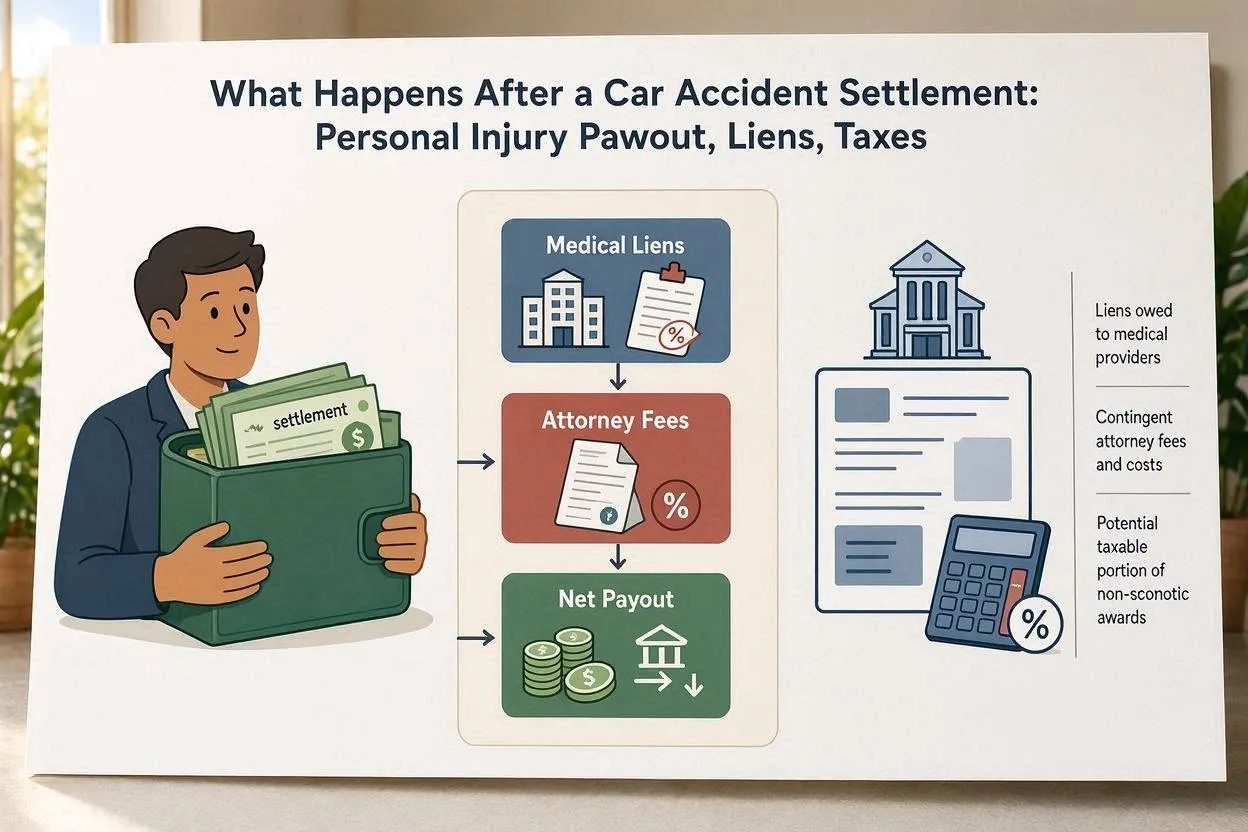
What Happens After a Car Accident Settlement: Personal Injury Payout, Liens, Taxes
Personal injury law governs every step that follows a car accident settlement, from the release you sign to the final deposit in your account. This guide walks through that process in order: payment timing, lien resolution, tax treatment, and the effect a settlement can have on federal benefits.
A car accident settlement check typically arrives within 2 to 6 weeks after you sign the release form, but the money passes through several stops first: your personal injury attorney’s trust account, medical lien payoffs, case cost deductions, and attorney fees, before you receive the remaining balance. The signature on the release is not the finish line. It starts a defined sequence of financial and legal steps that determine how much money reaches your bank account and when.
Most articles on this topic stop at the demand letter and negotiation stage. Fewer explain what actually happens between the handshake and the deposit. This guide covers that gap: payment timing, lien resolution, tax treatment, structured settlements, and the effect a personal injury settlement can have on federal benefits — the parts of a car accident claim that unfold after the at-fault driver’s insurance company agrees to pay.
The Personal Injury Settlement Timeline From Signing to Payment
Insurance companies generally issue payment within 10 to 30 business days of receiving your signed release, depending on state law and the insurer’s internal processing speed. Some states set a hard deadline. Georgia, for example, requires payment within 10 business days of a signed release in most cases, and insurers that miss the deadline owe interest on the delayed amount.
Three factors control how fast the money moves after that point in a personal injury claim:
- The at-fault driver’s insurance company’s internal check-issuing process, which ranges from same-week to 30 days
- Whether your personal injury lawyer needs to resolve liens before disbursing your portion
- Whether the payment involves a structured settlement annuity, which adds setup time before the first payment
Your attorney does not hand you a check on the day the insurer pays. The check goes into a client trust account first, sometimes called an IOLTA (Interest on Lawyers’ Trust Accounts) account, and stays there until liens are paid and the settlement statement is finalized. That process commonly adds another 1 to 3 weeks on top of the insurer’s payment timeline.
Who Gets Paid First in a Personal Injury Claim: Liens, Subrogation, and Deductions
Medical providers, health insurers, and your attorney get paid before you receive your net settlement, in an order set by lien priority and state law. A single settlement check funds multiple parties in a personal injury case, not just the injured claimant.
Medical Liens and Subrogation
Subrogation is the legal right of an insurer or medical provider to recover money it already paid for your treatment, out of your bodily injury settlement. If your health insurer covered $8,000 in emergency room and physical therapy bills after the negligent driver caused your crash, that insurer can file a lien against your settlement and reclaim some or all of that $8,000 before you see a dollar.
Common lienholders include:
- Health insurance companies, through contractual or statutory subrogation rights
- Hospitals, under state hospital lien laws
- Medicaid, which has a federal right of reimbursement under 42 U.S.C. § 1396k
- Medicare, through its own recovery process, separate from Medicaid’s
Attorneys frequently negotiate these liens down. A $10,000 hospital lien might settle for $6,000 to $7,000 once your attorney points out the insurer’s own comparative-negligence exposure or documents financial hardship. Negotiated lien reductions can add 2 to 4 weeks to your payout timeline, since the lienholder has to respond and agree in writing.
Medicare Set-Asides (MSA)
A Medicare Set-Aside (MSA) is a portion of your settlement placed into a separate account to cover future medical treatment that Medicare would otherwise pay for. Federal law requires this step if you are a Medicare beneficiary, or reasonably expected to become one within 30 months, and your settlement includes compensation for future medical care.
The Centers for Medicare & Medicaid Services (CMS) does not always require formal review of an MSA in liability settlements the way it does in workers’ compensation cases, but ignoring Medicare’s future interest creates real risk: Medicare can deny payment for accident-related treatment later, arguing your settlement should have covered it. An attorney experienced in this area calculates the set-aside amount and structures it correctly before your case closes, and this calculation can add 2 to 6 weeks depending on how much future treatment is expected.
Attorney Fees and Case Costs
Attorney fees on a contingency basis typically run 33% to 40% of the gross settlement, deducted before liens in some fee arrangements and after in others, depending on the retainer agreement you signed with your personal injury lawyer. Case costs are separate from fees and cover litigation expenses your attorney fronted while building your personal injury claim: filing fees, expert witness costs, medical record requests, and deposition transcripts. These costs are itemized on your settlement statement and subtracted from your share, not from the attorney’s fee.
How the Settlement Check Is Disbursed
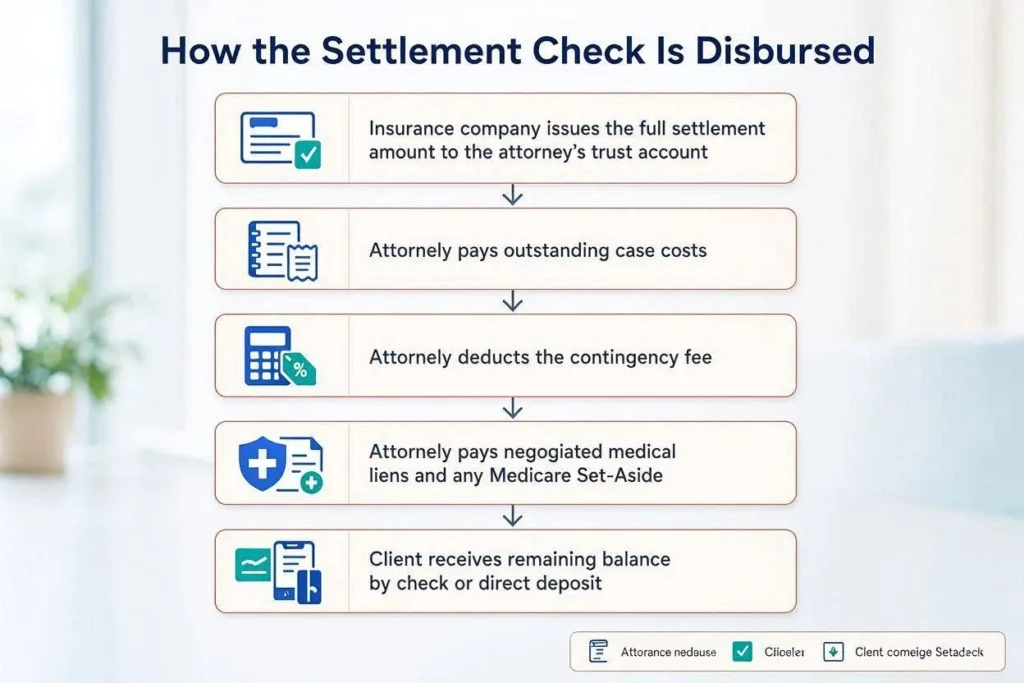
Your attorney disburses the settlement through a trust account, paying lienholders and deducting fees and costs first, then issuing you the remaining balance by check or direct deposit. The order commonly looks like this:
- Insurance company issues the full settlement amount to the attorney’s trust account
- Attorney pays outstanding case costs
- Attorney deducts the contingency fee
- Attorney pays negotiated medical liens and any Medicare Set-Aside contribution
- Attorney issues the net balance to you, along with a written settlement statement itemizing every deduction
Ask for the settlement statement in writing before you sign anything final. This document lists the gross settlement amount, every deduction, and your net payout. A reputable attorney provides this without being asked twice.
In cases involving multiple claimants, such as a family in one crash, or multiple lienholders with competing claims, funds sometimes route through a qualified settlement fund (QSF). A QSF is a court-supervised account that holds settlement money temporarily while allocation among claimants or lienholders gets resolved, which can extend the disbursement timeline by 30 to 90 days but protects the defendant from further liability while allocation is worked out.
Lump Sum vs. Structured Settlement
A lump sum pays your full net settlement in one payment; a structured settlement pays it out over months or years through an annuity, and most car accident claimants receive a lump sum unless the case involves a minor, a catastrophic injury, or a specific tax strategy.
| Factor | Lump Sum | Structured Settlement |
| Payment timing | One payment, 2-6 weeks after signing | Scheduled payments over years |
| Control over funds | Full control immediately | Limited; set by the payment schedule |
| Tax treatment | Same tax treatment as structured (compensatory portions are tax-free) | Same tax treatment, plus tax-free growth on the annuity itself |
| Common use case | Most adult claimants with moderate injuries | Minors, catastrophic injury cases, long-term care needs |
| Risk | Funds can be spent quickly without planning | Less flexibility if urgent expenses arise |
A structured settlement works through an annuity purchased by the insurance company, paid out on a schedule you and your attorney negotiate before signing the release. Once the structure is set, it cannot be changed, sold, or accelerated without a court-approved factoring transaction, which involves a judge reviewing whether the sale serves your best interest. Courts frequently deny these requests or approve only partial factoring.
Minors involved in a settlement almost always receive a structured settlement or a court-supervised blocked account, since state law in most jurisdictions restricts a minor’s direct access to settlement funds until age 18.
Taxes on a Car Accident Settlement

No, compensation for physical injuries and property damage is not taxable income under Internal Revenue Service (IRS) rules, but lost wages, interest, and punitive damages within the same settlement are taxable.
IRS Publication 4345 breaks down the distinction:
- Not taxable: Compensation for physical injuries, medical expenses (if not previously deducted), and pain and suffering that stems directly from a physical injury
- Taxable: Compensation for lost wages, interest accrued on the settlement while a case was pending, and punitive damages, regardless of the underlying injury
- Conditionally taxable: Emotional distress damages are tax-free if they originate from the physical injury; emotional distress damages with no physical injury component are taxable
Insurance companies do not automatically withhold taxes from a settlement check, and most do not issue a Form 1099 for the injury-related portion. If your settlement statement itemizes a lost-wages component, expect to report that portion as income. A tax professional, not your personal injury attorney, is the right person to confirm your specific liability, since the two practice areas require separate licensing and expertise.
Effect on SSI, SSDI, and Medicaid
Yes, a car accident settlement can reduce or suspend Supplemental Security Income (SSI) and Medicaid eligibility, but it does not affect Social Security Disability Insurance (SSDI) eligibility, since SSDI is not means-tested.
SSI and Medicaid impose asset limits, commonly $2,000 for an individual, and a lump sum settlement that pushes your countable assets above that threshold can suspend benefits until you spend down the excess or place funds into a qualifying special needs trust. SSDI has no asset limit because eligibility depends on your work history and disability status, not your income or resources, so a settlement does not disqualify you from SSDI.
A special needs trust, sometimes called a supplemental needs trust, holds settlement funds for your benefit without counting against SSI or Medicaid asset limits, provided an attorney sets it up correctly before the funds are disbursed to you directly. Setting this up after you already hold the funds in your own name creates complications and can trigger a benefits review. Coordinate this step with your attorney before the release is signed, not after the check arrives.
Can You Reopen a Settled Personal Injury Case?
No, signing a release form permanently closes your claim, and you cannot reopen a car accident settlement even if your injuries worsen, new symptoms appear, or medical costs exceed what the settlement covered.
The release form you sign transfers your right to pursue further compensation from the at-fault party and their insurer, in exchange for the settlement payment — a foundational principle in personal injury law known as finality of release. Courts uphold this finality except in narrow circumstances: proven fraud by the insurer, mutual mistake about a material fact at the time of signing, or a release signed under demonstrable duress. These exceptions rarely succeed and require separate civil litigation with its own cost and timeline.
This is why reaching maximum medical improvement (MMI), the point at which your treating doctor confirms your condition has stabilized and further treatment will not significantly change your prognosis, matters before you sign. Settling before MMI risks locking in a number that does not reflect your actual long-term medical costs.
Common Mistakes After Signing a Release
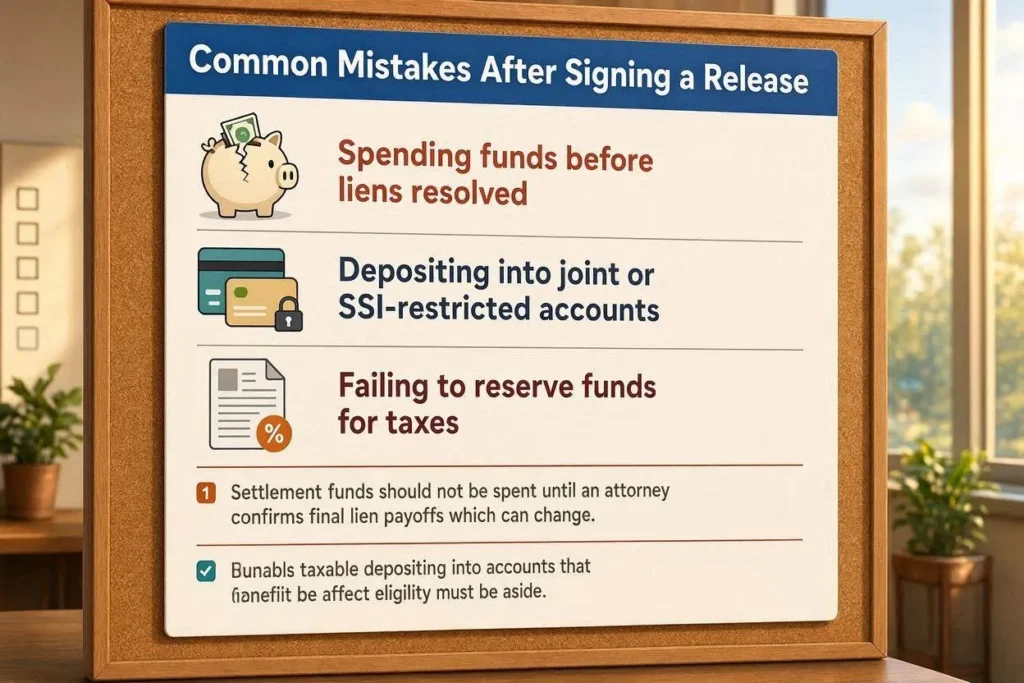
The most common mistakes after a settlement involve spending funds before liens are resolved, ignoring benefit eligibility rules, and failing to set aside money for taxable portions of the payout.
- Spending the full settlement amount before your attorney confirms final lien payoffs, which can leave you short if a lienholder’s negotiated amount changes
- Depositing settlement funds directly into a joint or SSI-restricted account without first consulting an attorney about asset limits
- Failing to set aside the taxable portion (lost wages, punitive damages) for the following tax year
- Signing a release before reaching MMI, based on pressure from an adjuster to close the case quickly
- Skipping a written settlement statement, which leaves you unable to verify every deduction taken from the gross amount
Protecting Your Settlement Money
Protect a car accident settlement by separating funds by purpose immediately: taxes, medical costs not covered by the settlement, and discretionary spending, held in separate accounts rather than one combined balance.
A financial advisor, particularly one with experience handling injury settlements, can help structure a spend-down plan if you are managing means-tested benefits, coordinate a special needs trust, or advise on whether a partial structured settlement makes sense even after a lump sum has already been negotiated. Creditors can generally reach settlement funds once they are in your personal account, so if you have outstanding debt or an active bankruptcy filing, consult an attorney before the check is deposited, since exemptions for personal injury settlements vary significantly by state.
Divorce proceedings treat settlement funds differently depending on the state and the source of the compensation. Portions compensating you personally for pain and suffering are commonly treated as separate property in equitable-distribution states, while portions compensating for lost wages earned during the marriage are more likely to be treated as marital property. This distinction matters if a divorce is pending or anticipated around the time of your settlement.
Personal Injury Law Terms Used in This Process
A car accident settlement sits inside the broader framework of personal injury law, which governs civil claims for harm caused by another party’s negligence. Understanding these terms helps you follow what your attorney is doing at each stage of the claim.
| Term | Meaning |
| Negligence | The failure to exercise reasonable care, which forms the legal basis of most car accident claims |
| Duty of care | The legal obligation every driver owes to operate a vehicle safely and avoid harming others |
| Liability | Legal responsibility for causing an accident and the resulting damages |
| Damages | Monetary compensation awarded or negotiated to cover a victim’s losses, split into economic and non-economic categories |
| Plaintiff | The injured party bringing a personal injury claim or civil lawsuit |
| Defendant | The at-fault party, or their insurer, against whom the claim is brought |
| Comparative negligence | A rule that reduces a claimant’s compensation by their percentage of fault in the accident |
| Tort | A civil wrong, such as a negligent car accident, that gives rise to a legal claim for damages |
| Bad faith insurance claim | A separate legal claim against an insurer that unreasonably delays, denies, or underpays a valid claim |
| Release of liability | The legal document that ends a claimant’s right to sue once a settlement is signed |
Every step covered in this guide, from lien resolution to the finality of a signed release, operates within this civil litigation framework. A car accident settlement is, at its core, the negotiated resolution of a personal injury tort claim rather than a purely financial transaction.
Conclusion
A car accident settlement moves through five distinct stages after you sign: insurer payment, trust account processing, lien and fee deductions, tax classification, and final disbursement to you. Each stage has its own timeline, ranging from days to several weeks, and each carries rules that determine how much money you actually keep. Lienholders, the Internal Revenue Service (IRS), and federal benefit programs all have a claim on portions of that payout, and none of these claims disappear just because negotiations ended.
The claimants who come out ahead are the ones who plan before the check arrives, not after. Ask your personal injury attorney for a written settlement statement, confirm whether a Medicare Set-Aside (MSA) applies to your case, and talk to a tax professional about which portions of your payout are taxable before you spend a dollar of it. If your settlement affects SSI, Medicaid, or a pending divorce, get that guidance in place before the funds land in your name. A little preparation in the weeks after signing protects far more of your personal injury settlement than any negotiation tactic used to get there.
FAQs

Amanda Brooks
Amanda Brooks leads JusticeInTown’s legal, justice, and community advocacy content division. She holds a background in legal research and public policy and specializes in topics related to civil rights, access to justice, legal awareness, and community issues. With years of experience researching legal and social justice topics, Amanda brings a careful, research-driven approach to complex legal information and public-interest issues. She is the primary author of JusticeInTown’s legal guides, justice-related resources, and community-focused content, helping readers better understand their rights, legal options, and the issues affecting their communities.
Related Posts