
What Happens If Child Support Is Not Paid? Penalties by Timeline (2026)
Missing child support payments triggers automatic family court enforcement within 30 days, not a warning letter. A noncustodial parent who falls behind on a child support order faces wage garnishment of 50% to 65% of disposable income, tax refund interception at $150 to $500 in arrears, driver’s license suspension within 30 days to 3 months depending on the state, passport denial at $2,500, and federal prosecution after 1 year or $5,000 owed. Custodial parents enforce the same order through a state child support agency or a family court petition.
What Happens If Child Support Is Not Paid: The Direct Answer
Enforcement runs on two separate tracks that operate at the same time.
The administrative track belongs to your state child support agency, which acts without a judge. Agency staff garnish wages, seize tax refunds, freeze bank accounts, suspend licenses, and report the child support arrears to credit bureaus using powers granted under Title IV-D of the Social Security Act. No hearing precedes most of these actions.
The judicial track belongs to the family court that issued the child support order, whether the order arrived through a divorce decree, a custody judgment, or a paternity determination. A custodial parent files an enforcement petition — called a violation petition in New York, a motion for contempt in most other states — and a family court judge decides whether the missed payments were willful. A willfulness finding opens the door to jail, attorney’s fees, and money judgments.
Federal criminal prosecution forms a third, rarer layer. The U.S. Department of Justice pursues cases under 18 U.S.C. § 228 only when the child lives in a different state than the parent who owes support, and only after state remedies have run their course.
Two facts shape everything below. Every state must operate a child support enforcement program under federal law, so the tools are similar everywhere. The trigger points, interest rates, and timelines differ state by state, which is why the numbers in each section carry a jurisdiction tag.
The Child Support Enforcement Timeline: What Happens and When
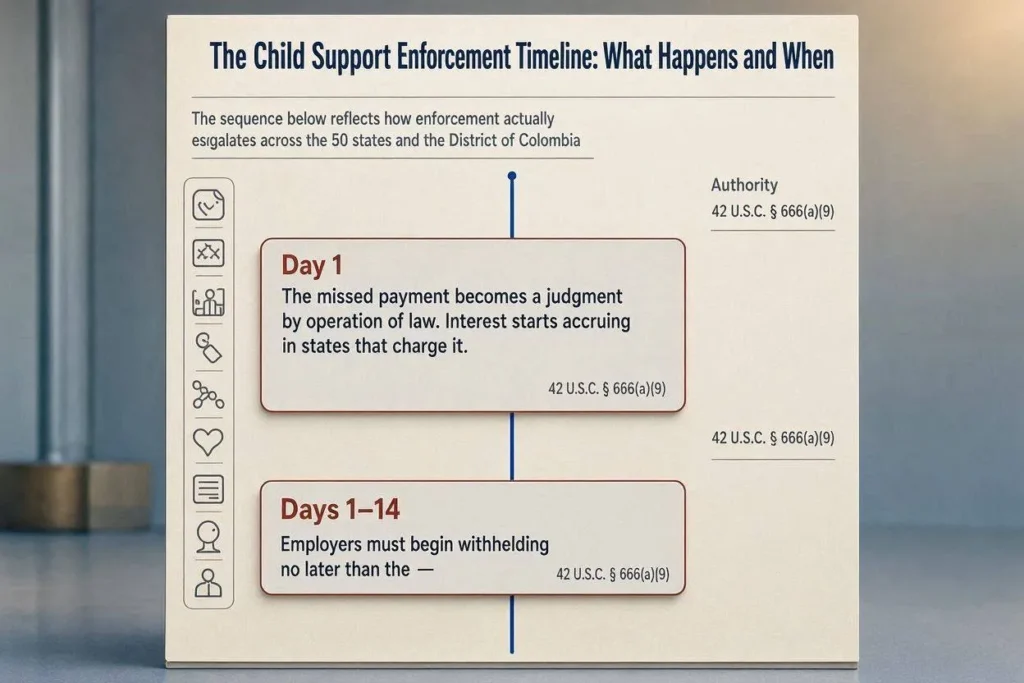
Competitors list consequences without saying when each one lands. The sequence below reflects how enforcement actually escalates across the 50 states and the District of Columbia.
| Trigger point | What happens | Authority |
| Day 1 | The missed payment becomes a judgment by operation of law. Interest starts accruing in states that charge it. | 42 U.S.C. § 666(a)(9) |
| Days 1–14 | Employers must begin withholding no later than the first pay period starting 14 days after receiving an Income Withholding for Support (IWO) order. | 42 U.S.C. § 666(b) |
| Within 7 business days | Employers must forward each withheld amount to the State Disbursement Unit. | 42 U.S.C. § 666(b)(6)(A)(i) |
| Day 30 | California suspends driver’s licenses at 30 days delinquent. Credit bureau reporting begins in most states. | Cal. Fam. Code § 17520 |
| $150 (public assistance cases) / $500 (all others) | The state submits the support arrears to the Federal Tax Refund Offset Program. | 45 C.F.R. § 303.72 |
| 12 weeks (84 days) | The federal garnishment ceiling rises by 5 percentage points, from 50% to 55% or from 60% to 65% of disposable earnings. | 15 U.S.C. § 1673(b)(2) |
| 3 months | Texas becomes eligible to suspend driver’s, professional, and hunting or fishing licenses. | Tex. Fam. Code § 232.003 |
| 4 months | New York suspends professional, business, and occupational licenses. | N.Y. Fam. Ct. Act § 458-b |
| $500 | A New York custodial parent may file a violation petition in Family Court. | N.Y. Fam. Ct. Act § 453 |
| $2,500 | The U.S. State Department denies passport applications and renewals. New York suspends driver’s licenses at the same figure. | 42 U.S.C. § 652(k) |
| 1 year past due or $5,000 | Federal misdemeanor exposure begins when the child lives in another state. Maximum 6 months in prison. | 18 U.S.C. § 228(a)(1) |
| 2 years past due or $10,000 | Federal felony exposure begins. Maximum 2 years in prison. | 18 U.S.C. § 228(a)(3) |
Days 1–30: Arrears and Interest Begin
Nothing dramatic happens in the first month, which misleads many parents into treating a missed payment as recoverable. The support obligation itself hardens immediately. Each unpaid installment converts into an enforceable money judgment the moment the due date passes, and no judge can later erase it.
Days 30–90: Administrative Enforcement Starts
The state agency moves without asking permission. Bank accounts surface through quarterly Financial Institution Data Match (FIDM) reporting. A new employer surfaces through the National Directory of New Hires, which employers must feed within 20 days of a hire. Credit bureaus receive the delinquency report.
Months 3–12: Licenses, Passports, and Liens
License suspension arrives in the window where most parents first feel real pressure. Texas acts at 3 months of arrears, New York at $2,500 for driving privileges and 4 months for professional credentials. Passport denial activates at $2,500 nationwide.
Year 1 and Beyond: Federal Criminal Exposure
Federal charges require an interstate element. A parent in Ohio who owes $6,000 for a child living in Ohio faces no § 228 exposure. The same parent owing the same amount for a child in Kentucky crosses into federal territory once the arrears pass 1 year or $5,000.
Child Support Wage Garnishment: How Much of Your Paycheck Is Withheld
Federal law caps child support garnishment at 50% to 65% of disposable earnings, set by the Consumer Credit Protection Act (CCPA) at 15 U.S.C. § 1673(b)(2).
| Your situation | Maximum withholding |
| Supporting another spouse or child, arrears under 12 weeks | 50% of disposable earnings |
| Supporting another spouse or child, arrears 12 weeks or more | 55% of disposable earnings |
| Not supporting another spouse or child, arrears under 12 weeks | 60% of disposable earnings |
| Not supporting another spouse or child, arrears 12 weeks or more | 65% of disposable earnings |
Disposable earnings mean gross pay minus legally required deductions: federal, state, and local taxes, Social Security, and mandatory retirement contributions. Voluntary deductions such as health insurance premiums, union dues, and 401(k) contributions stay inside the garnishable base.
Several states set lower ceilings than the federal maximum, and the lower figure controls. Delaware caps withholding at 60%. Employers apply whichever limit protects more of the paycheck.
Income withholding reaches beyond wages. Unemployment insurance benefits, workers’ compensation awards, Social Security Disability Insurance (SSDI) payments, pensions, commissions, and bonuses all qualify. Supplemental Security Income (SSI) stays exempt, since SSI is a needs-based benefit rather than an earned one.
Firing an employee over a child support withholding order is illegal under 15 U.S.C. § 1674 and parallel state statutes.
Tax Refund Interception: Federal and State Offsets
The Federal Tax Refund Offset Program routes refunds to child support arrears before the money reaches the taxpayer. The Office of Child Support Services (OCSS, formerly the Office of Child Support Enforcement) certifies the support arrears to the Treasury Offset Program, which flags the Social Security number.
Payment priority follows a fixed order. Arrears assigned to the state — covering periods when the custodial parent received public assistance — get paid first. The remaining balance goes to the custodial parent. Other federal debts, including defaulted student loans, take their share before child support in some scenarios.
A new spouse who files jointly keeps a claim on their portion of the refund by filing IRS Form 8379, Injured Spouse Allocation. States hold joint refunds for roughly 6 months before applying the money, which allows the injured spouse claim to process.
The program has a blind spot worth naming: a parent who owes nothing to the IRS, files no return, or claims no refund gives the offset program nothing to seize.
Most states run parallel state tax intercept programs. The nine states without a personal income tax — Alaska, Florida, Nevada, New Hampshire, South Dakota, Tennessee, Texas, Washington, and Wyoming — have no state refund to intercept, which shifts enforcement weight onto liens and license actions.
License Suspension: Driver’s, Professional, and Recreational
Every state suspends driver’s licenses for unpaid child support, a requirement written into 42 U.S.C. § 666(a)(16). Trigger points vary widely:
- California — 30 days delinquent
- Texas — 3 months of arrears
- New York — $2,500 in arrears for driving privileges, 4 months for professional licenses
Professional and occupational licenses fall under the same statutes. Nurses, contractors, cosmetologists, attorneys, real estate agents, and insurance brokers all face suspension. Texas extends the reach to hunting and fishing licenses.
Suspension produces an obvious problem: a parent who cannot drive often cannot work, and a parent who cannot work cannot pay. States answer with restricted or hardship licenses, which permit driving to work, school, medical appointments, and child care. Requesting a hardship license usually requires a payment plan agreement with the state agency.
Reinstatement demands either full payment of arrears or a signed payment plan, plus a reinstatement fee ranging from roughly $25 to $150 by state.
Passport Denial at $2,500 in Arrears
The U.S. State Department denies passport applications and renewals once certified arrears reach $2,500, under 42 U.S.C. § 652(k). Congress lowered the threshold from $5,000 to $2,500 in the Deficit Reduction Act of 2005, effective October 1, 2006.
Certification is automatic once the support arrears hit the figure, and the denial covers new applications, renewals, and replacements for lost or stolen passports. Existing passports stay valid until expiration, though the State Department may revoke one in limited circumstances.
Removal from the list requires paying the arrears down below $2,500, after which the state child support agency decertifies the arrears. Decertification takes 2 to 3 weeks to clear the federal system, so travel plans need that lead time built in.
Child Support Liens, Credit Reporting, and Account Freezes
Child support arrears appear on credit reports and stay there for 7 years from the date of each delinquency. State agencies report to Equifax, Experian, and TransUnion under 42 U.S.C. § 666(a)(7).
Family courts and state child support agencies attach liens automatically in most states once arrears accumulate. A recorded lien blocks the sale or refinancing of real property until the arrears clear, and vehicle liens block title transfer.
Bank levies work through the Financial Institution Data Match program, which requires banks to report account holders matching the state’s delinquent obligor list every quarter. The agency then freezes and seizes the balance, usually without a court order and often without advance notice.
Lottery winnings, insurance settlements, and unclaimed property intercepts feed the same child support enforcement pipeline. New York intercepts lottery prizes directly.
Contempt of Court and Jail Time
A judge can jail a parent for unpaid child support only after finding the failure to pay was willful. Willfulness means the parent had the money and chose not to pay.
Civil contempt and criminal contempt work differently:
- Civil contempt aims at compliance, not punishment. The judge sets a purge amount — a specific dollar figure that ends the jail term the moment it is paid. Release depends on payment, not on serving a fixed sentence.
- Criminal contempt punishes past conduct. The sentence runs its full length regardless of payment, and the proceeding carries stronger procedural protections.
Jail caps vary by state. New York limits contempt confinement to 6 months per finding. Repeat findings can stack.
Judges reach for jail late in the sequence. Courts generally exhaust garnishment, license suspension, and payment plans first, since an incarcerated parent earns nothing.
Can You Go to Jail If You Genuinely Cannot Pay?
No. Inability to pay is a complete defense to civil contempt, and the U.S. Supreme Court addressed the point directly in Turner v. Rogers, 564 U.S. 431 (2011).
Michael Turner was jailed for 12 months in South Carolina for unpaid child support after a hearing with no lawyer, no inquiry into his finances, and no finding about his ability to pay. The Supreme Court vacated the judgment and identified ability to pay as the central question that any contempt court must answer before ordering incarceration.
Turner did not create an automatic right to appointed counsel. The decision required states to supply adequate procedural safeguards instead:
- Notice that ability to pay is the deciding issue
- A form or process for disclosing financial information
- An opportunity at the hearing to respond to questions about finances
- An express court finding on ability to pay
Parents lose this defense by failing to raise it. A parent who skips the hearing, submits no financial documentation, or stays silent about job loss hands the court an unopposed record. Documentation carries the argument: termination letters, medical records, disability determinations, bank statements, and job application logs.
One limit deserves emphasis. Courts distinguish genuine inability from voluntary underemployment. A parent who quits a job, refuses available work, or hides income faces imputed income — the court assigns an earning capacity based on work history, education, and local job market data, then calculates support against the imputed figure rather than actual earnings.
Federal Criminal Charges Under 18 U.S.C. § 228
Federal prosecution requires an interstate element. The child must live in a different state than the parent who owes support, or the parent must cross state lines to evade the obligation.
| Offense | Elements | Classification | Maximum penalty |
| § 228(a)(1) | Willful failure to pay for a child in another state; debt past due over 1 year or exceeding $5,000 | Misdemeanor | Fines and 6 months in prison |
| § 228(a)(2) | Traveling in interstate or foreign commerce intending to evade a debt past due over 1 year or exceeding $5,000 | Felony | Fines and 2 years in prison |
| § 228(a)(3) | Willful failure to pay for a child in another state; debt past due over 2 years or exceeding $10,000 | Felony | Fines and 2 years in prison |
The Deadbeat Parents Punishment Act of 1998 added the felony tiers to the original Child Support Recovery Act of 1992.
Restitution accompanies conviction under 18 U.S.C. § 228(d), set at the full unpaid balance.
Federal charges remain rare. The Department of Justice states plainly that child support enforcement belongs to state and local authorities outside these narrow circumstances, and that all enforcement must proceed at the state or local level before federal involvement becomes available. Referrals typically involve large balances, repeated evasion, and documented failure of state remedies.
Interest on Child Support Arrears in Family Court, by State
Interest transforms a manageable support balance into an unpayable one. Rates range from 0% to 12% annually.
| State | Annual interest on arrears |
| Colorado | 12% |
| California | 10% |
| New York | 9% |
| Illinois | 9% |
| Washington | 12% |
| Texas | 6% simple |
| Arizona | 10% |
| Delaware | 0% (no interest charged) |
| Vermont | 12% |
Verify the current rate with your state agency before relying on any figure, since legislatures adjust rates and several states apply interest at judicial discretion rather than automatically.
The arithmetic deserves attention. A $10,000 balance in Colorado at 12% grows by $1,200 in a year. A parent paying $100 monthly toward that balance pays $1,200 annually — the entire payment services interest while the principal stays frozen.
Three Child Support Obligations That Never Expire
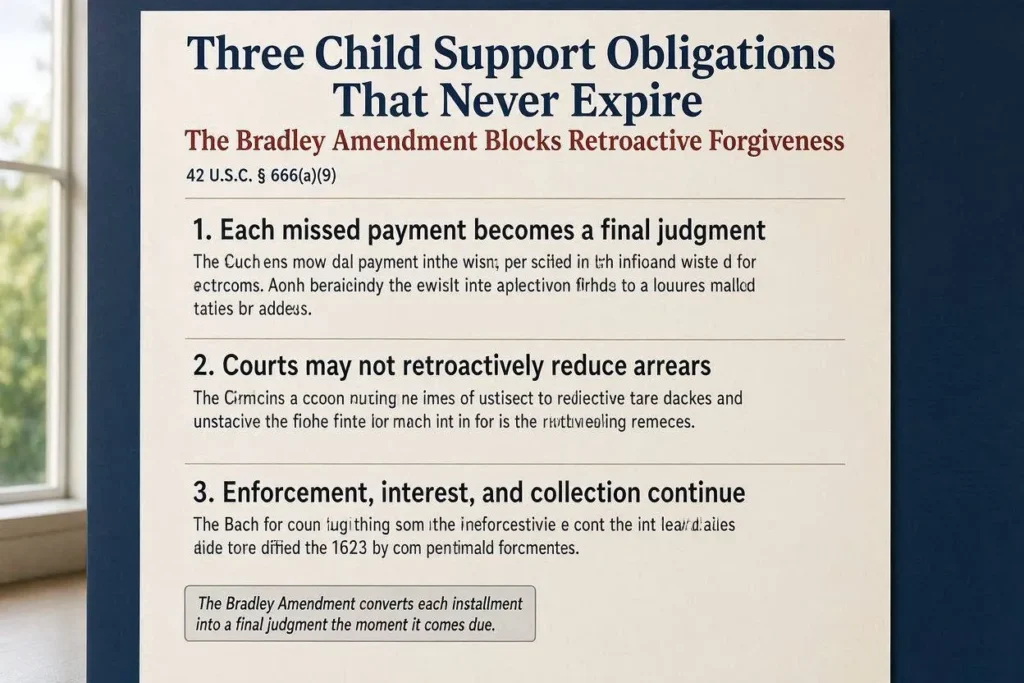
The Bradley Amendment Blocks Retroactive Forgiveness
Federal law prohibits any court from retroactively reducing or forgiving child support arrears. The Bradley Amendment, codified at 42 U.S.C. § 666(a)(9), converts each installment into a final judgment the moment it comes due.
The rule dismantles the most common piece of advice circulating on legal blogs — that struggling parents should simply talk to the other parent and work something out. An informal agreement carries no legal weight. Arrears continue accruing during any handshake arrangement, and the custodial parent can collect every dollar years later regardless of what was promised. A custodial parent who genuinely wants to forgive arrears must petition the court, and even then the state’s share of assigned arrears stays untouchable.
Modification works prospectively only. A modification filed today adjusts payments from today forward and does nothing about the balance already owed. Every month of delay in filing adds permanent arrears.
Bankruptcy Does Not Discharge a Child Support Order
Chapter 7 bankruptcy does not eliminate child support arrears. A child support order is a domestic support obligation, and domestic support obligations are non-dischargeable under 11 U.S.C. § 523(a)(5), and they hold first-priority status among unsecured claims under 11 U.S.C. § 507(a)(1)(A).
Chapter 13 offers a narrow benefit rather than an escape. The repayment plan can spread arrears across 3 to 5 years and pause enforcement actions during the plan, but the plan must pay the support arrears in full before any discharge issues under 11 U.S.C. § 1328(a).
Bankruptcy still helps indirectly. Discharging credit card debt, medical bills, and personal loans frees income that can service the support obligation.
Child Support Arrears Survive Your Child’s 18th Birthday
Reaching the age of majority terminates future payments and leaves accumulated arrears fully collectible. A parent who owes $40,000 when the child turns 18 still owes $40,000 at 25, and enforcement tools stay available.
Termination ages vary. Most states end support at 18, or at high school graduation for a student still enrolled. New York runs to 21. Massachusetts extends to 23 for a child in post-secondary education. Support for a disabled adult child can continue indefinitely.
Collection windows differ by state and typically run 10 to 20 years past emancipation. New York enforces support money judgments for 20 years.
How Child Support Agencies Locate a Noncustodial Parent
Title IV-D of the Social Security Act built a national data infrastructure that locates parents automatically. Understanding the machinery explains why evasion fails.
The National Directory of New Hires collects every new hire report in the country. Employers must report within 20 days of a hire date, and the directory cross-references reports against child support case records nationwide. Changing jobs or moving states triggers a match within weeks.
Financial Institution Data Match requires banks, credit unions, and brokerages to compare their account holder lists against state delinquent obligor lists every quarter. Matched accounts get frozen.
The Federal Parent Locator Service pulls from Internal Revenue Service records, Social Security Administration records, Department of Defense records, and state motor vehicle databases.
Title IV-D services cost little or nothing. Every state must offer them, and application fees cap at $25 for parents who never received public assistance. A custodial parent who cannot afford an attorney still has a fully funded enforcement agency available by filing a single application.
Interstate Enforcement: UIFSA and Full Faith and Credit
Crossing a state line changes nothing about the obligation.
The Uniform Interstate Family Support Act (UIFSA) has been adopted by all 50 states, the District of Columbia, and the U.S. territories. UIFSA establishes that one order controls at any given time and lets a custodial parent send an income withholding order directly to an employer in another state without opening a new case there.
The Full Faith and Credit for Child Support Orders Act, at 28 U.S.C. § 1738B, requires every state to honor and enforce another state’s support order.
International enforcement operates through the 2007 Hague Child Support Convention, in force for the United States since 2017, plus bilateral reciprocity agreements with individual countries.
What to Do If You Cannot Afford Your Payments
Speed determines outcomes, because the Bradley Amendment freezes every day of delay into permanent arrears.
- File a modification petition immediately. Filing date sets the earliest possible adjustment date. Waiting 6 months to file means 6 months of arrears that no court can remove.
- Document the change in circumstances. Termination letters, layoff notices, disability determinations, medical records, and pay stubs establish the factual record. Most states require a substantial change — commonly a 15% to 20% income drop, or a change producing a support recalculation of similar size.
- Keep paying something. Partial payments prove good faith and defeat a willfulness finding at any future contempt hearing.
- Contact the state child support agency directly. Agencies negotiate payment plans, and a signed plan often halts license suspension and passport denial.
- Request a hardship license if suspension threatens your ability to work.
- Attend every hearing. Absence guarantees a default judgment and forfeits the ability-to-pay defense that Turner v. Rogers protects.
- Never rely on a verbal agreement with the other parent. Only a court order changes the obligation.
What to Do If the Other Parent Is Not Paying You
- Open a Title IV-D case with your state child support agency. Services cost $25 or less and include location, garnishment, interception, and license actions.
- Document every missed payment with dates and amounts. The payment record forms the evidence at any enforcement hearing.
- File an enforcement or contempt petition once arrears reach your state’s filing threshold. New York sets the floor at $500 and charges no Family Court filing fee.
- Request attorney’s fees in the petition. Many states shift fees to the non-paying parent after a willfulness finding.
- Enroll in tax intercept through the agency, which handles both federal and state offsets.
- Continue honoring the parenting plan. Child support and visitation are legally independent, and withholding parenting time exposes you to a custody contempt finding.
Four Myths About Child Support, Custody, and Visitation
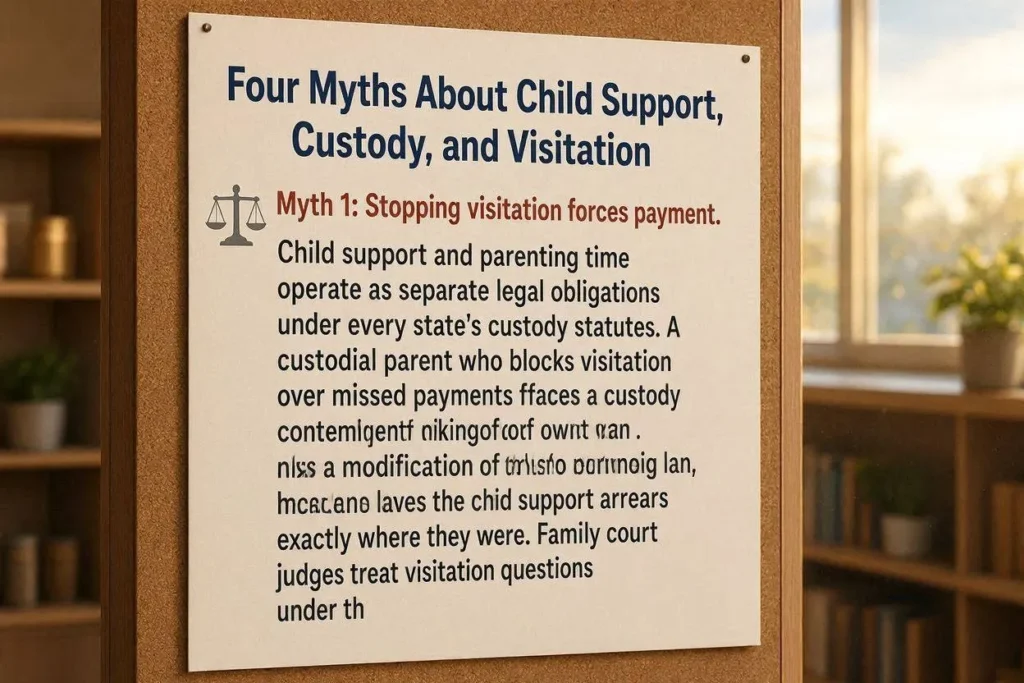
Myth 1: Stopping visitation forces payment. Child support and parenting time operate as separate legal obligations under every state’s custody statutes. A custodial parent who blocks visitation over missed payments faces a custody contempt finding of their own, risks a modification of the parenting plan, and leaves the child support arrears exactly where they were. Family court judges treat visitation questions under the best interests of the child standard, which measures the parent-child relationship rather than the payment record.
Myth 2: Both parents can agree to cancel the arrears. The Bradley Amendment prohibits retroactive forgiveness. Private agreements have no legal effect, and unfiled agreements leave both parents exposed.
Myth 3: Losing a job automatically pauses payments. The obligation continues at the ordered amount until a judge modifies it. Unemployment benefits face garnishment at the same CCPA percentages as wages.
Myth 4: Jail is the standard consequence. Incarceration sits at the far end of a long escalation, requires a willfulness finding, and remains unavailable against a parent who genuinely cannot pay under Turner v. Rogers.
Conclusion
Unpaid child support escalates on a schedule rather than at a judge’s whim. Garnishment begins within 14 days, license suspension lands between 30 days and 3 months, passport denial arrives at $2,500, and federal exposure opens after 1 year. The Bradley Amendment freezes each missed day into permanent debt, which makes filing speed the one variable either parent fully controls. A parent who cannot pay keeps a real defense under Turner v. Rogers, but only by appearing in court with financial documentation. A parent owed support gets a funded enforcement agency for $25 or less. Both paths reward filing over waiting.
Frequently Asked Questions

Amanda Brooks
Amanda Brooks leads JusticeInTown’s legal, justice, and community advocacy content division. She holds a background in legal research and public policy and specializes in topics related to civil rights, access to justice, legal awareness, and community issues. With years of experience researching legal and social justice topics, Amanda brings a careful, research-driven approach to complex legal information and public-interest issues. She is the primary author of JusticeInTown’s legal guides, justice-related resources, and community-focused content, helping readers better understand their rights, legal options, and the issues affecting their communities.
Related Posts