
What Is Adverse Possession? Elements, Timelines & State Rules
Adverse possession is a legal doctrine that allows a trespasser to gain formal ownership of land belonging to someone else, provided the trespasser meets a strict set of state-defined conditions over a fixed period of years. The doctrine traces back to English common law, and every U.S. state has adopted its own version through statute. A person who occupies, uses, and treats a parcel as their own openly, without the owner’s permission, for long enough can eventually ask a court to transfer legal title into their name.
The policy reasoning isn’t about rewarding trespassing for its own sake. Courts and legislatures built adverse possession to push land toward productive use and to penalize owners who ignore their property for years at a stretch. Charles I. Stone, Professor of Law, Monte Mills at the University of Washington School of Law describes the underlying logic simply: the law favors people who actually use land over people who merely hold a deed to it. A neighbor who fences off, farms, or builds on a strip of land next door, without ever hearing an objection from the record owner, is the classic fact pattern behind most adverse possession cases.
The Five Legal Elements of Adverse Possession
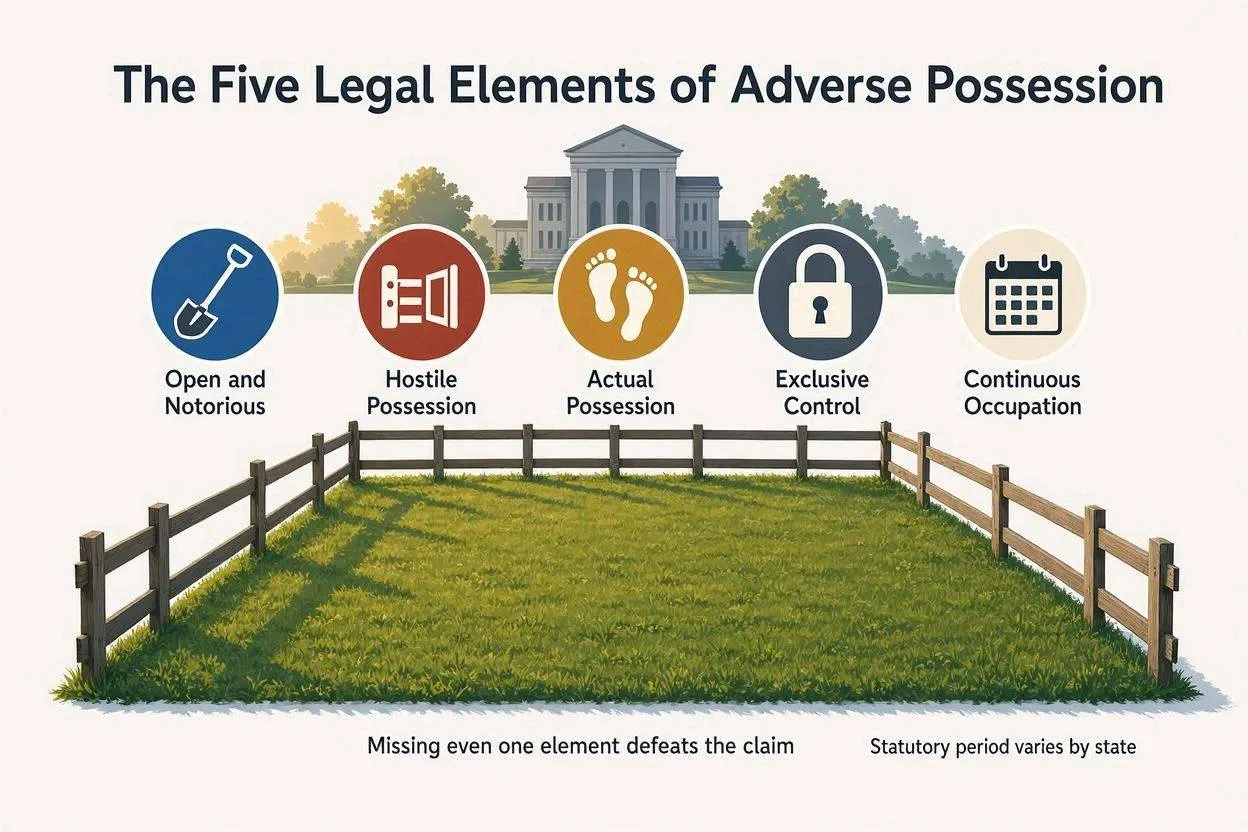
A valid adverse possession claim requires five elements: open and notorious use, hostile possession, actual possession, exclusive control, and continuous occupation for the statutory period. Missing even one element defeats the claim, regardless of how long the occupation lasted. Courts apply these elements consistently across jurisdictions, though the exact statutory period and a handful of secondary rules shift from state to state.
Open and Notorious
Open and notorious possession means the trespasser’s use of the land must be visible enough that a reasonably attentive owner would notice it. Secret or hidden occupation never qualifies. A person who builds a shed on a neighbor’s back corner, in plain view from the property line, satisfies this element. Someone who quietly stores items in a locked, hidden structure the owner never sees does not.
Hostile
Hostile possession means the trespasser occupies the land without the owner’s permission, not that the trespasser acts with hostility or ill will toward the owner. If the true owner grants a license, lease, or verbal consent, the occupation stops being hostile immediately, and the adverse possession clock never starts. Tenants can never adversely possess property they’re renting, no matter how many years pass, because a lease is permission by definition.
Actual
Actual possession requires the trespasser to physically occupy, use, or improve the property in a manner consistent with how an owner would use that type of land. A rural rancher who grazes cattle on an unfenced back pasture for a decade demonstrates actual possession. Filing paperwork or making a verbal claim without physical use of the land does not satisfy this element.
Exclusive
Exclusive possession means the trespasser controls the property alone, without sharing that control with the general public or the true owner. Two neighbors who both use a strip of land for parking, without either excluding the other, generally fail this element, since neither has exclusive control. A single adverse possessor who fences the disputed strip and keeps others out meets the standard.
Continuous
Continuous possession means the occupation must run without a break for the entire statutory period set by state law, though the required activity can match normal seasonal use. A cabin used only during summer months for ten straight years can still count as continuous if summer use matches how similar properties in the area are typically used. A three-year gap in occupation, however, resets the clock in most states.
How Long Does Adverse Possession Take? (State Statutory Periods)
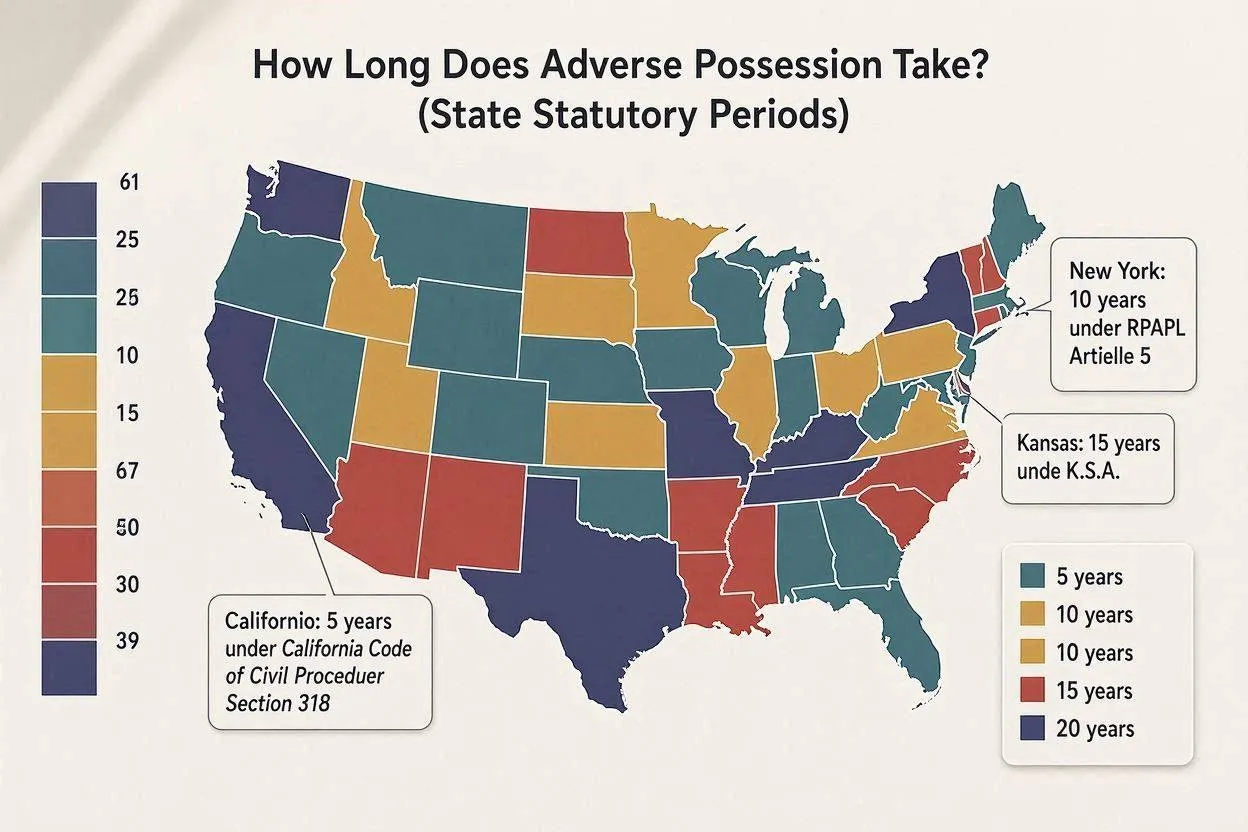
Adverse possession statutory periods range from 5 years to 20 years, depending on the state and whether the possessor holds color of title. California requires only 5 years of continuous possession under California Code of Civil Procedure Section 318. New York requires 10 years under Real Property Actions and Proceedings Law (RPAPL) Article 5. Kansas sets a 15-year period under Kansas Statutes Annotated (K.S.A.) 60-503, applying whether the possessor claims under a “knowingly adverse” theory or a good-faith “belief of ownership.” Many states shorten the timeline for possessors who hold color of title (a defective or invalid deed that still gives the appearance of ownership) and lengthen it for those without any documentary claim at all.
| State | Statutory Period | Legal Citation |
| California | 5 years | Cal. Code Civ. Proc. § 318 |
| New York | 10 years | RPAPL Article 5 |
| Kansas | 15 years | K.S.A. 60-503 |
| Typical baseline (many states) | 7 years with color of title, 20 years without | Varies by state |
Confirm the exact period and any local filing requirements with a licensed attorney in the relevant state, since legislatures amend these statutes periodically and county courts apply local procedural rules on top of the state statute.
What Is Color of Title, and Why Does It Matter?
Color of title is a document that appears to grant valid legal ownership of a property but actually contains a legal defect, such as a faulty description, an invalid signature, or a broken chain of ownership. A person who buys property based on a deed later found to be defective still possesses color of title, even though the sale never legally transferred ownership. Many states reward color-of-title claimants with a shorter statutory period than trespassers who have no paperwork at all, since a written instrument signals a good-faith belief in ownership rather than knowing trespass.
Can You Tack Possession From a Previous Owner?
Tacking allows a current possessor to add their period of occupation to a prior possessor’s period, as long as privity connects the two and neither is the true owner. Privity means a direct legal relationship between successive possessors, such as a sale, inheritance, or gift of the disputed parcel between them. The landmark case Howard v. Kunto established that successive purchasers of a summer cabin could tack their possession periods together to meet Washington’s statutory requirement, even though no single owner had occupied the land long enough alone. A squatter who simply takes over land from a stranger, without any transfer of interest between them, cannot tack that stranger’s prior occupation onto their own.
Adverse Possession vs. Prescriptive Easement vs. Squatters’ Rights
Adverse possession transfers full ownership of land, a prescriptive easement grants only a limited right to use land for a specific purpose, and squatters’ rights is an informal term people often use loosely to describe either doctrine. A prescriptive easement might give a neighbor the permanent right to cross a driveway without transferring ownership of the driveway itself. Adverse possession, by contrast, ends with the possessor holding full legal title after a successful quiet title action. “Squatters’ rights” has no single legal definition and gets applied by non-lawyers to both scenarios, along with short-term occupancy protections under landlord-tenant law that have nothing to do with either doctrine.
| Doctrine | What It Transfers | Typical Duration |
| Adverse possession | Full ownership/title | 5–20 years, by state |
| Prescriptive easement | Right to use (not own) | Similar to adverse possession period |
| Squatters’ rights (informal term) | No fixed legal meaning | Varies; often confused with the above |
How to File an Adverse Possession Claim (Quiet Title Action)
A successful adverse possession claim is finalized through a quiet title action, a lawsuit filed in state court asking a judge to formally declare the possessor as the legal owner. The process generally follows four stages:
- Document the occupation. Gather photographs, receipts for improvements, tax records, and witness statements covering the entire statutory period.
- Confirm the statutory period has run. Calculate the exact start and end dates of continuous possession, accounting for any tolling periods triggered by the owner’s incapacity.
- File a quiet title lawsuit. Name the record owner and any other parties with a potential interest in the property as defendants.
- Prove each element at trial. Present clear and convincing evidence of open, hostile, actual, exclusive, and continuous possession for the full statutory period.
A judge who finds all five elements satisfied will issue a court order transferriVaries; often confused with the aboveng legal title to the possessor, which then gets recorded with the county.
How Property Owners Can Prevent a Claim
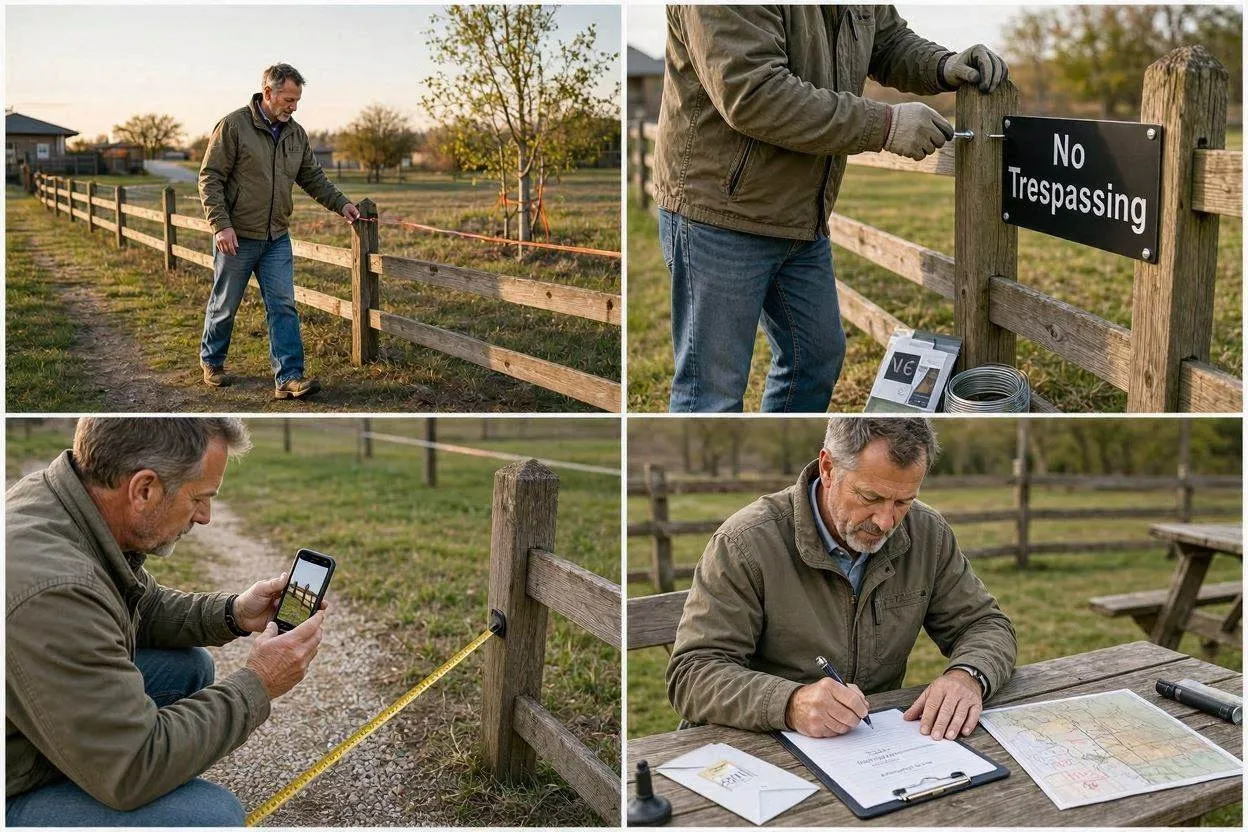
Property owners prevent adverse possession claims primarily by inspecting their land regularly and acting immediately against any unauthorized use. Four practical steps reduce risk substantially:
- Walk the full property boundary at least once a year, checking fence lines, easements, and any unused corners for signs of encroachment.
- Post “No Trespassing” signs along boundaries that see foot traffic or vehicle access from neighboring parcels.
- Grant written permission for any neighbor’s use the owner is willing to tolerate, since documented permission defeats the “hostile” element entirely.
- Send a written demand or file an eviction action the moment unauthorized use is discovered, rather than waiting to see whether it stops on its own.
Professor Mills notes that active management, not aggressive confrontation, is usually enough: an owner who simply shows up, checks the property, and enforces boundaries every so often rarely loses land to an adverse possessor.
Exceptions and Limits on Adverse Possession
Adverse possession does not apply to government-owned land, and most states pause (toll) the statutory period while the true owner is a minor, legally incapacitated, or incarcerated. A private party cannot acquire title to federal, state, or municipal property through occupation, no matter how many decades the occupation lasted. Tolling provisions exist so that owners unable to protect their own interests, due to age, mental incapacity, or imprisonment, aren’t penalized for failing to act during that period. Once the disabling condition ends, the clock resumes rather than restarting from zero in most states.
Adverse possession claims involving cotenants (co-owners of the same property) face an additional hurdle: continued possession by one cotenant is presumed non-adverse to the others, unless that cotenant takes a clear, provable step to “oust” the co-owners from any claim to the property.
Conclusion
Adverse possession turns on five non-negotiable elements and a statutory clock that varies from 5 years in California to 15 years in Kansas and beyond. Property owners who inspect their land regularly, document permission in writing, and act fast against unauthorized use rarely face a successful claim. Anyone occupying land they don’t legally own, or defending against someone who is, should confirm the exact statutory requirements in the relevant state and consult a real estate attorney before relying on any general summary, including this one.
FAQs

Amanda Brooks
Amanda Brooks leads JusticeInTown’s legal, justice, and community advocacy content division. She holds a background in legal research and public policy and specializes in topics related to civil rights, access to justice, legal awareness, and community issues. With years of experience researching legal and social justice topics, Amanda brings a careful, research-driven approach to complex legal information and public-interest issues. She is the primary author of JusticeInTown’s legal guides, justice-related resources, and community-focused content, helping readers better understand their rights, legal options, and the issues affecting their communities.
Related Posts