
How to File a Court Case in the USA: 2026 Guide
To file a court case, you submit a completed complaint form to the correct court, pay a filing fee between $30 and $435, and arrange legal service on the defendant. The process takes 4 steps: choose the right court, prepare your documents, file your complaint, and serve the opposing party.
Every case follows this same structure, whether you pursue a small claims dispute over $500 or a civil lawsuit seeking $100,000. The court type, filing fees, and deadlines differ. The core steps do not.
What Is a Court Case and When Can You File One in 2026
A court case is a formal legal dispute filed with a court that has jurisdiction — the legal authority to hear that specific type of case in that geographic area. You can file a court case if you have legal standing, meaning you personally suffered a harm that the law recognizes as actionable.
3 basic requirements must exist before you file:
- You have a valid legal claim — a harm, breach, or violation the law covers
- The statute of limitations has not expired for your claim type
- You file in the correct court with jurisdiction over the case
How to Choose the Right Court to File Your Case
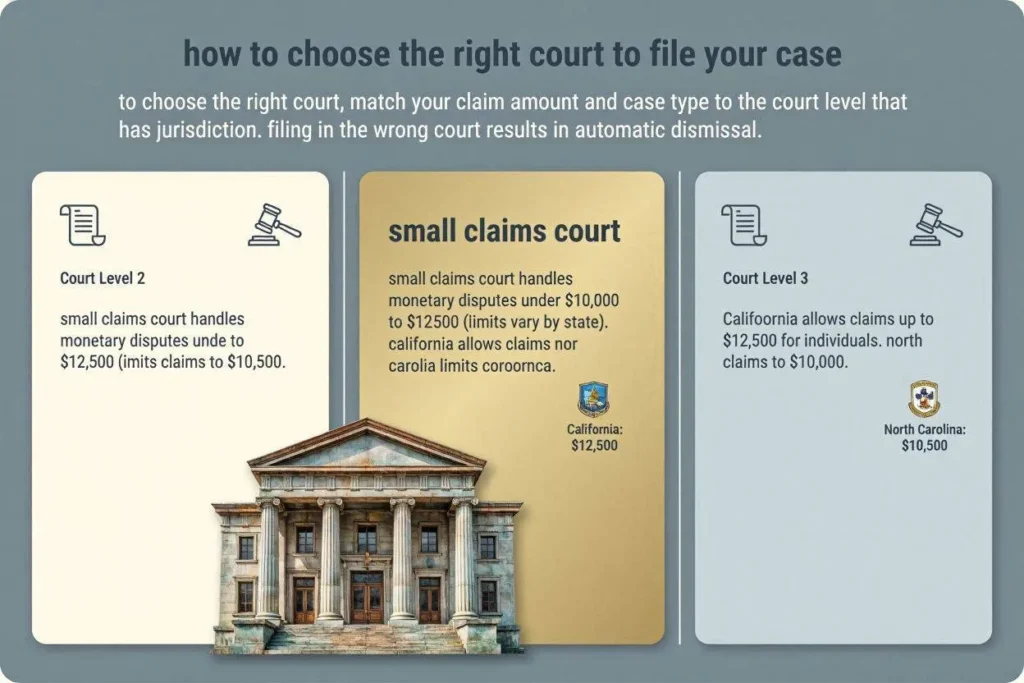
To choose the right court, match your claim amount and case type to the court level that has jurisdiction. Filing in the wrong court results in automatic dismissal.
3 court types handle most civil disputes in the USA:
Small Claims Court
Small claims court handles monetary disputes under $10,000 to $12,500 (limits vary by state). California allows claims up to $12,500 for individuals. North Carolina limits claims to $10,000. No attorney is required — you represent yourself as a pro se litigant.
File in the county where the defendant lives, works, or does business.
Civil District Court
District court handles claims above the small claims limit, typically $10,000 to $25,000 at the lower level and unlimited amounts at the superior court level. These courts follow strict procedural rules under the Federal Rules of Civil Procedure (FRCP) or state equivalents.
Most plaintiffs at this level hire an attorney. You can file pro se, but procedural mistakes carry significant risk of dismissal.
Federal District Court
Federal court hears cases involving federal law violations, constitutional rights claims, or disputes between parties from 2 different states where the amount exceeds $75,000 (called diversity jurisdiction). Filing in federal court requires registration with the PACER (Public Access to Court Electronic Records) system and, in most cases, an admitted attorney.
How to File a Court Case: 6 Steps for 2026
To file a court case in 2026, complete these 7 steps in order. Skipping any step — especially the demand letter or defendant service — causes delays or dismissal.
Step 1: Send a Demand Letter (Required in Most States)
A demand letter formally requests payment or action from the opposing party before you sue. Most courts require proof that you attempted to resolve the dispute. Send the letter by certified mail with return receipt so you have proof of delivery. Wait at least 10 days (15 days in some jurisdictions) before filing your complaint. Keep a copy of the letter, the certified mail receipt, and any response you receive.
Step 2: Gather Your Evidence and Documents
Courts require written evidence. Collect all documents relevant to your claim before you visit the clerk’s office. Bring 3 categories of documentation:
- Financial records — invoices, receipts, bank statements, contracts
- Communication records — emails, text messages, letters
- Supporting evidence — photographs, repair estimates, medical bills
Step 3: Identify the Correct Defendant Name
Name the defendant exactly. If you sue an individual, use the person’s full legal name. If you sue a business, use the full formal business name — not a trade name. For a California corporation named ‘Jones Plumbing, Inc.’ doing business as ‘Joe’s Plumbing,’ file against ‘Jones Plumbing, Inc.’ An incorrect defendant name voids your judgment even if you win.
Verify a business’s legal name through your state’s Secretary of State business search portal. This search is free in all 50 states.
Step 4: Complete the Complaint Form
Obtain the complaint form from the court clerk’s office or the court’s official website. In California, individuals use Form SC-100. In North Carolina, use Form AOC-CVM-200. Federal civil cases require a Civil Cover Sheet (Form JS-44) and a signed complaint under Federal Rule of Civil Procedure 8.
Every complaint form requires 4 pieces of information:
- Your full legal name and contact address as plaintiff
- The defendant’s full legal name and address
- The specific amount of money or relief you are requesting
- A factual description of the harm and how it occurred
Type or print neatly. Some courts — including Henderson Justice Court in Nevada — reject handwritten forms.
Step 5: Pay the Filing Fee
Filing fees for civil cases in 2026 range from $30 to $435 depending on claim size and court level:
- Small claims under $1,500: $30 to $75 in most states
- Small claims $1,500 to $5,000: $50 to $100 in most states
- Civil court $5,000 to $25,000: $100 to $225
- Federal court: $405 for most civil complaints
If you cannot afford the filing fee, apply for a fee waiver called in forma pauperis (IFP). Submit a sworn financial affidavit to the court clerk proving your income falls below the federal poverty threshold. Courts grant IFP status in approximately 60% of qualifying applications.
Step 6: File Your Complaint With the Court Clerk
Take your completed complaint form, 3 copies, your filing fee, and your demand letter copy to the clerk’s counter at the correct courthouse. The clerk assigns a case number (docket number), stamps your documents, and issues a Writ of Summons to officially notify the defendant.
Many courts now offer e-filing through their official websites. Federal courts use the CM/ECF (Case Management/Electronic Case Files) system, which allows registered attorneys and, in some courts, pro se litigants to file 24 hours a day, 7 days a week. Check your specific court’s website to confirm whether pro se e-filing is available.
Court Case Filing: Quick-Reference Table
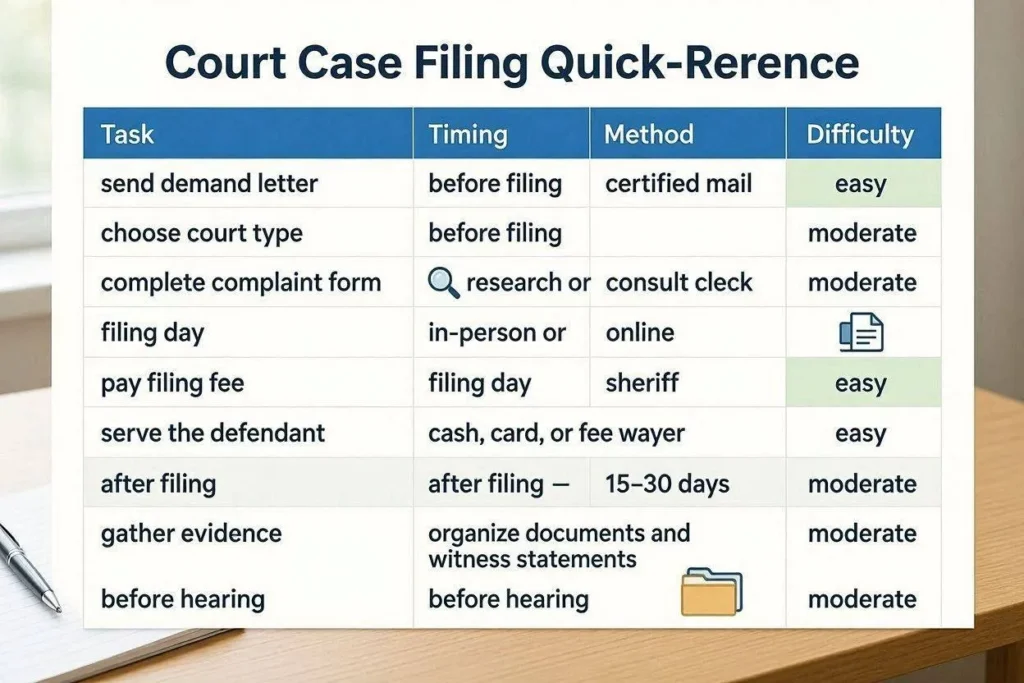
Use this table to track all 6 key actions, their timing, method, and difficulty level before your hearing date.
| Task | Timing | Method | Difficulty |
| Send demand letter | Before filing | Certified mail | Easy |
| Choose court type | Before filing | Research or consult clerk | Moderate |
| Complete complaint form | Filing day | In-person or online | Moderate |
| Pay filing fee | Filing day | Cash, card, or fee waiver | Easy |
| Serve the defendant | After filing (15–30 days) | Sheriff or process server | Moderate |
| Attend court hearing | 20–70 days after filing | In-person | Challenging |
What Happens After You File a Court Case
After you file, the court schedules a hearing date within 20 to 70 days for small claims. Civil court trials may be scheduled within 18 months of filing under federal civil delay-reduction guidelines.
The Defendant’s Response Window
The defendant has 20 days to file a written response after receiving the summons (30 days if the defendant lives out of state). 3 outcomes are possible during this window:
- Defendant pays: notify the court immediately to dismiss the case
- Defendant does not respond: file a Motion for Default Judgment — you win automatically
- Defendant files a counterclaim: you have 20 days to file a written response
Mediation Before Trial
Many courts order mediation before scheduling a trial. A neutral mediator meets with both parties to negotiate a settlement. Mediation costs between $0 and $200 through court-connected programs like the Colorado Office of Dispute Resolution (720-625-5940). Private mediators charge $150 to $400 per hour.
If mediation produces an agreement, both parties sign a written settlement, and the court closes the case. If mediation fails, the case proceeds to trial.
Preparing for the Court Hearing
Arrive 30 minutes early on your hearing date. Bring 3 sets of all documents — 1 for you, 1 for the judge, and 1 for the defendant. Organize exhibits by number starting at Exhibit 1. Courts permit witnesses, but witnesses must appear voluntarily or under a subpoena (court order to appear) issued by the judge.
Present your facts first. State what happened, show your evidence, and name the exact dollar amount you are requesting. Courts provide free interpreters for non-English speakers — request an interpreter at least 10 days before your hearing date.
How to File a Court Case Online in 2026

To file a court case online, use your state court’s official e-filing portal or the federal CM/ECF system. Online filing is now available in all 50 states for at least some case types.
State-level e-filing portals include: Tyler Technologies’ Odyssey File & Serve (used in Texas, Illinois, and 30 other states), File & ServeXpress (used in California state courts), and individual court websites in states like New York and Florida.
E-filing does not remove the requirement to serve the defendant in person. Electronic service is permitted in federal cases and some state courts where both parties consent in writing.
Frequently Asked Questions About Filing a Court Case
Can you file a court case without a lawyer?
Yes. You can file a court case without a lawyer as a pro se litigant in all U.S. courts. Small claims court is specifically designed for self-represented filers. Federal and civil district courts permit pro se filing, but the procedural complexity makes professional legal representation a strong advantage in those venues.
How much does it cost to file a court case in 2026?
Filing fees range from $30 to $435 in 2026, based on the court level and claim amount. Small claims filing fees average $30 to $100. Federal civil court charges $405 for most case types. Courts waive fees for low-income filers who qualify for in forma pauperis (IFP) status.
How long does a court case take after filing?
A small claims hearing is scheduled within 20 to 70 days of filing. A civil trial is typically scheduled within 18 months of the complaint date under federal guidelines. Complex cases involving discovery, depositions, and pretrial motions take 12 to 36 months from filing to verdict.
What is the difference between a civil and criminal court case?
A civil court case is a dispute between 2 private parties — individuals or organizations — seeking money or specific performance. A criminal court case is brought by the government against a person accused of breaking a law, with potential penalties including fines and imprisonment. Private individuals cannot file criminal cases; they file civil cases only.
What happens if you win a court case but the defendant doesn’t pay?
If you win a court case but the defendant does not pay, you must take additional collection steps. Courts do not collect judgments on your behalf. You can file a wage garnishment order, a bank levy, or a property lien against the defendant to enforce the judgment. These post-judgment collection tools are available in all 50 states.
Take Your First Step Toward Filing a Court Case Today
Filing a court case starts with 1 decision: choosing the correct court for your claim amount and case type. From there, you prepare your evidence, complete the complaint form, pay the filing fee, and serve the defendant. Each step builds directly on the previous one.
Most small claims cases resolve within 60 to 90 days of filing. Many civil disputes settle before the trial date once the defendant receives the summons and realizes the case is proceeding. The demand letter alone resolves a significant portion of disputes without any court appearance.

Amanda Brooks
Amanda Brooks leads legal, justice, and community advocacy content at JusticeInTown, drawing on a background in legal research and public policy. She specializes in civil rights, access to justice, and legal awareness, bringing a careful, research-driven approach to complex legal and public-interest topics. Her guides help readers better understand their rights, legal options, and the issues affecting their communities.
Related Posts