
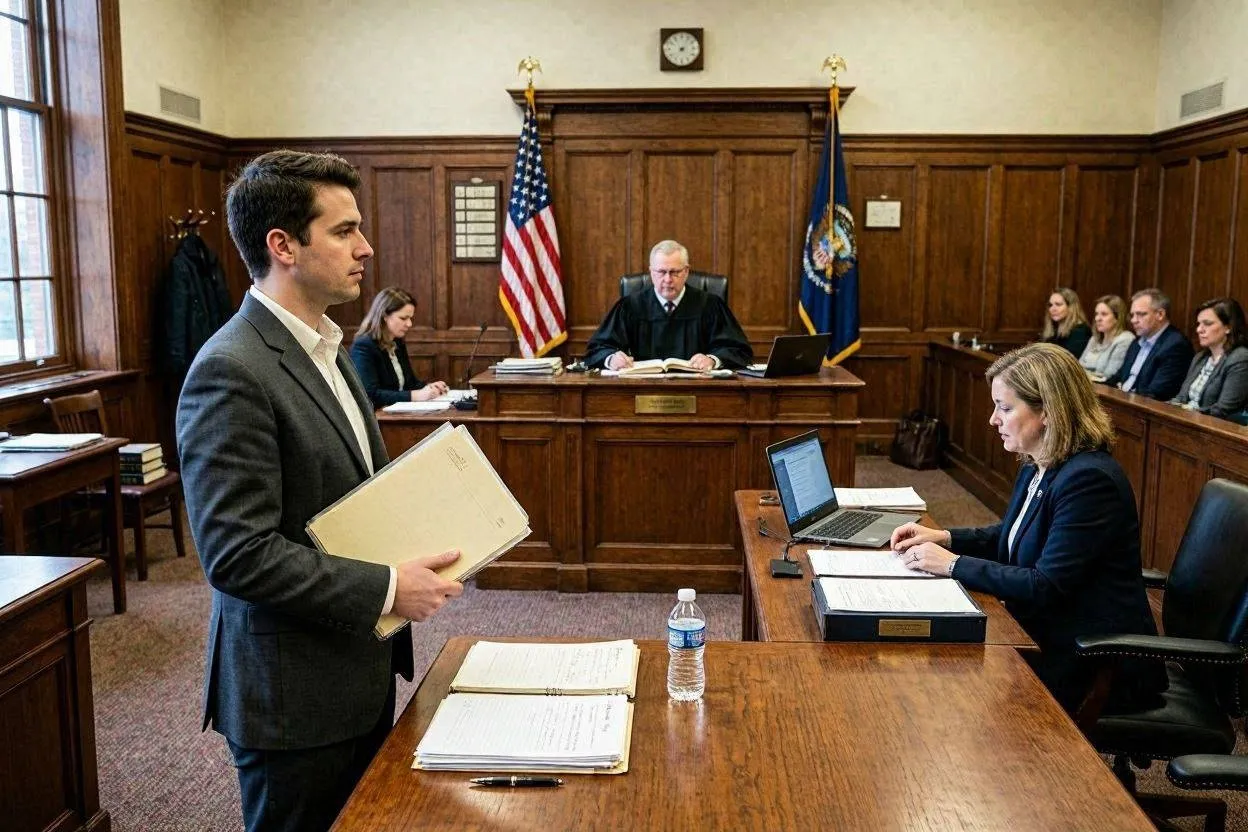
How to Represent Yourself in Court in 2026
To represent yourself in court, file your own pleadings, follow all procedural rules, and present your evidence directly to the judge without an attorney. This right, called pro se (pro say) in federal court and pro per in some state systems, is protected under 28 U.S.C. § 1654 for civil cases.
Representing yourself in court is a viable option for small claims disputes, uncontested divorces, and simple landlord-tenant cases. It is rarely the right choice for criminal felony defense, immigration matters, or personal injury claims where a contingency attorney costs you nothing upfront.
This guide walks you through 6 steps to prepare your case, explains which case types suit self-representation, and lists the 5 mistakes that end most pro se cases before they start.
What Representing Yourself in Court Means
Representing yourself in court — called pro se litigation in federal practice — means you act as your own attorney for every part of your case. You draft and file all court documents, respond to every motion the other side files, gather and label your own evidence, and speak directly to the judge during hearings.
Federal courts and all 50 state court systems hold pro se litigants to the same procedural standards as licensed attorneys. Under the Supreme Court’s ruling in Haines v. Kerner, 404 U.S. 519 (1972), judges read pro se pleadings with slightly more flexibility — but that leniency applies only to how documents are written, not to missed deadlines or ignored court rules.
Courts do not provide pro se litigants with extra time, legal advice, or procedural guidance. Judges and court clerks can explain basic filing procedures but cannot advise you on legal strategy, what to argue, or whether your case is winnable.
When to Represent Yourself in Court — and When Not To
The decision to represent yourself depends on 3 factors: case complexity, the consequences of losing, and your ability to invest significant preparation time.
| Case Type | Safe to Self-Represent? | Complexity Level | Biggest Risk |
| Small claims | Yes — recommended | Low | Missing filing deadlines |
| Uncontested divorce | Yes — with caution | Medium | Missing asset disclosures |
| Landlord-tenant dispute | Yes — common | Low to Medium | Procedural missteps |
| Immigration case | No — high stakes | Very High | Deportation or visa denial |
| Criminal defense (felony) | No — strongly discouraged | Very High | Jail time, permanent record |
| Personal injury | No — contingency available | High | Losing maximum compensation |
Never represent yourself in a felony criminal case. If you cannot afford a defense attorney, the court appoints one at no cost under the Sixth Amendment. Turning down appointed counsel in a serious criminal matter puts your freedom at permanent risk.
Personal injury cases are also poor candidates for self-representation. Contingency fee attorneys take personal injury cases at no upfront cost, collecting a percentage of any award — typically 33% (one-third). A skilled attorney almost always recovers a larger net amount than a self-represented litigant keeps after losing.
How to Prepare to Represent Yourself in Court in 6 Steps
To prepare your case for self-representation, complete all 6 steps before your hearing date. Skipping any step increases your risk of a default judgment or a procedurally dismissed case.
Step 1: Read Your Court’s Pro Se Handbook
Every federal district court and most state courts publish a Pro Se Handbook — a free document that lists every procedural rule, filing format, deadline, and local requirement specific to that court. Download your court’s handbook from the court’s official website before you file a single document.
State courts often publish self-help guides at their official judicial branch websites. California Courts Self-Help (selfhelp.courts.ca.gov), Iowa Judicial Branch (iowacourts.gov), and Nebraska Judicial Branch (nebraskajudicial.gov) all publish free, court-approved self-representation guides.
Step 2: Identify Every Deadline on a Master Calendar
Court deadlines are absolute. A missed filing deadline triggers a default judgment against you in civil cases or additional criminal penalties if you are the defendant in a criminal matter.
Record 4 types of deadlines immediately after filing:
- Response deadline: the date by which you must respond to any motion the opposing party files.
- Discovery deadline: the date by which all evidence exchange under Federal Rule of Civil Procedure (FRCP) Rule 26 must be complete.
- Hearing date: the scheduled date of your actual court appearance.
- Motion filing deadline: the date by which you must file any motions, such as a motion to dismiss under FRCP Rule 56.
Step 3: Observe a Live Courtroom Hearing Before Your Date
Visit your assigned courtroom and watch at least 2 hearings before your own. Courtrooms are open to the public. Observation teaches you where each party sits, how the judge opens proceedings, how attorneys and pro se litigants address the judge, and the actual pace of hearings — something no handbook captures.
Ask the court clerk which courtroom your case is assigned to and whether hearings are open to the public that week. Arrive at least 30 minutes early to pass through security and locate the correct room.
How to File Court Documents Without a Lawyer
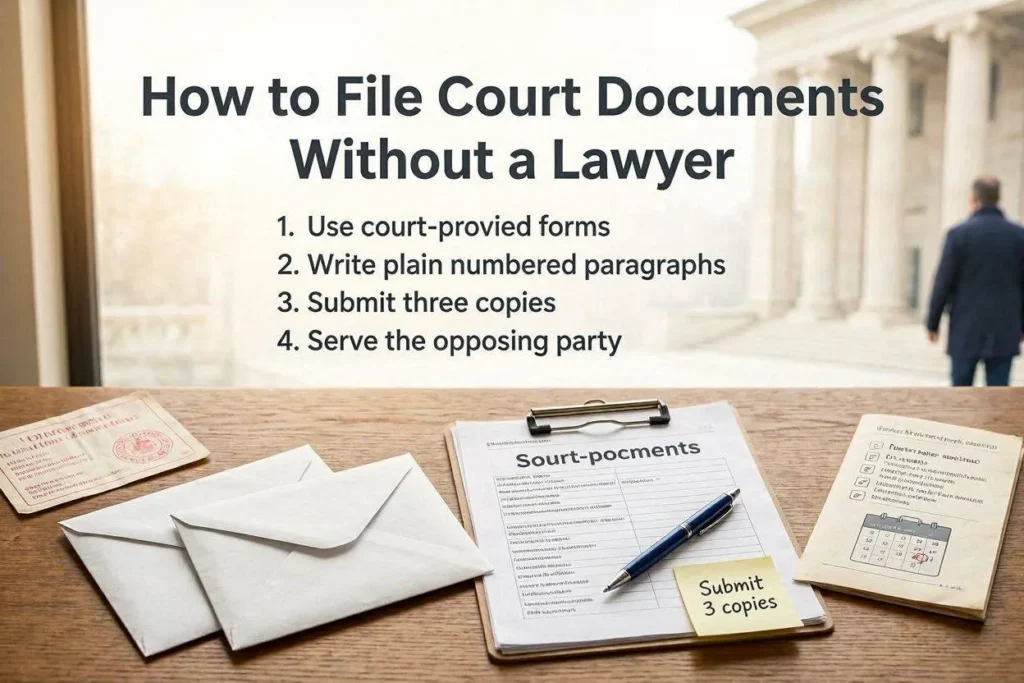
To file court documents without a lawyer, gather the required forms, complete them in plain numbered paragraphs, and submit 3 copies — one for the court, one for the opposing party, and one for your own records.
Follow these 4 filing rules on every document you submit:
- Use court-provided forms. Most courts publish standard complaint forms, answer forms, and motion templates. Use the court’s official forms before drafting your own — custom-drafted documents are rejected more often by clerks checking for format compliance.
- Write in short, numbered paragraphs. Federal Rule of Civil Procedure 8 requires short, plain statements. Write one fact per paragraph. Number each paragraph consecutively.
- Serve every document on the opposing party. Filing with the court is not enough. You must also send a copy of every filing to the opposing party or their attorney, then file a proof of service with the court.
- Keep a date-stamped copy of every filing. The court clerk stamps your copy with the filing date and time. Store every stamped copy in a dedicated case folder.
To request a continuance — a postponed hearing date — file a written motion for continuance with the court at least 10 business days before your hearing. Include the reason for the request and, if possible, written agreement from the opposing party. A judge is far more likely to grant a continuance when both sides agree in writing.
How to Present Your Case in a Courtroom
To present your case in court, organize your evidence before the hearing, make a brief opening statement, present your evidence in a logical sequence, and question any witnesses you call.
How to Organize Your Evidence
To organize evidence for court, label every document as Exhibit 1, Exhibit 2, Exhibit 3, and so on, before you walk into the courtroom. Bring 3 copies of every exhibit — 1 for the judge, 1 for the opposing party, and 1 for yourself.
Acceptable physical evidence in most cases includes: signed contracts, canceled checks, invoices, photographs, text message screenshots (printed and dated), and emails (printed with full header information showing sender, recipient, date, and time).
If a witness refuses to appear voluntarily, file a subpoena with the clerk’s office at least 14 days before your hearing. A subpoena is a court order requiring a person to appear and testify. The clerk issues the subpoena; you are responsible for delivering it to the witness.
How to Address the Judge and Handle Objections
Address the judge as “Your Honor” in every verbal exchange. Speak loudly and clearly. Do not interrupt the judge or the opposing party under any circumstances — a judge can hold you in contempt of court for interrupting, which can result in a fine or removal from the courtroom.
If opposing counsel says “Objection” after a question is asked to you or your witness, stop speaking immediately and wait for the judge’s ruling. The judge will either say ‘sustained’ (the objection is granted — do not answer) or ‘overruled’ (the objection is denied — answer the question). Never argue with an objection.
If you do not understand a question, say “I don’t understand the question, Your Honor. Could it be repeated?” Never guess at the meaning of a question and answer based on a guess.
5 Mistakes That End Pro Se Cases Early
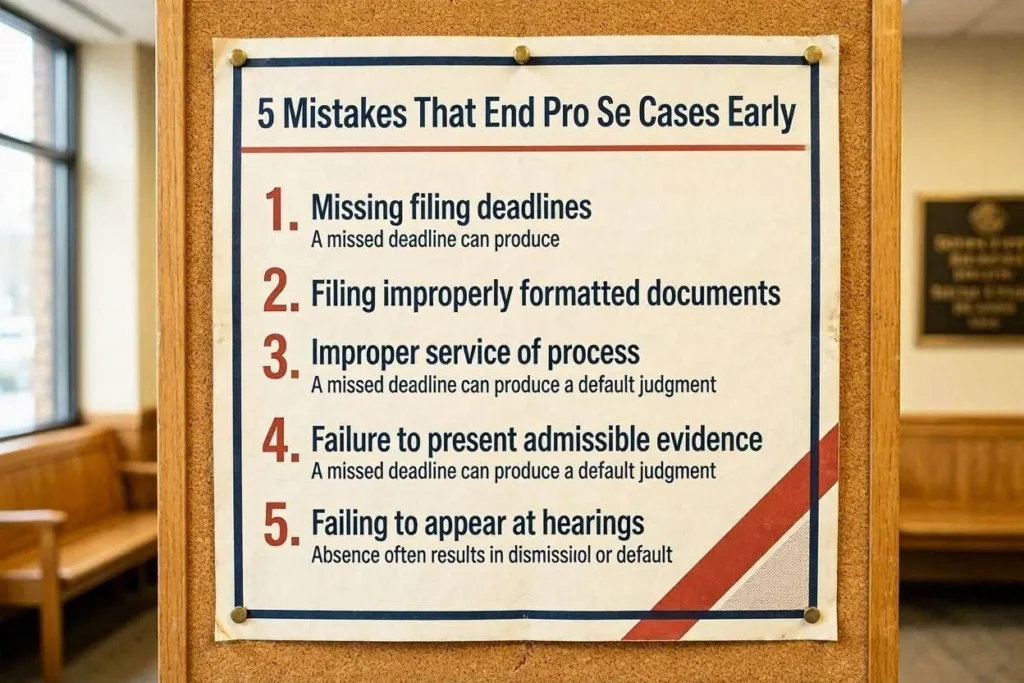
Self-represented litigants lose cases most often due to procedural errors, not lack of merit. These 5 mistakes appear in the majority of failed pro se cases.
- Mistake 1 — Missing filing deadlines. Courts enforce deadlines identically for represented and pro se parties. A single missed response deadline produces a default judgment against you in civil cases.
- Mistake 2 — Filing improperly formatted documents. Courts reject documents that do not follow local formatting rules. Always use the court’s official forms and verify the correct font size, margin requirements — typically 1 inch (2.54 cm) on all sides — and caption format before filing.
- Mistake 3 — Speaking to the judge outside of court. Ex parte communication — any exchange with the judge without the opposing party present — is prohibited and can result in sanctions or dismissal. All communication with the court goes through written filings.
- Mistake 4 — Bringing disorganized or unlabeled evidence. A judge cannot admit evidence that is not labeled and submitted through proper procedure. Unlabeled exhibits get refused at the point of presentation.
- Mistake 5 — Failing to respond to motions. Every motion the opposing party files requires a written response within the deadline your court sets — typically 14–21 days. An unanswered motion is often granted automatically.
Free Resources for Self-Represented Litigants in the USA
You do not need to navigate the court system without any support. 5 categories of free legal resources exist specifically for pro se litigants across the United States.
- Court self-help centers: Most state courthouses operate a self-help center staffed by legal professionals who explain procedures, provide forms, and review documents for format compliance — but not for legal strategy. Find your local center at your state’s judicial branch website.
- Federal pro se clerk offices: Every US district court maintains a pro se clerk’s office. The Northern District of New York and District of Oregon both publish detailed pro se handbooks free of charge on their official court websites.
- Legal aid organizations: Legal Aid organizations such as the Legal Aid Center of Southern Nevada and OregonLawHelp.org provide free legal guidance to income-qualified individuals. Eligibility typically requires income at or below 125–200% of the federal poverty level.
- Law school legal clinics: Accredited law school clinics in all 50 states offer free supervised legal representation in civil, family, and immigration matters. Student attorneys handle cases under direct faculty supervision.
- Alternative dispute resolution (ADR): Before filing in court, consider mediation or arbitration. ADR resolves disputes outside the courtroom — typically faster and at lower cost. The Colorado Bar Association and many other state bars publish free ADR guides for individuals considering self-representation.
Represent Yourself With the Right Preparation
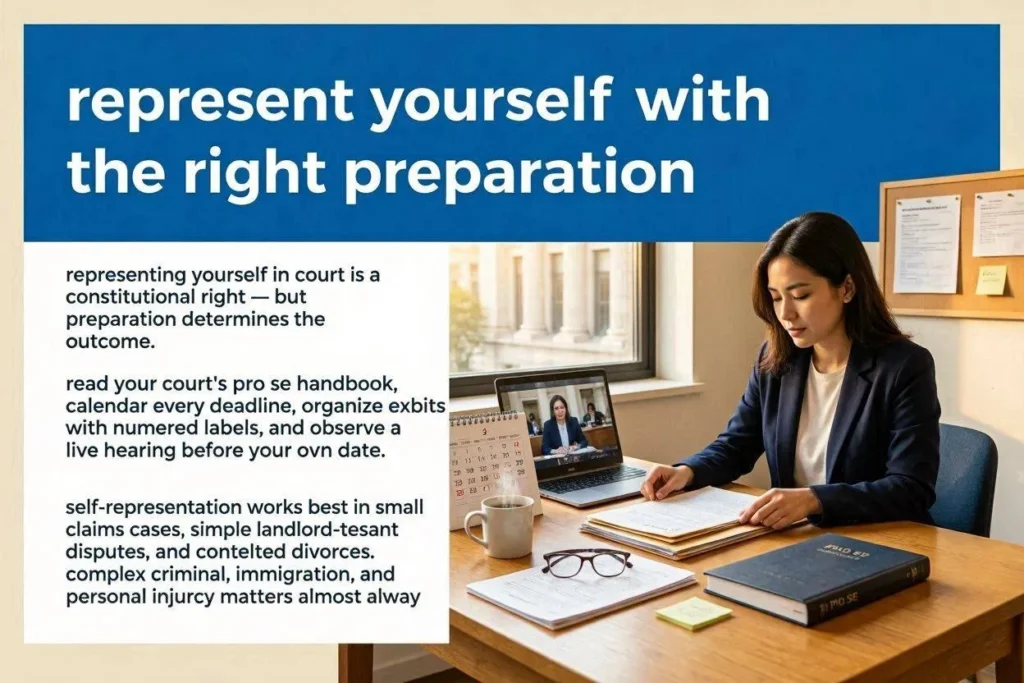
Representing yourself in court is a constitutional right — but preparation determines the outcome. Read your court’s Pro Se Handbook, calendar every deadline, organize exhibits with numbered labels, and observe a live hearing before your own date.
Self-representation works best in small claims cases, simple landlord-tenant disputes, and uncontested divorces. Complex criminal, immigration, and personal injury matters almost always produce better results with professional legal help — especially when free or contingency representation is available.
Frequently Asked Questions About Representing Yourself in Court
Is it legal to represent yourself in federal court?
Yes. 28 U.S.C. § 1654 gives every person the right to appear pro se in federal civil court. You cannot represent yourself in a criminal case where the government charges you — in that scenario, appointed counsel is available at no cost if you cannot afford an attorney.
Can you represent yourself in court for a criminal charge?
Yes, but courts strongly discourage it. The Sixth Amendment guarantees appointed counsel to anyone facing criminal charges who cannot afford a lawyer. Waiving that right in a felony case puts your freedom and permanent record at serious risk. Self-representation in misdemeanor cases is more common and carries lower stakes.
What does pro se mean in court?
Pro se means representing yourself without an attorney. The term comes from Latin meaning “for oneself.” Federal courts use “pro se.” Some state courts, including California, use the term “pro per” — short for propria persona, meaning the same thing.
Do you have to follow the same court rules as a lawyer when representing yourself?
Yes. Judges enforce every procedural rule — filing deadlines, document format, evidence standards, and hearing conduct — equally for pro se litigants and attorneys. The only limited exception is that judges read pro se pleadings slightly more flexibly under Haines v. Kerner, 404 U.S. 519 (1972).
What should you bring to court when representing yourself?
Bring 3 copies of every exhibit, your master deadline calendar, a numbered exhibit list, any subpoenaed witness contact confirmation, and a written outline of your opening statement. Arrive at least 30 minutes (approximately half an hour) before your scheduled hearing time to clear security and locate your courtroom.
Conclusion
Representing yourself in court is a constitutional right — but preparation determines the outcome. Read your court’s Pro Se Handbook, calendar every deadline, organize exhibits with numbered labels, and observe a live hearing before your own date.
Self-representation works best in small claims cases, simple landlord-tenant disputes, and uncontested divorces. Complex criminal, immigration, and personal injury matters almost always produce better results with professional legal help — especially when free or contingency representation is available.

Amanda Brooks
Amanda Brooks leads legal, justice, and community advocacy content at JusticeInTown, drawing on a background in legal research and public policy. She specializes in civil rights, access to justice, and legal awareness, bringing a careful, research-driven approach to complex legal and public-interest topics. Her guides help readers better understand their rights, legal options, and the issues affecting their communities.
Related Posts