

How Much Does a Lawyer Cost in 2026? Complete Guide
A lawyer costs $150 to $500 per hour on average in the US, but the total bill depends on 4 things: fee structure, practice area, attorney experience, and location. Most people pay $1,500 to $15,000 per case — though personal injury attorneys often charge nothing upfront through a contingency arrangement.
This guide breaks down every fee structure lawyers use, shows you real costs by practice area, and gives you 4 proven tactics to reduce your legal bill without cutting corners.
How Much Does a Lawyer Cost? Quick Reference by Legal Matter
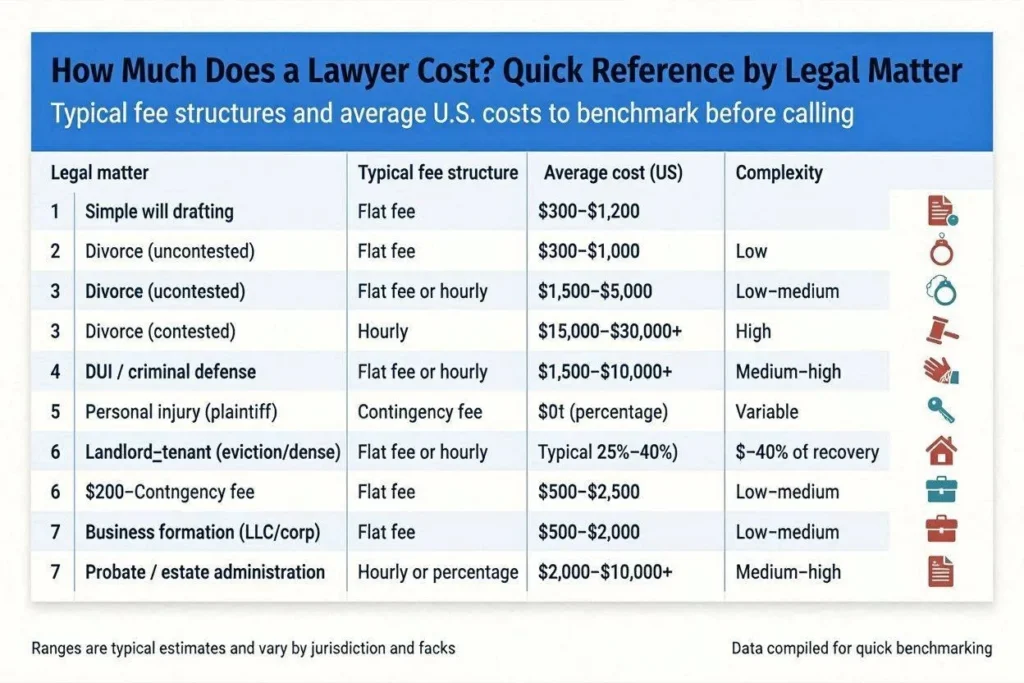
The table below shows typical fee structures and average costs across 8 common legal matters so you can benchmark what your case might cost before calling anyone.
| Legal Matter | Typical Fee Structure | Average Cost (US) | Complexity |
| Simple will drafting | Flat fee | $300–$1,200 | Low |
| Divorce (uncontested) | Flat fee or hourly | $1,500–$5,000 | Low–Medium |
| Divorce (contested) | Hourly | $15,000–$30,000+ | High |
| DUI / Criminal defense | Flat fee or hourly | $2,500–$10,000+ | Medium–High |
| Personal injury claim | Contingency (33%) | $0 upfront | Medium |
| Immigration (green card) | Flat fee | $3,000–$8,000 | Medium |
| Business contract review | Hourly or flat | $500–$2,500 | Low–Medium |
| Chapter 7 bankruptcy | Flat fee | $1,000–$3,500 | Medium |
All figures reflect 2026 US national averages. Rates in Washington D.C. ($392/hr) and New York ($358/hr) sit at the top end; West Virginia ($162/hr) sits at the bottom, based on Statista data collected across tens of thousands of law firms.
4 Fee Structures Lawyers Use and What Each One Costs You
Lawyers charge clients using 4 billing models. Understanding each model before signing a fee agreement protects you from unexpected costs.
1. Hourly Rate Billing
Hourly billing costs $150 to $500+ per hour, depending on the attorney’s experience and location. The attorney bills for every task: phone calls, emails, court appearances, and document review. Clients receive itemized invoices showing time in 6-minute (0.1-hour) increments.
Hourly billing is standard in family law disputes, criminal defense cases, business litigation, and civil rights matters where the total time needed is hard to predict upfront.
2. Flat Fee Billing
Flat fees cover a defined legal task for a fixed price — you pay the same amount whether the attorney spends 2 hours or 10. Common flat-fee services include: will drafting ($300–$1,200), uncontested divorce ($1,500–$3,500), DUI defense ($2,500–$5,000), green card application ($3,000–$8,000), and LLC formation ($500–$1,500).
Flat fees give you cost certainty. They work well for routine matters with predictable scope, such as estate planning, real estate closings, and immigration filings.
3. Contingency Fee
A contingency fee charges you nothing upfront — the attorney takes 25% to 40% of the final settlement or verdict. Personal injury attorneys, medical malpractice lawyers, and employment discrimination attorneys commonly use this model. If the attorney loses your case, you owe zero in legal fees, though you may still owe court filing fees and expert witness costs.
A standard contingency percentage in the US is 33.3% (one-third) of the recovery. On a $100,000 settlement, the attorney receives $33,333 and you receive $66,667 before deducting case expenses.
4. Retainer Fee
A retainer is an upfront deposit — typically $2,000 to $10,000 — held in a client trust account and drawn down as the attorney bills hours. The retainer is not the total cost; it is a prepayment toward hourly or flat fees. Bankruptcy attorneys and family law attorneys request the highest average retainers, while immigration attorneys tend to request lower amounts.
Ask your attorney in writing whether the retainer is refundable and what happens to unspent funds. Most states require attorneys to return unearned retainer balances.
How Much Does a Lawyer Cost by Practice Area in 2026?
Lawyer costs vary widely across 7 practice areas. The numbers below reflect US national averages for 2026.
- Personal injury: $0 upfront; attorney takes 33%–40% of settlement. Average US personal injury settlement: $52,900.
- Divorce (contested): $15,000–$30,000 total at $250–$450/hr. High-conflict divorces involving business assets or custody disputes exceed $50,000.
- Criminal defense (felony): $5,000–$25,000 flat or hourly. Federal felony cases reach $50,000–$100,000+.
- Immigration (family green card): $3,000–$8,000 flat fee plus $1,820 in USCIS filing fees.
- Estate planning (basic will + trust): $1,500–$5,000 flat fee.
- Business litigation: $350–$500/hr. A single lawsuit through trial averages $100,000–$300,000 total.
- Bankruptcy (Chapter 7): $1,000–$3,500 flat fee plus $338 court filing fee.
How Much Does a Lawyer Cost Per Hour by State?
Average lawyer hourly rates range from $162 in West Virginia to $392 in Washington D.C. The 5 most expensive states for legal services are: Washington D.C. ($392/hr), New York ($358/hr), California ($344/hr), Delaware ($344/hr), and Connecticut ($342/hr). The 5 least expensive states are: West Virginia ($162/hr), Maine ($193/hr), Montana ($199/hr), Iowa ($202/hr), and Kentucky ($204/hr).
You can find licensed attorneys across all 50 states through JusticeInTown at no cost to search.
Within any single state, rates in major metro areas run 15%–30% higher than rural rates. A family law attorney in Manhattan charges $400–$600/hr; the same specialization in upstate New York runs $200–$350/hr.
5 Hidden Costs Beyond the Attorney’s Fee
Attorney fees are not the only expense. Budget for these 5 additional costs before your case begins.
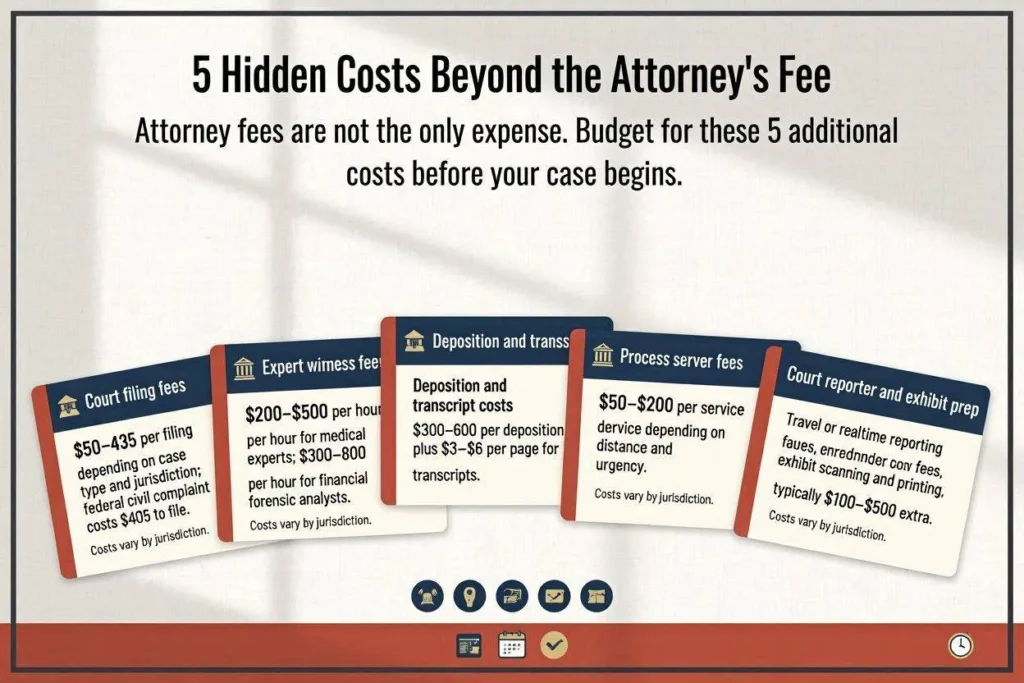
- Court filing fees: $50–$435 per filing depending on case type and jurisdiction. A federal civil complaint costs $405 to file.
- Expert witness fees: $200–$500/hr for medical experts; $300–$800/hr for financial forensic analysts.
- Deposition and transcript costs: $300–$600 per deposition plus $3–$6 per page for transcripts.
- Process server fees: $50–$200 per service of process.
- Investigator fees: $50–$150/hr for private investigators used in criminal defense and custody cases.
Review all available free legal resources before committing to paid representation — some disputes resolve through mediation without full court proceedings.
4 Proven Ways to Reduce How Much a Lawyer Costs You
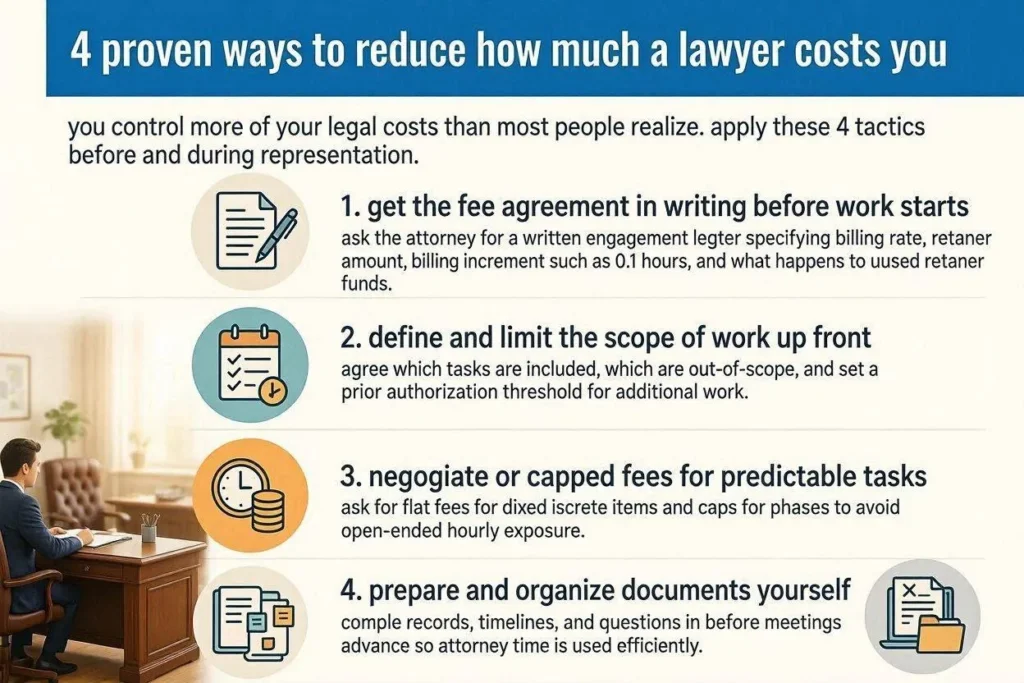
You control more of your legal costs than most people realize. Apply these 4 tactics before and during representation.
1. Get the Fee Agreement in Writing Before Work Starts
To get a binding fee agreement, ask the attorney to provide a written engagement letter that specifies the billing rate, retainer amount, billing increment (e.g., 0.1 hours), and what happens to unused retainer funds. A verbal agreement is unenforceable in most states.
2. Choose the Right Fee Structure for Your Case Type
To minimize risk on an uncertain outcome, use a contingency attorney for personal injury, workers’ compensation, or employment discrimination. To cap costs on a defined task, use a flat-fee attorney for wills, immigration filings, or uncontested divorces. Paying hourly makes sense only when the case scope is complex and unpredictable.
3. Ask About Unbundled Legal Services
Unbundled legal services — also called limited-scope representation — let you hire an attorney for specific tasks only. You pay for document review ($200–$500) or a single court appearance ($500–$1,500) without paying for full representation. This approach cuts total costs by 40%–60% in straightforward cases.
4. Check Eligibility for Free Legal Aid
To access free legal help, contact your local bar association’s lawyer referral service — most offer a 30-minute initial consultation for $20–$50 or free. The Legal Services Corporation (LSC) funds free civil legal aid for individuals earning less than 125% of the federal poverty level. Law school clinics provide free legal services in family law, immigration, and landlord-tenant disputes.
How Much Does a Lawyer Cost? Understanding the First Consultation
A first consultation costs $0 to $350 depending on the attorney and practice area. Personal injury, immigration, and criminal defense attorneys commonly offer free consultations. Estate planning, business law, and family law attorneys charge $150–$350 for an initial 60-minute meeting.
Bring 3 things to your first meeting: a written timeline of key events, copies of all relevant documents, and a list of questions about the attorney’s fee structure. This preparation cuts consultation time and reduces billable hours if the attorney charges for the meeting. You can explore practice areas on JusticeInTown to identify which type of attorney your situation requires before booking.
FAQs: How Much Does a Lawyer Cost?
Is hiring a lawyer worth the cost?
Yes — in most cases involving significant money, criminal charges, or contested rights. Attorneys increase personal injury settlements by an average of 3.5x compared to self-represented claimants, according to Insurance Research Council data.
Can I negotiate lawyer fees?
Yes. You can negotiate hourly rates, ask for a payment plan, request a fee cap, or propose a flat-fee structure for a defined scope of work. Attorneys are more flexible on rates for clients with straightforward, low-risk cases.
What is a retainer fee and is it refundable?
A retainer is a prepayment deposited into a trust account before work begins. Earned retainers (applied to completed work) are non-refundable. Unearned retainers — funds not yet applied to billed time — are refundable in most US states under American Bar Association (ABA) ethics rules.
How much does a lawyer cost for a small claims case?
Most people represent themselves in small claims court since legal fees often exceed the recoverable amount. Claims cap at $2,500–$25,000 depending on state. If you want legal advice before filing, a 1-hour unbundled consultation costs $150–$350.
Does a free consultation mean the lawyer works for free?
No. A free consultation is a 15–60 minute intake meeting to evaluate your case — not an agreement to provide full representation. The attorney assesses whether to take the case; you assess whether to hire the attorney. After the consultation, the attorney’s standard fees apply.
What You Should Do Next
Lawyer costs range from $0 upfront (contingency) to $500/hr (complex litigation), and the right fee structure depends entirely on your case type. The single most important step: get a written fee agreement before any attorney does billable work.
To find a licensed US attorney matched to your legal matter, visit JusticeInTown’s attorney directory. Every consultation starts free — you pay only when you decide to move forward.

Amanda Brooks
Amanda Brooks leads legal, justice, and community advocacy content at JusticeInTown, drawing on a background in legal research and public policy. She specializes in civil rights, access to justice, and legal awareness, bringing a careful, research-driven approach to complex legal and public-interest topics. Her guides help readers better understand their rights, legal options, and the issues affecting their communities.
Related Posts