
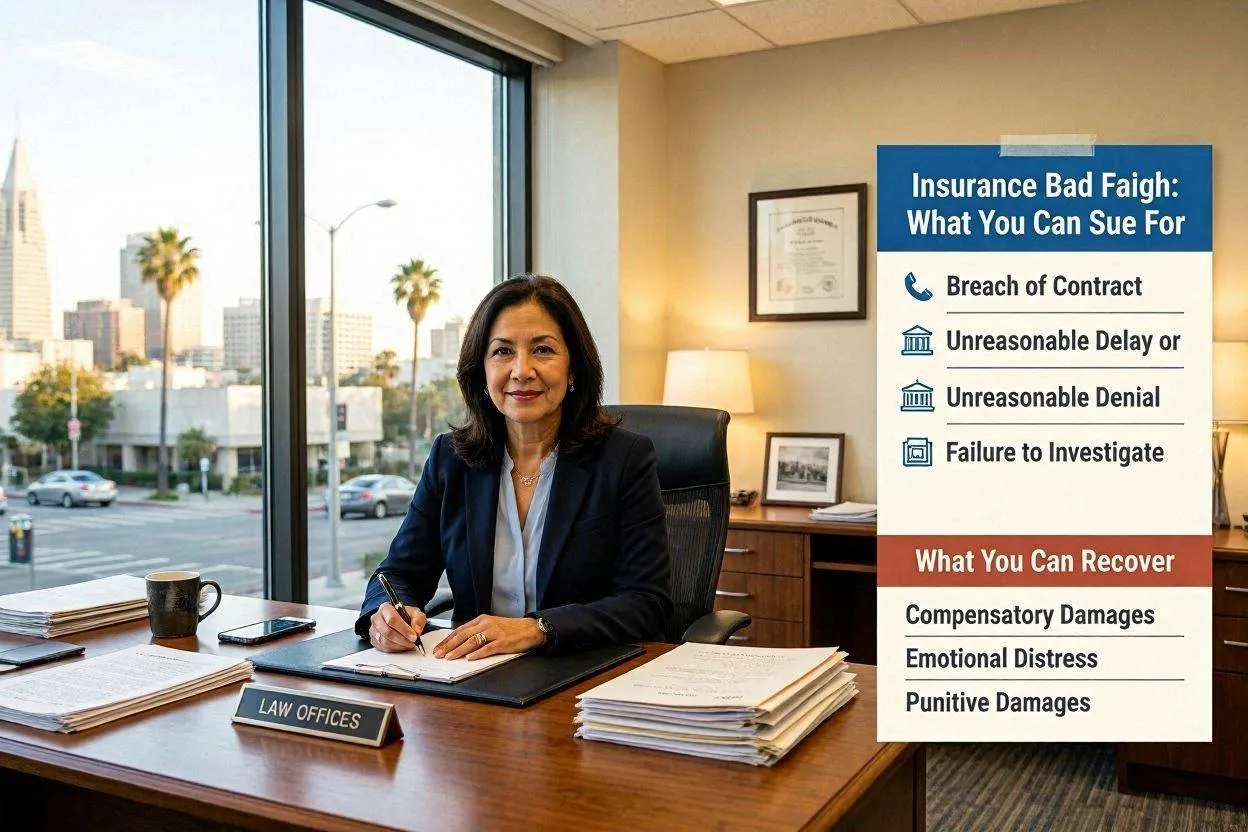
Insurance Bad Faith Attorney Los Angeles: What You Can Sue For and What You Can Recover
Insurance bad faith occurs when your insurance company unreasonably denies, delays, or underpays a legitimate claim — and California law gives you the right to sue for damages that go far beyond your original policy limits. Los Angeles policyholders can recover the original claim value, consequential damages, emotional distress, attorney’s fees, and punitive damages when an insurer’s conduct is fraudulent or oppressive.
California has some of the strongest policyholder protections in the United States. The covenant of good faith and fair dealing is implied in every insurance contract under California law. Violating it is not just a contract breach — it is a tort. That distinction matters enormously for what you can recover.
This guide covers every aspect of insurance bad faith in Los Angeles: California law, the 9 most common bad faith tactics insurers use, what damages you can recover, statute of limitations, how to prove your case, and when to hire a Los Angeles bad faith attorney.
What Is Insurance Bad Faith Under California Law?
Insurance bad faith is the unreasonable withholding of policy benefits owed to a policyholder. To establish bad faith under California law, you must prove 2 elements:
- Benefits due under the policy were withheld — meaning you had a valid, covered claim that the insurer refused to pay, underpaid, or delayed without justification.
- The withholding was unreasonable or without proper cause — meaning no legitimate dispute existed, or the insurer failed to conduct a fair investigation before denying.
The legal foundation is the landmark California Supreme Court case Gruenberg v. Aetna Insurance Co. (1973), which established that an insurer can be held liable in tort — not just contract — for unreasonably refusing to pay a claim. This opened the door to punitive damages, emotional distress recovery, and awards that exceed policy limits.
2026 Context: Insurance companies paid over $52 billion in damages after the 2025 Los Angeles wildfires — yet thousands of policyholders reported denied, delayed, and underpaid claims. The Los Angeles County Board of Supervisors launched a formal investigation into State Farm in late 2025, citing systemic delays and denials of wildfire claims across Altadena, Palisades, and surrounding areas.
First-Party vs. Third-Party Bad Faith Claims
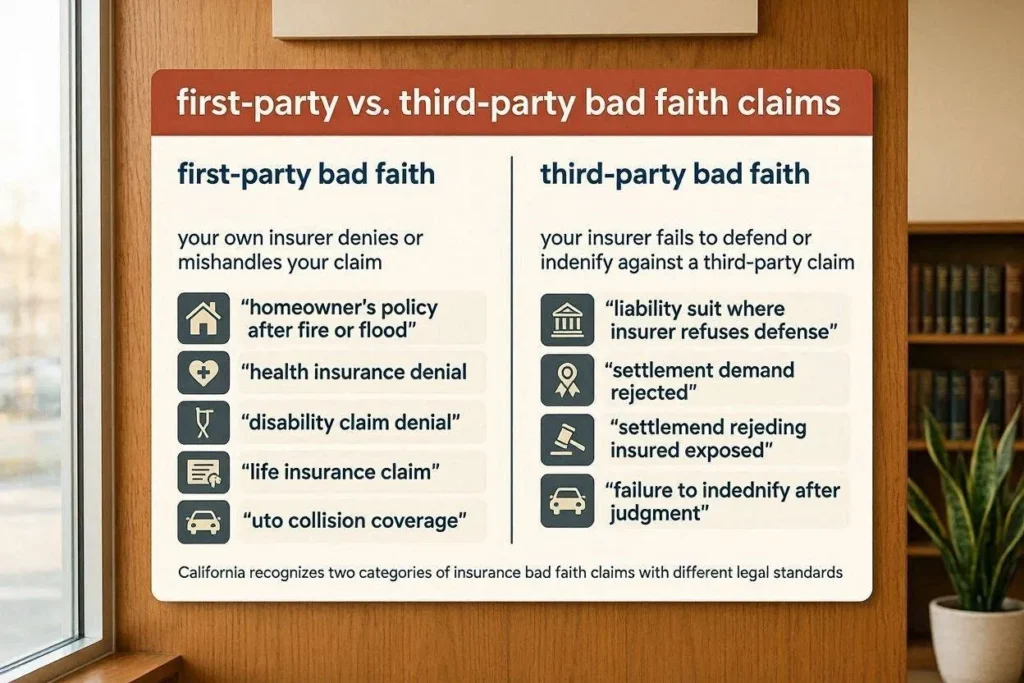
California recognizes 2 categories of insurance bad faith claims. Each has different legal standards and applies to different situations.
| Type | What It Means | Common Examples |
|---|---|---|
| First-Party Bad Faith | Your own insurer denies or mishandles your claim | Homeowner’s policy after fire or flood, health insurance denial, disability claim denial, life insurance claim, auto collision coverage |
| Third-Party Bad Faith | Your insurer fails to defend or settle a claim made against you by someone else | Auto liability after an accident, premises liability suit against you, business liability claim where insurer refuses to defend |
First-party bad faith is the most common type in Los Angeles. Third-party bad faith typically arises when an insurer refuses to settle a lawsuit within policy limits, exposing you to a personal judgment that exceeds your coverage — known as an excess judgment.
California Insurance Bad Faith Law — Key Statutes and Cases
The Covenant of Good Faith and Fair Dealing
California courts imply a covenant of good faith and fair dealing into every insurance contract. This means your insurer cannot do anything — by act or omission — to deprive you of the benefits you bargained for when you paid your premiums. No written clause in your policy can waive this duty.
California Insurance Code Section 790.03 — The UIPA
The Unfair Insurance Practices Act (UIPA), codified at California Insurance Code Section 790.03, lists 16 specific prohibited practices. The most actionable ones in Los Angeles bad faith cases include:
- Misrepresenting pertinent facts or insurance policy provisions relating to a coverage dispute
- Failing to acknowledge and act reasonably promptly on communications about a claim
- Failing to adopt and implement reasonable standards for prompt investigation of claims
- Refusing to pay claims without conducting a reasonable investigation
- Failing to affirm or deny coverage of claims within a reasonable time
- Not attempting in good faith to make prompt, fair, and equitable settlements when liability is clear
- Compelling policyholders to initiate litigation to recover amounts due under a policy
- Attempting to settle a claim for less than a reasonable amount based on the facts
Key California Bad Faith Precedents
| Case | Year | What It Established |
|---|---|---|
| Gruenberg v. Aetna Ins. Co. | 1973 | Insurer liable in tort — not just contract — for unreasonably refusing to pay a claim |
| Crisci v. Security Insurance Co. | 1967 | Insurers owe a duty of utmost good faith to their insured |
| Egan v. Mutual of Omaha | 1979 | Punitive damages available in egregious bad faith cases |
| Brandt v. Superior Court | 1985 | Attorney’s fees recoverable as damages when insurer forces litigation to obtain policy benefits |
| Jordan v. Allstate Ins. Co. | 2007 | Insurer exposed to full tort remedies including punitive damages for unreasonable denial |
9 Insurance Bad Faith Tactics Los Angeles Policyholders Face
These are the 9 most documented tactics insurers use in Los Angeles to reduce or eliminate claim payouts.
- Unreasonable claim denial without investigation. Denying a claim before completing a thorough investigation violates the duty to investigate. A hasty denial is often a bad faith denial — California courts treat the failure to gather sufficient facts, interview witnesses, or consult qualified experts as direct evidence of bad faith.
- Low-ball settlement offers far below actual loss value. Offering $40,000 on a $200,000 fire damage claim — without documentation justifying the reduction — is a textbook bad faith settlement tactic. Insurers know most policyholders lack resources to fight and accept inadequate offers out of desperation.
- Unreasonable delay of claim processing. California requires insurers to acknowledge claims promptly and complete investigations within a reasonable time. Delays of months or years — while a displaced family pays rent out of pocket — are a form of bad faith even if the insurer eventually pays.
- Misrepresenting policy language to deny coverage. Telling a policyholder their policy does not cover a loss when the policy language clearly includes it is deliberate deception. California Penal Code addresses this directly — it is not a gray area under state law.
- Cancelling or non-renewing policies immediately before a foreseeable loss. In Los Angeles, insurers including Liberty Mutual cancelled thousands of homeowner policies in wildfire-risk zip codes months before the 2025 Palisades and Eaton fires. A class action lawsuit filed by Singleton Schreiber alleged Liberty Mutual used fabricated aerial photos as pretextual justification for these cancellations.
- Using biased or unqualified investigators and adjusters. Assigning adjusters with financial incentives to minimize payouts, or relying on a single biased expert opinion to deny a claim, supports a bad faith finding.
- Imposing unreasonable documentation demands. Requiring excessive, repetitive, or impossible-to-obtain documentation — particularly after a disaster where records were destroyed — is a stalling tactic courts recognize as bad faith conduct.
- Denying coverage based on policy exclusions that do not apply. Applying exclusions incorrectly or out of context to deny a valid claim is a misrepresentation of policy terms and actionable bad faith.
- Failing to defend you against a third-party lawsuit. When someone sues you and your insurer refuses to provide defense counsel or refuses to settle within policy limits — exposing you to a personal judgment — the insurer is liable for all damages including the excess judgment.
What Damages Can You Recover in a Los Angeles Bad Faith Insurance Lawsuit?
California bad faith law allows recovery of 5 categories of damages. The total recovery can significantly exceed your original policy limits when punitive damages apply.
| Damage Category | What It Covers | Available In |
|---|---|---|
| Policy Benefits | The original amount your insurer owed under the policy | All bad faith cases |
| Consequential Damages | Financial losses caused by the insurer’s delay or denial — out-of-pocket costs, lost income, additional expenses | All bad faith cases |
| Emotional Distress | Compensation for anxiety, stress, humiliation, and psychological harm caused by the insurer’s misconduct | All bad faith cases |
| Attorney’s Fees (Brandt Fees) | Legal costs incurred to obtain benefits the insurer wrongfully withheld — recoverable as damages, not just costs | When insurer forces litigation to recover policy benefits |
| Punitive Damages | Additional damages to punish and deter oppressive, fraudulent, or malicious insurer conduct — can reach millions | When conduct is fraudulent, oppressive, or malicious |
Punitive Damages in California Bad Faith Cases
Punitive damages require clear and convincing evidence that the insurer acted with fraud, oppression, or malice. California courts have upheld punitive damage awards of millions of dollars against insurers whose conduct was particularly egregious.
Punitive damages serve 2 purposes: to punish the insurer for conduct that goes beyond mere negligence, and to deter the insurance company — and the industry — from repeating the behavior. Because insurance companies are large corporate entities, only significant punitive awards create meaningful deterrence.
California allows 10% annual interest on past-due disability insurance benefits. In cases with years of delay, the interest alone can be substantial. Attorney’s fees — called Brandt fees — are awarded as compensatory damages, not just litigation costs, making them fully recoverable.
Statute of Limitations for Bad Faith Insurance Claims in Los Angeles
California sets 2 separate deadlines depending on how you frame your claim.
| Claim Type | Statute of Limitations | Legal Basis |
|---|---|---|
| Breach of contract (policy benefits) | 4 years from denial or breach | California Code of Civil Procedure § 337 |
| Tort / bad faith (emotional distress, punitive damages) | 2 years from when bad faith conduct occurred | California Code of Civil Procedure § 339 |
Filing under the tort theory unlocks emotional distress and punitive damages — but the 2-year deadline is strict. Courts can toll (pause) the statute of limitations in limited circumstances, including when the insurer failed to advise you of applicable time limits or actively misled you about your claim status.
Do not wait to consult a Los Angeles bad faith insurance attorney. The 2-year tort deadline runs from the date of the bad faith conduct — not necessarily the final denial letter. Missing it bars all tort damages permanently.
Types of Insurance Claims That Generate Bad Faith Lawsuits in Los Angeles
Homeowner’s Insurance — Fire, Wildfire, and Natural Disaster Claims
Los Angeles homeowners face the highest volume of bad faith claims in California. The 2025 Palisades, Eaton, and Hurst wildfires triggered tens of thousands of claims — and widespread reports of denials, delays, and underpayments followed immediately.
- Insurers denied smoke and soot damage claims, arguing the home did not burn directly
- FAIR Plan issued blanket denials of remediation claims for homes with documented soot damage
- State Farm faced a formal Board of Supervisors investigation after processing delays left 13,500+ policyholders without payments for months
- Liberty Mutual faced a class action for using fabricated aerial photographs to cancel coverage before the fires
If your homeowner’s insurance claim was denied, underpaid, or delayed after a Los Angeles wildfire, flood, earthquake, or other covered event, California bad faith law gives you the right to sue for all damages plus punitive damages if the conduct was egregious.
Health Insurance Claim Denials
Health insurers in California deny coverage for medically necessary treatments, specialist referrals, hospital stays, and prescription medications. Common bad faith tactics include citing policy exclusions that do not apply, demanding excessive prior authorization, and delaying approval until the medical need has passed.
Disability Insurance Bad Faith
Long-term disability insurers are among the most aggressive bad faith defendants in Los Angeles. Tactics include terminating benefits mid-claim by claiming the policyholder has recovered, demanding impossible levels of ongoing medical documentation, and using biased independent medical examiners (IMEs) to justify denials.
Life Insurance Claim Denials
Life insurance companies deny death benefit claims by alleging material misrepresentation on the original application — even for conditions unrelated to the cause of death. California courts scrutinize these post-death denials closely and frequently find bad faith when insurers failed to investigate during the application process but use application discrepancies as a post-death pretext.
Auto Insurance Bad Faith
Auto insurers act in bad faith by refusing to settle third-party injury claims within policy limits, leaving their insured exposed to excess personal liability. Underinsured motorist (UIM) claims are also a frequent source of bad faith — insurers delay or deny UIM benefits even when the at-fault driver’s coverage is clearly insufficient.
Business Interruption Insurance Denials
Los Angeles businesses whose premises were damaged or inaccessible during the 2025 wildfires submitted business interruption claims that insurers frequently denied, citing policy language disputes about whether physical damage triggering the coverage occurred. California courts apply the reasonable expectations doctrine — if the policy language is ambiguous, it is construed against the insurer.
How to Prove Insurance Bad Faith in California — 5 Evidence Categories
Proving bad faith requires more than showing the insurer denied your claim. You must show the denial was unreasonable. These are the 5 categories of evidence Los Angeles bad faith attorneys use to build a case.
- The Claim File. Every insurer maintains an internal claim file containing all notes, communications, reports, and decisions made during your claim. California law requires insurers to produce this file in litigation. The claim file often contains the most damaging evidence — internal notes showing the adjuster knew the claim was valid, supervisor pressure to deny, or policy guidance to minimize payouts.
- Denial Letter and Written Communications. Preserve every letter, email, and written communication from your insurer. The denial letter itself often reveals bad faith — vague or shifting reasons, incorrect policy citations, or flat refusals without explanation.
- Timeline of the Claim. A documented timeline shows unreasonable delay. If your claim sat without action for 90 days while you paid rent on a displacement home, the timeline is evidence. California requires insurers to acknowledge claims within 10 days and complete investigations within 40 days of receiving proof of loss.
- Independent Expert Opinions. A qualified public adjuster, construction estimator, or medical expert can establish that the value of your loss significantly exceeded what the insurer offered — directly contradicting the insurer’s assessment and supporting bad faith.
- Industry Standards Evidence. Expert witnesses on insurance claims handling standards testify that the insurer’s conduct fell below what a reasonable insurer in the same position would have done. Deviation from industry standards is direct evidence of unreasonableness.
How to File a Complaint with the California Department of Insurance
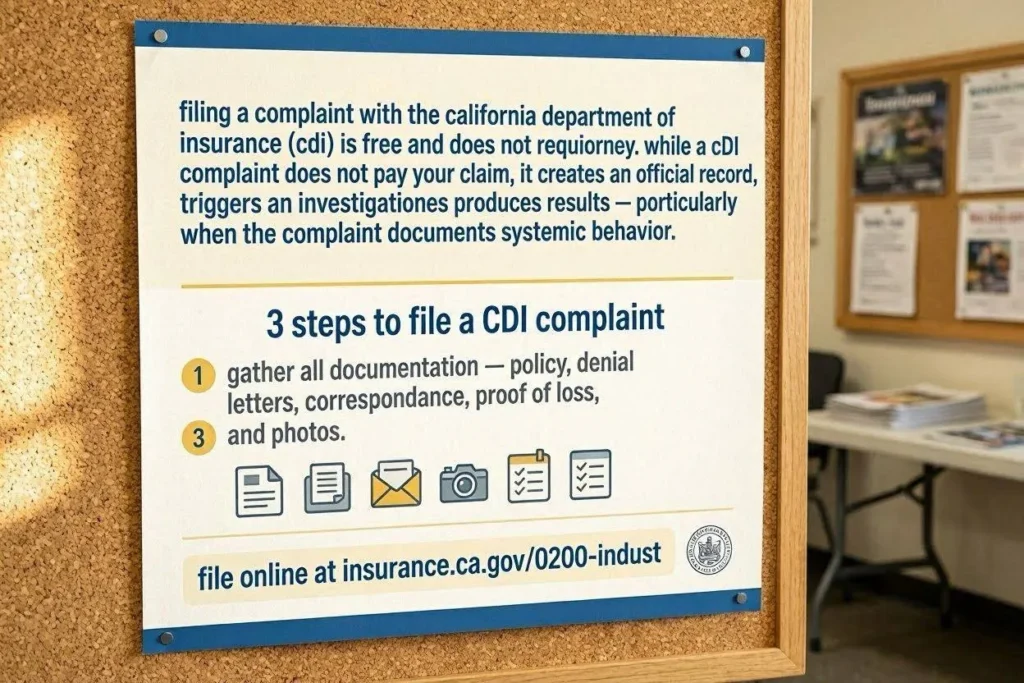
Filing a complaint with the California Department of Insurance (CDI) is free and does not require an attorney. While a CDI complaint does not pay your claim, it creates an official record, triggers an investigation, and sometimes produces results — particularly when the complaint documents systemic behavior.
3 Steps to File a CDI Complaint
- Gather all documentation — policy, denial letters, correspondence, proof of loss, and photos.
- File online at insurance.ca.gov/0200-industry/0100-companies/0300-insurers/complaint.cfm or call 1-800-927-4357.
- Request a written response from the CDI with their findings — keep this for your attorney.
CDI complaint alone rarely reverses a denial. For significant claims — any denial over $25,000, or any case involving punitive damages or bad faith — consult a Los Angeles bad faith insurance attorney before or alongside filing a CDI complaint. Statements made during the CDI process can affect your legal case.
How to Hire a Los Angeles Insurance Bad Faith Attorney
Contingency Fees — You Pay Nothing Unless You Win
Most Los Angeles bad faith insurance attorneys work on a contingency fee basis. You pay no upfront fees. The attorney takes a percentage — typically 33% to 40% — of the final recovery. If the case does not settle or win at trial, you owe nothing.
Contingency arrangements make bad faith representation accessible to policyholders who cannot afford litigation — and they align the attorney’s financial interest directly with your outcome.
5 Questions to Ask Before Hiring a Bad Faith Attorney
- How many insurance bad faith cases have you handled in California — specifically in Los Angeles courts?
- Have you tried bad faith cases to verdict, or do you settle all cases before trial?
- What is your assessment of punitive damages in my specific case?
- Who at your firm will handle my case day-to-day — the partner I meet or an associate?
- What is your contingency fee percentage, and are litigation costs deducted before or after your fee?
What to Bring to Your Free Consultation
- Your complete insurance policy — all pages including declarations, endorsements, and exclusions
- Every denial letter and written communication from the insurer
- Your proof of loss documentation — estimates, receipts, medical records, or other evidence of your loss
- Timeline of events — when you filed, when you received responses, how long the insurer took at each stage
- Any independent estimates or appraisals you obtained
Bad Faith Insurance Claim vs. Regular Coverage Dispute — Key Differences
| Factor | Coverage Dispute | Bad Faith Claim |
|---|---|---|
| Legal basis | Breach of contract | Contract + tort (independent bad faith cause of action) |
| Damages available | Policy benefits only | Policy benefits + consequential damages + emotional distress + attorney’s fees + punitive damages |
| Can exceed policy limits? | No | Yes — bad faith damages have no ceiling |
| Statute of limitations | 4 years (contract) | 2 years (tort) — runs concurrently |
| Burden of proof | Preponderance of evidence | Preponderance + clear and convincing for punitive damages |
| Who handles it | General litigator or insurance attorney | Specialist bad faith insurance attorney recommended |
6 Mistakes That Weaken a Bad Faith Insurance Claim in Los Angeles
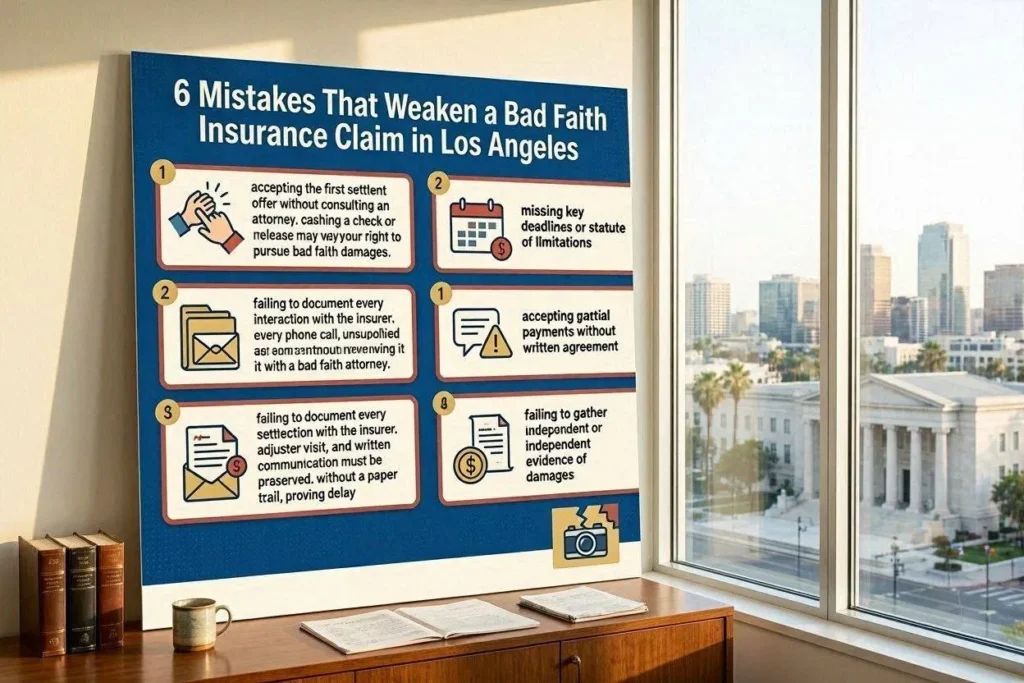
- Accepting the first settlement offer without consulting an attorney. Cashing a check or signing a release may waive your right to pursue bad faith damages. Never accept a final settlement without reviewing it with a bad faith attorney.
- Failing to document every interaction with the insurer. Every phone call, email, adjuster visit, and written communication must be preserved. Without a paper trail, proving delay and misconduct is significantly harder.
- Missing the 2-year tort statute of limitations. The 2-year deadline for bad faith tort claims runs from the date of misconduct — not the date you learn about your legal rights. Missing it permanently bars emotional distress and punitive damages.
- Giving a recorded statement without counsel. Insurers use recorded statements to find contradictions and minimize claims. You are not legally required to give a recorded statement to your own insurer in most circumstances.
- Repairing or discarding damaged property before the insurer inspects. Disposing of evidence — even in an emergency — can give the insurer grounds to dispute your claim value. Document everything with photos and video before any cleanup.
- Filing only a CDI complaint and waiting for results. A CDI complaint does not stop the statute of limitations from running. File your lawsuit or at minimum consult a bad faith attorney within the 2-year window regardless of CDI status.
Frequently Asked Questions
How Do I Know If My Insurance Claim Was Denied in Bad Faith?
Your claim was likely denied in bad faith if: the insurer denied without completing an investigation, the reason given does not match your policy language, the offer is dramatically below documented loss value, the insurer delayed for months without explanation, or the insurer shifted its denial reason multiple times. An attorney can evaluate these factors in a free consultation.
Can I Sue My Insurance Company in Los Angeles?
Yes. California law gives you the right to sue your insurer for breach of the covenant of good faith and fair dealing. You can file in Los Angeles Superior Court for state law claims. Federal court is an option when diversity jurisdiction applies. Most cases settle before trial — but having an attorney willing to litigate to verdict produces better settlement outcomes.
How Long Does a Bad Faith Insurance Lawsuit Take in Los Angeles?
Most bad faith cases in Los Angeles resolve in 12 to 36 months. Straightforward cases with strong evidence settle in under a year. Complex cases involving large punitive damage claims or class actions can take 3 to 5 years. USCIS processing times do not apply — Los Angeles Superior Court has its own case management schedule, and wait times for trial have increased since 2020.
Does Bad Faith Apply to Wildfire Claims After the 2025 LA Fires?
Yes — and it is one of the most active areas of bad faith litigation in California in 2026. Palisades, Eaton, and Hurst fire victims whose claims were denied, delayed, or underpaid have strong bad faith claims under California law. The CDI issued formal guidance criticizing blanket denial practices. The California FAIR Plan’s handling of smoke and soot damage claims has generated multiple lawsuits.
What Is the Difference Between a Bad Faith Claim and a Coverage Dispute?
A coverage dispute is a disagreement about whether your policy covers a specific loss. A bad faith claim is a separate tort based on the unreasonable way the insurer handled your claim. You can have both simultaneously. Even if a court ultimately rules the loss was not covered, the insurer can still be liable for bad faith if it conducted a deficient investigation or misrepresented policy terms.
Can I File a Bad Faith Claim If My Insurer Underpaid My Claim — Not Outright Denied It?
Yes. Underpayment is actionable bad faith. Offering $80,000 on a $300,000 claim without supporting documentation, using an in-house adjuster’s estimate that ignores actual rebuilding costs, or applying depreciation improperly all constitute bad faith. The insurer’s obligation is to make a prompt, fair, and equitable settlement — not just to avoid outright denial.
Is Hiring a Los Angeles Insurance Bad Faith Attorney Worth It?
Hiring a bad faith attorney is worth it in 4 specific situations that cover the vast majority of Los Angeles insurance disputes:
- Your claim was denied or underpaid and the insurer’s explanation does not match your policy language — an attorney can identify whether the denial was unreasonable and quantify the full damages you can recover.
- You suffered financial losses beyond the denied claim itself — rent costs, lost income, medical expenses out of pocket, or business losses caused by the insurer’s delay are recoverable consequential damages most policyholders leave on the table.
- The insurer’s conduct was egregious — cancellations based on false information, deliberate misrepresentation, or documented patterns of misconduct open the door to punitive damages that can dwarf the original claim value.
- Your loss exceeds $50,000 — at this level, the math of a contingency arrangement strongly favors legal representation even accounting for attorney’s fees.
California bad faith law was built to protect you from exactly this situation. You paid your premiums in good faith. The insurer’s obligation is to pay your legitimate claims — fully, promptly, and fairly. When it does not, the law does not limit you to the policy value. It gives you tort remedies, emotional distress damages, attorney’s fees, and punitive damages designed to make you whole and punish corporate misconduct.
The statute of limitations runs. Consult a Los Angeles insurance bad faith attorney before it does.

Amanda Brooks
Amanda Brooks leads legal, justice, and community advocacy content at JusticeInTown, drawing on a background in legal research and public policy. She specializes in civil rights, access to justice, and legal awareness, bringing a careful, research-driven approach to complex legal and public-interest topics. Her guides help readers better understand their rights, legal options, and the issues affecting their communities.
Related Posts