

How to File Bankruptcy in 2026 — Complete Step-by-Step Guide
To file bankruptcy, complete a credit counseling course, gather your financial documents, file your petition with the federal bankruptcy court, attend the 341 meeting of creditors, finish a debtor education course, and receive your discharge. Chapter 7 takes 4 to 6 months. Chapter 13 takes 3 to 5 years.
Chapter 7 and Chapter 13 are the 2 types individuals use. Chapter 7 eliminates most unsecured debt within months. Chapter 13 creates a 3 to 5-year repayment plan and lets you keep assets you would otherwise lose.
This guide covers every step — eligibility, documents, the means test, fees, and 8 mistakes that cause denials. Updated for 2026.
What Is Bankruptcy?
Bankruptcy is a federal legal process that eliminates or restructures debt when you cannot repay it. Filing immediately triggers the automatic stay — a court order that stops all collection actions, including wage garnishments, foreclosures, repossessions, lawsuits, and creditor calls.
Bankruptcy does not erase all debt. It discharges most unsecured debts and gives you a legal fresh start.
Debts Bankruptcy Can Eliminate
- Credit card balances
- Medical bills
- Personal loans and payday loans
- Utility arrears
- Most old court judgments
- Some income tax debts (if they meet strict IRS timing rules)
Debts Bankruptcy Cannot Eliminate
- Child support and alimony
- Most federal student loans (unless you prove undue hardship)
- Recent income tax debts (last 3 years)
- Debts from fraud or willful injury
- Criminal fines and restitution
- DUI-related liability
Chapter 7 vs Chapter 13 Bankruptcy — Which One to File
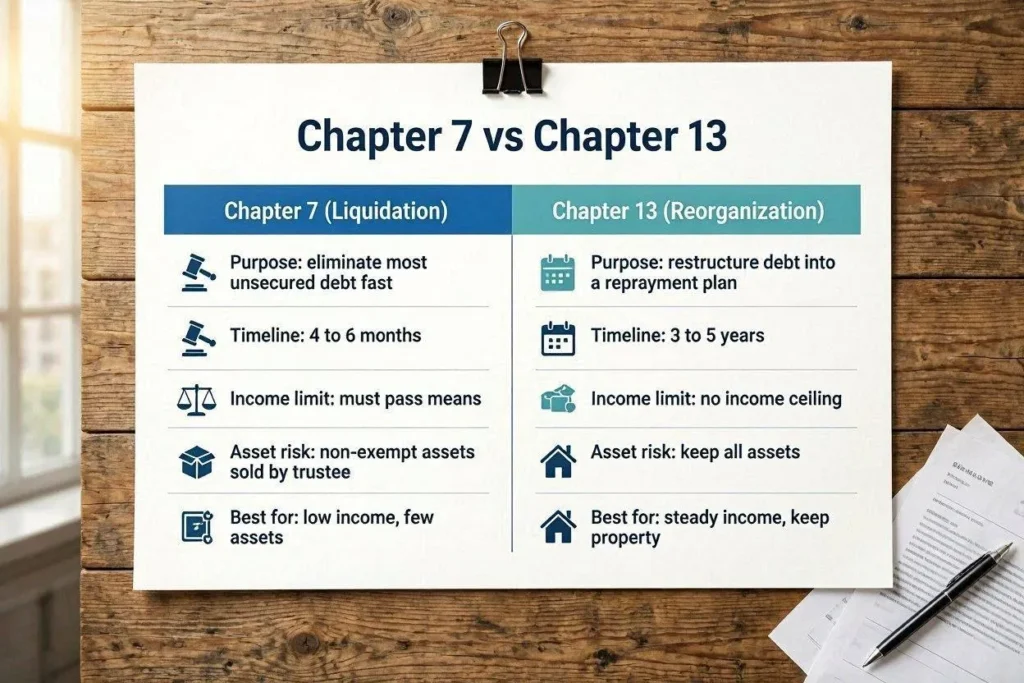
Chapter 7 and Chapter 13 cover 98% of individual bankruptcy filings. The right choice depends on your income, assets, and goals.
| Factor | Chapter 7 (Liquidation) | Chapter 13 (Reorganization) |
|---|---|---|
| Purpose | Eliminate most unsecured debt fast | Restructure debt into a repayment plan |
| Timeline | 4 to 6 months | 3 to 5 years |
| Income Limit | Must pass means test | No income ceiling |
| Asset Risk | Non-exempt assets sold by trustee | Keep all assets |
| Best For | Low income, few assets, urgent relief | High income, saving home, catching up arrears |
| Filing Fee | $338 | $313 |
| Credit Report | 10 years from filing | 7 years from filing |
| Re-filing Wait | 8 years for another Chapter 7 | 2 years for another Chapter 13 |
When to Choose Chapter 7
- Your income is below your state’s median household income
- Your debts are mostly unsecured — credit cards, medical, personal loans
- You have few non-exempt assets to protect
- You need fast relief from garnishments or collection calls
When to Choose Chapter 13
- Your income is too high to pass the Chapter 7 means test
- You are behind on mortgage payments and want to save your home
- You own non-exempt property you want to keep
- You owe back taxes or domestic support you can repay over 3 to 5 years
Bankruptcy Eligibility Requirements in 2026
Chapter 7 Eligibility — The Means Test
The bankruptcy means test determines if your income is low enough to qualify for Chapter 7. It compares your average monthly income over the past 6 months against the median household income for your state and family size.
3 outcomes exist on the means test:
- Your income falls below the state median — you automatically qualify for Chapter 7
- Your income exceeds the median but allowed expenses bring your disposable income below the threshold — you still qualify
- Your disposable income exceeds the threshold — you do not qualify for Chapter 7 and must consider Chapter 13
| State | Single-Person Median (Annual) | 4-Person Median (Annual) | Effective Date |
|---|---|---|---|
| California | $74,940 | $118,240 | April 1, 2026 |
| Texas | $66,837 | $98,400 | April 1, 2026 |
| Florida | $63,210 | $95,820 | April 1, 2026 |
| New York | $72,160 | $110,500 | April 1, 2026 |
| National Average | $65,400 | $100,200 | April 1, 2026 |
Additional Chapter 7 Eligibility Rules
- No Chapter 7 discharge in the past 8 years
- No Chapter 13 discharge in the past 6 years
- No prior case dismissed for fraud in the past 180 days
- Must complete credit counseling within 180 days before filing
Chapter 13 Eligibility
Chapter 13 has no income ceiling but does have a debt limit. As of 2026, your total unsecured debt must be below $2,750,000. Prior to April 2022, Chapter 13 had separate secured and unsecured limits — the current single combined limit applies to all cases filed after that date.
How to File Bankruptcy — 8 Steps
Step 1: Decide Which Chapter to File
Run the means test before anything else. If your income is below your state median, Chapter 7 is available. If you are above median or want to save a home or non-exempt property, calculate Chapter 13 feasibility.
You can file without an attorney — called pro se filing — in straightforward Chapter 7 cases. Chapter 13 is significantly more complex due to plan drafting, confirmation hearings, and multi-year case management. Most Chapter 13 filers hire a bankruptcy attorney.
Step 2: Complete Credit Counseling (Within 180 Days of Filing)
Credit counseling is mandatory before you file. Complete the course from an agency approved by the U.S. Trustee Program. The course explores whether bankruptcy — or another option like debt settlement or a debt management plan — is the right choice.
- Duration: 60 to 90 minutes
- Format: Online, by phone, or in person
- Cost: $10 to $50 (fee waiver available if income is below 150% of the federal poverty line)
- Certificate: Valid for 180 days — must be submitted with your bankruptcy petition
- Exception: Filers in Alabama and North Carolina use a separately approved provider list
Step 3: Gather Your Financial Documents
The bankruptcy petition requires a complete picture of your finances — income, assets, debts, and expenses. Missing or inaccurate documents are the top reason for delays and dismissals.
9 Documents You Need to File Bankruptcy
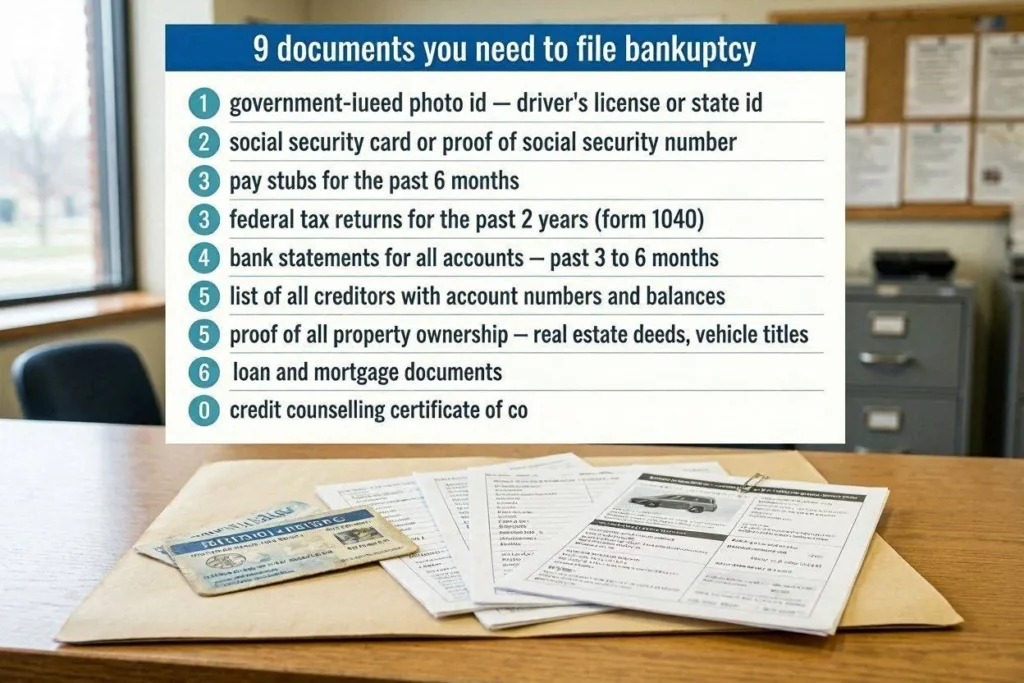
- Government-issued photo ID — driver’s license or state ID
- Social Security card or proof of Social Security number
- Pay stubs for the past 6 months
- Federal tax returns for the past 2 years (Form 1040)
- Bank statements for all accounts — past 3 to 6 months
- List of all creditors with account numbers and balances
- Proof of all property ownership — real estate deeds, vehicle titles
- Loan and mortgage documents
- Credit counseling certificate of completion
Step 4: Complete Bankruptcy Forms
Download current bankruptcy forms free at uscourts.gov. Always use the most current version — outdated forms are rejected. Most Chapter 7 and Chapter 13 cases require 20 or more forms totaling up to 70 pages.
Key Bankruptcy Forms
| Form | Purpose |
|---|---|
| Voluntary Petition (Form 101) | Officially starts your case; triggers automatic stay |
| Schedule A/B | Lists all property you own |
| Schedule C | Claims exemptions for property you keep |
| Schedule D | Lists secured creditors (mortgages, car loans) |
| Schedule E/F | Lists unsecured creditors (credit cards, medical bills) |
| Schedule I / Schedule J | Documents monthly income and expenses |
| Form 122A-1 (Chapter 7) | Means test — current monthly income |
| Form 122A-2 (Chapter 7) | Means test — disposable income calculation |
| Form 122C-1 (Chapter 13) | Current monthly income and commitment period |
| Statement of Financial Affairs | Discloses financial history for past 2 to 4 years |
Step 5: File the Petition with the Bankruptcy Court
File your petition with the federal bankruptcy court in your district. The U.S. has 94 bankruptcy districts. File in the district where you have lived for the greater portion of the past 180 days.
Chapter 7 and Chapter 13 Filing Fees (2026)
| Fee Component | Chapter 7 | Chapter 13 |
|---|---|---|
| Case filing fee | $245 | $235 |
| Administrative fee | $78 | $78 |
| Trustee surcharge | $15 | $0 |
| Total filing fee | $338 | $313 |
| Fee waiver (Form IFP) | Available | Available |
| Installment payment | Up to 4 installments | Up to 4 installments |
Step 6: Attend the 341 Meeting of Creditors
The 341 meeting is a short hearing — typically 5 to 15 minutes — where the bankruptcy trustee asks you questions under oath. It takes place 20 to 45 days after filing. In 2026, most 341 hearings are held by video conference or phone.
What the Trustee Asks at the 341 Meeting
- Confirm your name, address, and Social Security number
- Verify you reviewed and signed the petition
- Ask about your assets, income, and recent financial transactions
- Question any recent property transfers or large payments to creditors
What to Bring to the 341 Meeting
- Government-issued photo ID
- Social Security card
- Copies of your filed bankruptcy petition
- Any additional documents the trustee requested
Creditors can attend and ask questions, but rarely do in consumer cases. The trustee is not a judge — the judge in your case will never attend the 341 meeting.
Step 7: Complete the Debtor Education Course
The debtor education course — also called the financial management course — is required after filing. You must file the certificate of completion before the court grants your discharge.
- Duration: 2 hours
- Cost: $10 to $50 (fee waiver available)
- Deadline: Before discharge — in Chapter 7, within 60 days of the 341 meeting
- Content: Budgeting, avoiding future debt, smart use of credit
Step 8: Receive Your Discharge
The discharge order legally eliminates eligible debts. Creditors can never attempt to collect a discharged debt. The court issues the discharge automatically in Chapter 7 if no creditor objects within 60 days of the 341 meeting.
| Chapter | When Discharge Is Issued | What Gets Discharged |
|---|---|---|
| Chapter 7 | 60 to 90 days after 341 meeting | Most unsecured debts — credit cards, medical bills, personal loans |
| Chapter 13 | After completing 3 to 5-year repayment plan | Remaining eligible unsecured debts after plan payments |
Bankruptcy Exemptions — What Property You Keep
Exemptions protect specific property from being sold by the trustee. In most Chapter 7 consumer cases, filers keep everything they own because all their property falls within exemption limits.
Exemptions vary by state. Some states let you choose between state exemptions and federal exemptions — always compare both to maximize what you protect.
| Exemption Type | Federal Amount (2026) | What It Protects |
|---|---|---|
| Homestead | $27,900 | Equity in your primary home |
| Motor Vehicle | $4,450 | Equity in one vehicle |
| Household Goods | $700 per item / $14,875 total | Furniture, appliances, electronics |
| Wildcard | $1,475 + unused homestead up to $13,950 | Any property of your choice |
| Retirement Accounts | Unlimited (401k, IRA, pension) | ERISA-qualified retirement savings |
| Tools of Trade | $2,800 | Tools and equipment for your job or business |
| Life Insurance | $14,875 cash value | Whole life insurance cash value |
Bankruptcy Timeline — From Filing to Discharge
| Stage | Chapter 7 Timeline | Chapter 13 Timeline |
|---|---|---|
| Credit counseling | Before filing (up to 180 days) | Before filing (up to 180 days) |
| File petition | Day 1 | Day 1 |
| Automatic stay begins | Day 1 — immediately | Day 1 — immediately |
| 341 meeting of creditors | 30 to 45 days after filing | 30 to 45 days after filing |
| Trustee asset review | 60 to 90 days after filing | Ongoing during plan |
| Plan confirmation | Not applicable | 2 to 4 months after filing |
| Debtor education course | Before discharge deadline | Before final payment |
| Discharge issued | 4 to 6 months from filing | 3 to 5 years from filing |
How Much Does It Cost to File Bankruptcy?
| Cost Category | Chapter 7 | Chapter 13 |
|---|---|---|
| Court filing fee | $338 | $313 |
| Credit counseling course | $10–$50 | $10–$50 |
| Debtor education course | $10–$50 | $10–$50 |
| Attorney fees (average) | $1,000–$3,500 | $2,500–$6,000 |
| Total without attorney | $358–$438 | $333–$413 |
| Total with attorney | $1,358–$3,938 | $2,833–$6,413 |
Attorney fees vary by state and case complexity. California, New York, and Florida tend to have higher attorney fees. Rural markets average lower. If you cannot afford an attorney, legal aid organizations provide free representation to qualifying low-income filers.
8 Mistakes That Cause Bankruptcy Denials and Delays
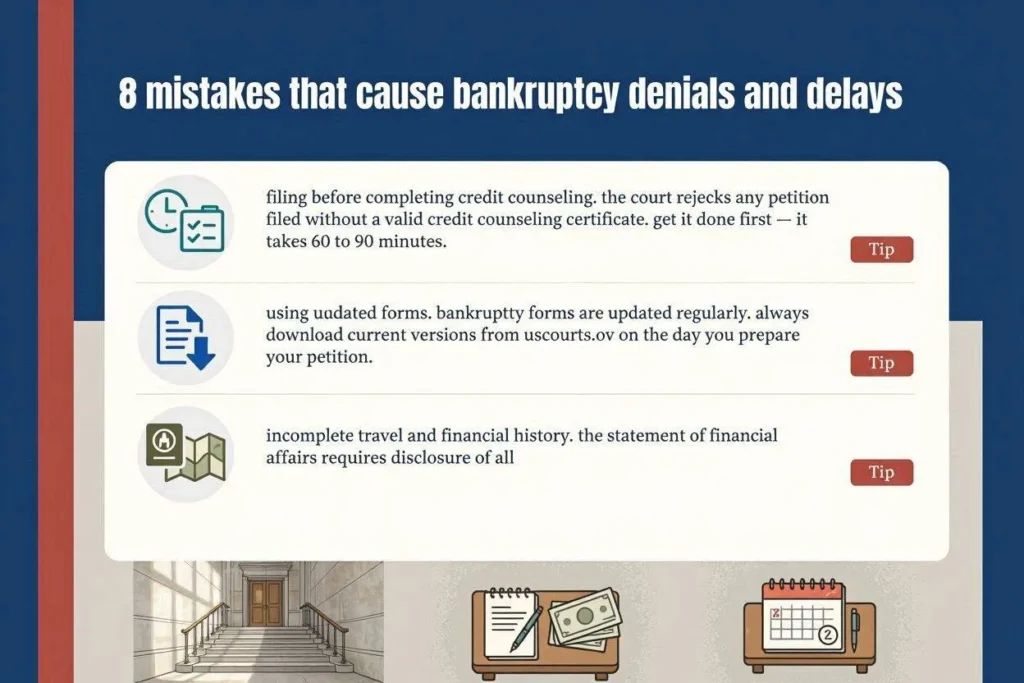
- Filing before completing credit counseling. The court rejects any petition filed without a valid credit counseling certificate. Get it done first — it takes 60 to 90 minutes.
- Using outdated forms. Bankruptcy forms are updated regularly. Always download current versions from uscourts.gov on the day you prepare your petition.
- Incomplete travel and financial history. The Statement of Financial Affairs requires disclosure of all income, property transfers, and payments to creditors in the past 2 to 4 years. Missing items are treated as concealment.
- Hiding assets or recent transfers. Transferring property to family or friends before filing is a red flag the trustee investigates. Transfers within 2 years of filing can be reversed.
- Failing to disclose all creditors. Every creditor must appear on Schedule E/F. Omitting a creditor means that debt may survive the bankruptcy.
- Using credit cards before filing. Luxury purchases over $800 or cash advances over $1,100 within 90 days of filing create a legal presumption of fraud. Those specific debts become nondischargeable.
- Missing the 341 meeting. Failure to appear causes the trustee to request dismissal of your case. Rescheduling adds weeks to your timeline.
- Not filing the debtor education certificate. Courts deny discharge if you miss this filing deadline. Set a reminder immediately after your 341 meeting.
Frequently Asked Questions
Can I File Bankruptcy Without a Lawyer?
Yes. Filing without an attorney is called pro se filing. Thousands of people file Chapter 7 successfully each year without legal representation. Chapter 13 is significantly harder to file pro se — the plan must be drafted correctly and confirmed by the court, which requires knowledge of bankruptcy law. Legal aid organizations offer free help to qualifying filers.
How Long Does Bankruptcy Stay on My Credit Report?
Chapter 7 stays on your credit report for 10 years. Chapter 13 stays for 7 years. Both are counted from the filing date, not the discharge date. Most filers begin rebuilding credit within 1 to 2 years of discharge and qualify for a mortgage within 2 to 4 years after Chapter 7.
Can I File Bankruptcy If I Have a Job?
Yes. Employment does not disqualify you from bankruptcy. Chapter 7 eligibility is based on the means test — if your income falls below your state’s median household income for your family size, you qualify regardless of employment status.
Will Bankruptcy Stop Wage Garnishment?
Yes — immediately. The automatic stay halts all wage garnishments the moment you file. Your employer must stop the garnishment on the day the court issues the stay. Future garnishments by the same creditor are permanently stopped after discharge.
Can I Keep My Car in Bankruptcy?
Yes, in most cases. If your car equity falls within your state’s vehicle exemption limit, the trustee cannot sell it. If you owe money on the car, you can sign a reaffirmation agreement to keep making payments and retain the vehicle after discharge.
Does Bankruptcy Discharge Student Loans?
Generally no — but it has become easier in 2026. Federal student loans require an adversary proceeding to prove ‘undue hardship.’ The DOJ and Department of Education issued revised guidance in 2025 making discharge more accessible. Through early 2025, roughly 98% of cases where the government took a position resulted in full or partial discharge. A tax professional must be consulted in 2026 — the American Rescue Plan’s student loan tax exemption expired December 31, 2025.
Conclusion
Bankruptcy is not a moral failure. It is a legal tool built into federal law for exactly these situations. Chapter 7 filings rose 17% in Q1 2026 — millions of people with jobs, families, and assets use it each year to reset and rebuild.
If you qualify under Chapter 7, the 4 to 6-month process that eliminates years of debt is the most direct financial reset available. If Chapter 13 fits better, the structured repayment plan with automatic stay protection gives you control over debt you can actually manage.

Amanda Brooks
Amanda Brooks leads legal, justice, and community advocacy content at JusticeInTown, drawing on a background in legal research and public policy. She specializes in civil rights, access to justice, and legal awareness, bringing a careful, research-driven approach to complex legal and public-interest topics. Her guides help readers better understand their rights, legal options, and the issues affecting their communities.
Related Posts