
How to Contest a Will in the USA: 8-Step Legal Guide (2026)
To contest a will, file a petition in the probate court that handles the deceased person’s estate — before your state’s deadline expires. Deadlines range from 30 days in some states to 2 years in others. Miss the window and the court closes your case permanently, regardless of how strong your evidence is.
This guide covers 8 steps, 6 valid legal grounds, state-by-state deadlines, realistic costs, and success rates — so you can decide whether to proceed before spending a dollar.
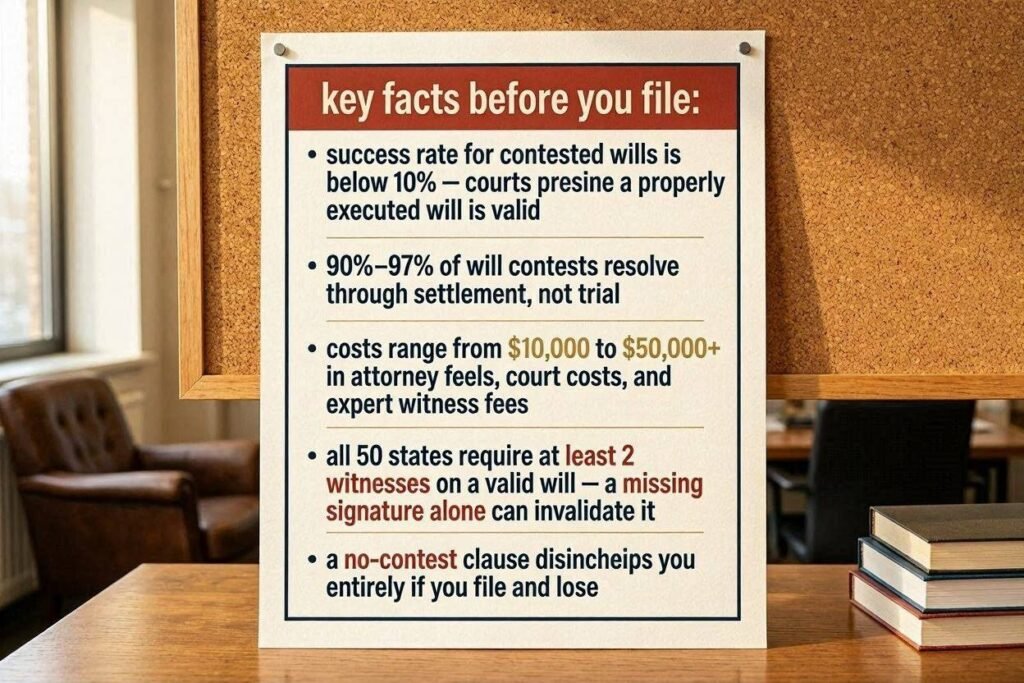
| Key facts before you file:
• Success rate for contested wills is below 10% — courts presume a properly executed will is valid • 90%–97% of will contests resolve through settlement, not trial • Costs range from $10,000 to $50,000+ in attorney fees, court costs, and expert witness fees • All 50 states require at least 2 witnesses on a valid will — a missing signature alone can invalidate it • A no-contest clause disinherits you entirely if you file and lose |
What Is Contesting a Will?
Contesting a will is a formal legal challenge to the validity of a deceased person’s last will and testament (LWT), filed in probate court. A successful contest results in 1 of 3 outcomes: the entire will is invalidated, specific provisions are struck, or the estate is redistributed under a prior valid will or state intestacy laws.
Contesting a will is not the same as disputing how an executor manages the estate. If your concern is executor misconduct — mismanagement, theft, or breach of fiduciary duty — file an objection during probate administration instead of a will contest petition.
Who Can Contest a Will? Legal Standing Explained
Only people with legal standing can contest a will. Standing means you have a direct financial interest that changes depending on whether the will is upheld or thrown out. Courts reject petitions from people without standing before hearing any evidence.
4 groups that typically have standing:
- Heirs-at-law — surviving spouse, children, grandchildren, parents, or siblings who would inherit under state intestacy laws if no valid will existed
- Named beneficiaries in the current will who believe the distribution is fraudulent or coerced
- Beneficiaries named in a prior will who were removed or reduced in the newer will
- Estate creditors in limited circumstances defined by state law
| No standing = no case:
Being upset about asset distribution is not standing. A neighbor, friend, caretaker, or distant relative who would not inherit under intestacy laws cannot contest the will — regardless of how unfair the distribution appears. |
6 Valid Legal Grounds for Contesting a Will
You cannot contest a will because you dislike it. The law requires 1 specific legal defect that existed at the time the will was created or signed. The 6 recognized grounds in US probate courts are:
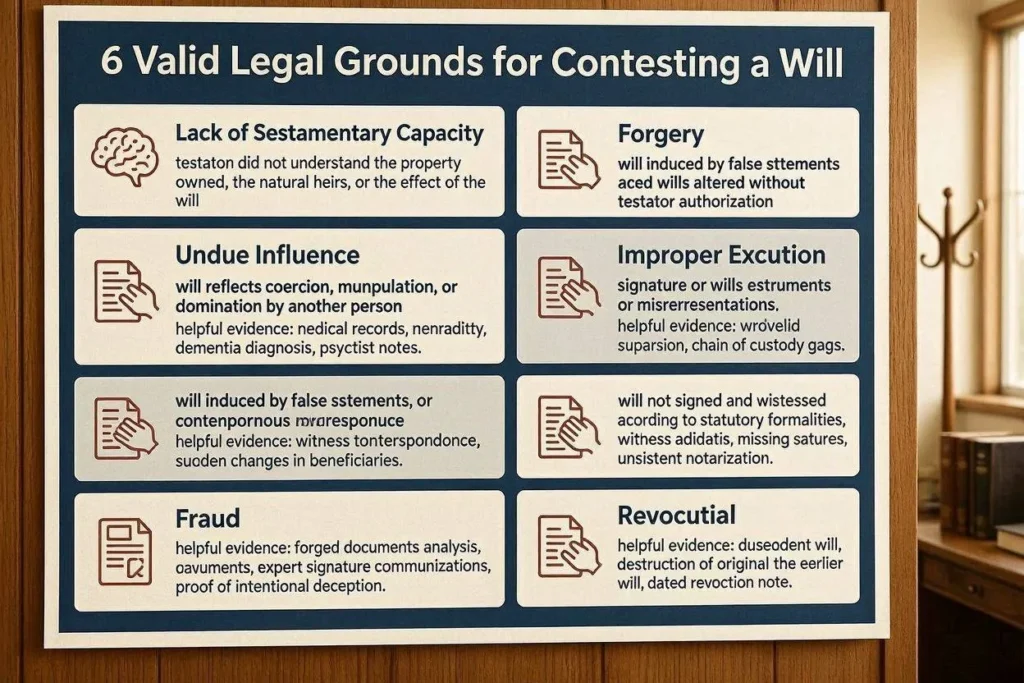
| Ground | What You Must Prove | Evidence That Helps |
|---|---|---|
| 1. Lack of Testamentary Capacity | Testator did not understand: (a) the property owned, (b) who the heirs were, (c) what the will would do | Medical records, dementia diagnosis, psychiatrist testimony |
| 2. Undue Influence | A person exploited a confidential relationship to pressure the testator into changing the will | Caretaker had sole access, sudden large inheritance, prior wills were different |
| 3. Fraud | Testator was tricked into signing a document misrepresented as something else, or a false will was substituted | Handwriting expert, document metadata, witness statements |
| 4. Improper Execution | Will was not signed/witnessed per state law — missing 1 of 2 required witness signatures, witness was a beneficiary, or will was not signed at all | Copy of the will, witness interview records |
| 5. Forgery | The testator’s signature was forged on the will | Forensic handwriting expert comparing known signatures to the will |
| 6. Revocation | Testator created a later will that replaced this one, or physically destroyed the original | Later will, letters referencing intent to revoke, attorney records |
How to Contest a Will: 8 Steps
Step 1 — Confirm You Have Legal Standing
Verify your standing before spending a dollar on legal fees. Ask: ‘Would I inherit more — or anything at all — if this will were thrown out?’ If the answer is no, you do not have standing.
Standing applies if you fall into 1 of these 3 categories:
- You would inherit under state intestacy laws if no will existed
- You were named in a prior version of the will that was replaced
- You are a named beneficiary and believe fraud or coercion altered the distribution
Step 2 — Obtain a Copy of the Will
Request a certified copy of the will from the probate court in the county where the testator died. Once the will is submitted for probate, it becomes a public document. Any person can request a copy.
If the executor refuses to share the will before probate, contact the county probate court clerk directly. Courts have authority to compel custodians to deliver the will — including arresting a non-compliant custodian until the document is produced.
Step 3 — Identify Your Legal Ground
Match your situation to 1 of the 6 recognized grounds before filing anything. Disapproval of asset distribution is not a ground. Courts dismiss petitions that cite unfairness without a specific legal defect.
3 questions that identify your ground:
- Was the testator mentally competent when the will was signed? → Testamentary capacity
- Did someone have exclusive access and an unexpectedly large inheritance? → Undue influence
- Did the will skip required signatures or witness requirements? → Improper execution
Step 4 — Hire a Probate Litigation Attorney
Hire a probate litigation attorney — not a general estate planning attorney — before filing any petition. Probate litigation is a specialized field. An estate planning attorney who drafts wills is not the same as an attorney who litigates will contests in court.
Will contests cost $10,000 to $50,000 at minimum. Simple cases with clear evidence of improper execution resolve faster. Cases involving undue influence or testamentary capacity — which require medical experts and depositions — cost the most and take the longest.
Most probate litigation attorneys charge hourly ($250–$500/hour). Some take contingency arrangements on high-value estates. Confirm the fee structure before signing a retainer.
Step 5 — Gather Evidence
Evidence is the single most important factor in a will contest. Courts presume a properly executed will is valid. The petitioner must overcome that presumption with documented, admissible proof.
6 types of evidence that strengthen a will contest:
- Medical records — dementia diagnosis, psychiatric evaluations, medication logs showing cognitive impairment at the time of signing
- Prior versions of the will — compare changes between versions to identify suspicious alterations
- Witness testimony — family members, physicians, or caregivers who observed the testator’s mental state
- Financial records — sudden large transfers to a beneficiary immediately before the will was signed
- Communications — texts, emails, or letters showing pressure, manipulation, or fraud
- Forensic handwriting analysis — required for forgery claims; a court-qualified expert compares known signatures
Step 6 — File the Petition in Probate Court
File a will contest petition in the probate court of the county where the testator died — before your state’s deadline. The petition must include 3 specific elements:
- Your relationship to the deceased and proof of legal standing
- The specific legal ground for the challenge
- The outcome you are seeking — invalidate the entire will, strike specific provisions, or reinstate a prior will
After filing, all interested parties — including beneficiaries named in the will, heirs-at-law, and the executor — must be formally served notice of the contest.
Step 7 — Complete Discovery
Discovery runs 6 to 18 months and gives both sides access to all evidence, documents, and witness statements before trial. Discovery in will contests includes 3 key processes:
- Interrogatories — written questions both sides answer under oath
- Depositions — recorded interviews with witnesses, medical experts, and the drafting attorney who prepared the will
- Document requests — medical records, financial records, prior will drafts, and attorney correspondence
The drafting attorney’s testimony is particularly powerful. Courts place significant weight on what the attorney observed about the testator’s mental state and whether the testator was alone during the signing.
Step 8 — Negotiate Settlement or Proceed to Trial
90%–97% of will contests settle before trial through private negotiation. Settlement means the beneficiaries redistribute assets by agreement — without the court invalidating the will. Settlements are confidential, faster, and less expensive than trial.
If settlement fails, the case goes to trial before a judge and, in some states, a jury. The trial follows the same structure as civil litigation: opening statements, plaintiff evidence, defense evidence, closing arguments, and verdict.
A successful trial verdict results in the court declaring the will invalid in full or in part. Assets then pass under a prior valid will or state intestacy laws. Either side may appeal based on procedural errors or incorrect application of law.
Will Contest Deadlines by State — 2026
Missing the filing deadline ends your case permanently. Deadlines vary from 30 days in some jurisdictions to 2 years in others. The clock typically starts when the will is admitted to probate — not when the testator died.
| State | Filing Deadline | Clock Starts From | Key Notes |
|---|---|---|---|
| California | 120 days | Date will is admitted to probate | One of the shortest windows in the USA — act immediately |
| New York | 2 years | Date will is admitted to probate | Undue influence: 6 years from date of death; Surrogate’s Court handles all contests |
| Florida | 3 months (solemn form) / 2 years | Service of notice / death of testator | Shorter window applies after formal notice is served |
| Texas | 2 years | Date will is admitted to probate | After 2 years, the will is treated as fully valid and binding |
| Illinois | 6 months | Date will is admitted to probate | Very short window — consult an attorney within days of probate filing |
| Pennsylvania | 1 year | Date of probate notice | Appeal of probate order must be filed within 1 year |
| Georgia | 4 years | Date of testator’s death | One of the more generous windows; still act promptly |
| North Carolina | No fixed deadline* | Caveat filed in Clerk’s court | *Must file before estate is fully distributed; earlier is always safer |
| Washington | 4 months | Date will is filed with court | Short window; file within weeks of learning of the will |
| Colorado | 3 years | Date of testator’s death | Discovery rule may apply in fraud cases |
Minor and fraud exceptions:
Most states toll (pause) the deadline for minors until they reach age 18. Fraud and forgery claims often carry extended deadlines under the discovery rule — the clock starts when you discovered (or should have discovered) the fraud, not when the will was probated. Confirm both exceptions with a local probate attorney.
Costs and Success Rates — What to Expect
Will contests are expensive and difficult to win. Courts presume a properly executed will reflects the testator’s true intentions. Overcoming that presumption requires documented, expert-supported evidence.
| Factor | Realistic Figures |
|---|---|
| Attorney fees | $250–$500/hour; total $10,000–$50,000+ for a contested case |
| Expert witness fees | $3,000–$10,000 per expert (medical, forensic handwriting, estate) |
| Court filing fees | $200–$500 depending on state and county |
| Discovery costs | $5,000–$20,000 for depositions, document production, and transcripts |
| Overall success rate | Below 10% — most cases settle or are dismissed |
| Settlement rate | 90%–97% of will contests resolve outside of court |
| Timeline | 6 months to 4 years depending on complexity and state court backlog |
Weigh estate size against total litigation cost before filing. A will contest that costs $40,000 to litigate is not worth pursuing if the contested inheritance is worth $60,000. A probate attorney gives a realistic assessment of costs and odds during an initial consultation — most offer the first consultation free.
No-Contest Clauses — The Risk Before You File
A no-contest clause (NCC) — also called an in terrorem clause — disinherits any beneficiary who contests the will and loses. If the will leaves you $50,000 and you contest it seeking more, losing the contest means you receive nothing.
No-contest clauses are enforceable in most US states. 3 states do not enforce them: Florida, Indiana, and Iowa. In California, NCCs are unenforceable if you had probable cause to file the contest.
Check for an NCC before filing. The clause is usually located near the end of the will document. Present the clause to your attorney and confirm whether your state enforces it and whether an exception applies to your situation.
Mediation vs. Litigation — Which Path Is Right?

Mediation costs 60%–80% less than full litigation and resolves disputes in weeks rather than years. A neutral mediator facilitates negotiation between the contesting party and the beneficiaries. Any agreement reached in mediation is binding and confidential.
Choose mediation over litigation when:
- The estate is modest and litigation costs would consume the disputed inheritance
- Preserving family relationships matters more than maximizing the financial outcome
- Evidence is solid but not overwhelming — mediation avoids the risk of a court dismissal
- The other beneficiaries are willing to negotiate rather than defend the will at trial
Choose litigation when:
- Fraud or forgery is clear and well-documented — courts take these seriously
- The estate is large enough that litigation costs represent a small percentage of the disputed amount
- The other parties refuse to negotiate and a strong precedent needs to be established
Frequently Asked Questions
Can you contest a will after it has been probated?
Yes, but it is harder and more expensive. Once a will is admitted to probate, contesting it requires filing a petition to revoke the probate admission. This adds a procedural layer that increases attorney fees and court time. File before probate admission whenever possible — contact the probate court and file a written objection the moment you learn a will is being submitted.
How long does contesting a will take?
Contesting a will takes 6 months to 4 years depending on the ground, the evidence, and whether the case settles or goes to trial. Improper execution claims — which turn on verifiable facts like missing signatures — resolve faster. Undue influence and testamentary capacity claims require medical experts, depositions, and lengthy discovery, which adds 1 to 3 years to the timeline.
Can you contest a will without a lawyer?
Yes, but you should not. Probate courts follow strict procedural rules. Petitions that miss required elements, cite the wrong legal ground, or are filed in the wrong court are dismissed. Expert witnesses — required for capacity and undue influence claims — must meet court qualification standards that laypeople cannot navigate alone. Hire a probate litigation attorney from day one.
What happens to the estate while a will contest is pending?
The estate is frozen during an active will contest. The executor cannot distribute assets to beneficiaries while the contest is unresolved. This means beneficiaries named in the will do not receive their inheritance until the court rules. Estates that hold businesses, rental properties, or investments can lose significant value during a prolonged contest — a real cost both sides should weigh before choosing litigation over settlement.
Does contesting a will affect your inheritance?
Yes — in 2 ways. First, if the will contains a no-contest clause and you lose, you forfeit any inheritance you were already entitled to receive. Second, your legal costs come out of pocket. Even a successful contest that increases your inheritance by $100,000 may yield little net gain after $50,000 in attorney fees. Calculate the net outcome before filing.
Conclusion
Contesting a will has 3 non-negotiable requirements: legal standing, a valid legal ground, and a filed petition before the state deadline. Missing any 1 of these 3 ends the case before it starts.
Success rates below 10% do not mean strong cases fail — they mean most filings lack documented evidence or a clearly provable ground. The strongest contests involve missing witness signatures (verifiable fact), fraud with a handwriting expert’s report, or testamentary capacity with a dementia diagnosis dated before the will was signed.
Mediation resolves 90%–97% of disputes without trial. If the other parties are willing to negotiate, a settlement preserves relationships, reduces costs, and delivers faster results than a 3-year court battle.
Consult a probate litigation attorney this week — not next month. State deadlines start running the moment the will enters probate, and some close in as few as 30 days.

Amanda Brooks
Amanda Brooks leads legal, justice, and community advocacy content at JusticeInTown, drawing on a background in legal research and public policy. She specializes in civil rights, access to justice, and legal awareness, bringing a careful, research-driven approach to complex legal and public-interest topics. Her guides help readers better understand their rights, legal options, and the issues affecting their communities.
Related Posts