Estate Probate Process in the United States: Complete 2026 Step-by-Step Guide
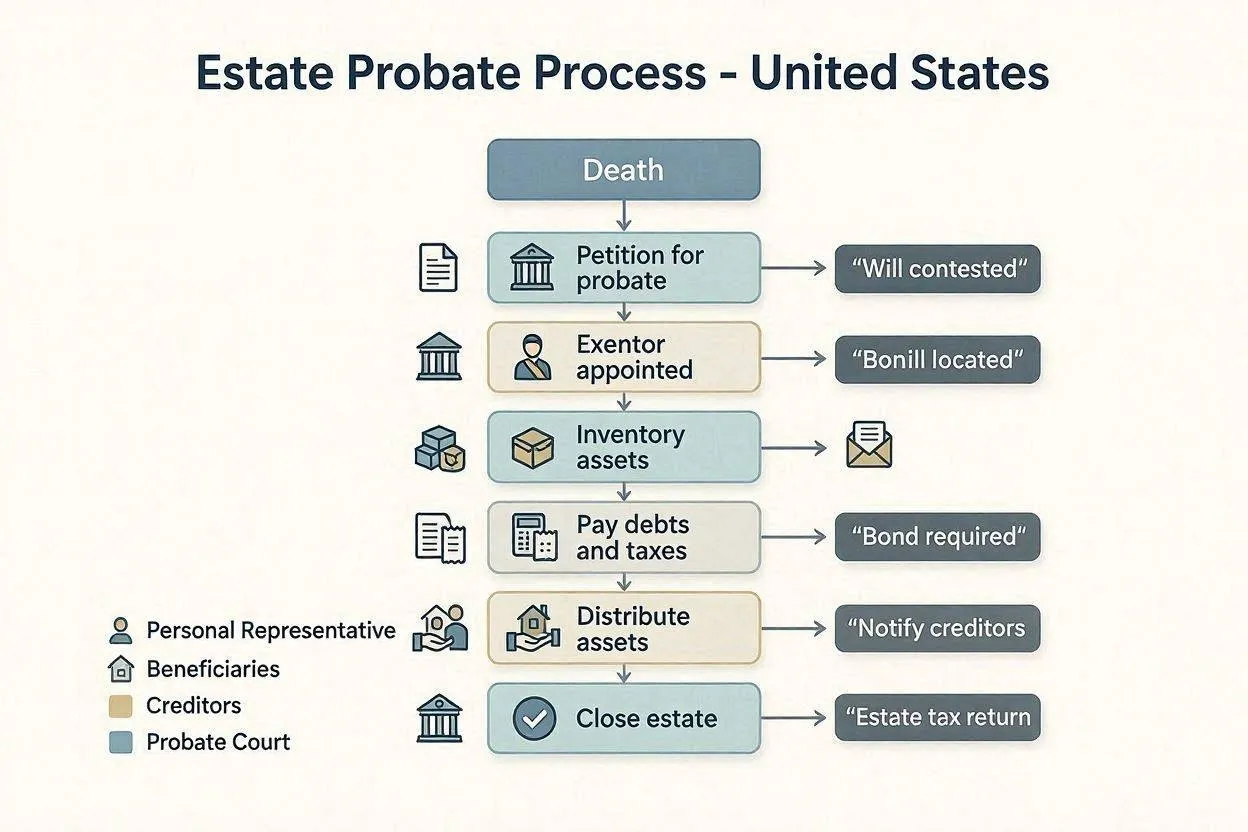
Probate is the court-supervised legal process that validates a deceased person’s will, appoints an executor, pays outstanding debts and taxes, and distributes remaining assets to heirs and beneficiaries. The process takes 6 to 24 months depending on estate size, state law, and whether any disputes arise. It typically costs 3% to 7% of the gross estate value in attorney fees, executor compensation, and court costs.
Most estates in the United States go through some form of probate. Whether you’re an executor facing the process for the first time, a beneficiary waiting on an inheritance, or someone planning their estate to minimize court involvement for their family — understanding how probate works is essential.
This guide covers every stage of the US probate process: what triggers probate, the 9 core steps from petition to final distribution, executor duties, costs by state, timelines, what happens without a will, and 5 proven strategies to avoid probate entirely.
What Is Probate?
Probate is the legal mechanism through which a deceased person’s estate is settled under court supervision. The probate court verifies the authenticity of the will (or applies state intestacy law when no will exists), authorizes an executor or administrator to manage the estate, ensures creditors are paid, and oversees the transfer of remaining assets to the rightful recipients.
68% of American adults have no basic estate plan, according to a 2023 Caring.com survey. Most of those estates will go through probate — often taking longer and costing more than necessary.
2026 Note: Digital assets — cryptocurrency, online financial accounts, digital media libraries, and intellectual property stored online — are now treated as probate assets in 46 states under the Revised Uniform Fiduciary Access to Digital Assets Act (RUFADAA). Executors have legal authority to access and manage digital assets in these states, but only if the deceased granted access through their estate plan or an online tool.
Probate Assets vs. Non-Probate Assets
Not all property goes through probate. Understanding the difference between probate and non-probate assets determines whether probate is necessary at all — and how much of an estate it covers.
| Asset Type | Goes Through Probate? | How It Transfers |
|---|---|---|
| Solely-owned real estate | Yes | Through probate court order and deed transfer |
| Bank accounts (no beneficiary) | Yes | Through probate court order |
| Investment accounts (no beneficiary) | Yes | Through probate court order |
| Personal property (vehicles, jewelry, furniture) | Yes | Through probate inventory and distribution |
| Life insurance (named beneficiary) | No | Directly to named beneficiary |
| Retirement accounts — 401(k), IRA (named beneficiary) | No | Directly to named beneficiary |
| Payable-on-death (POD) bank accounts | No | Directly to named beneficiary |
| Transfer-on-death (TOD) brokerage accounts | No | Directly to named beneficiary |
| Joint tenancy with right of survivorship | No | Automatically to surviving joint owner |
| Assets held in a living trust | No | Per trust terms without court involvement |
3 Types of Probate in the United States
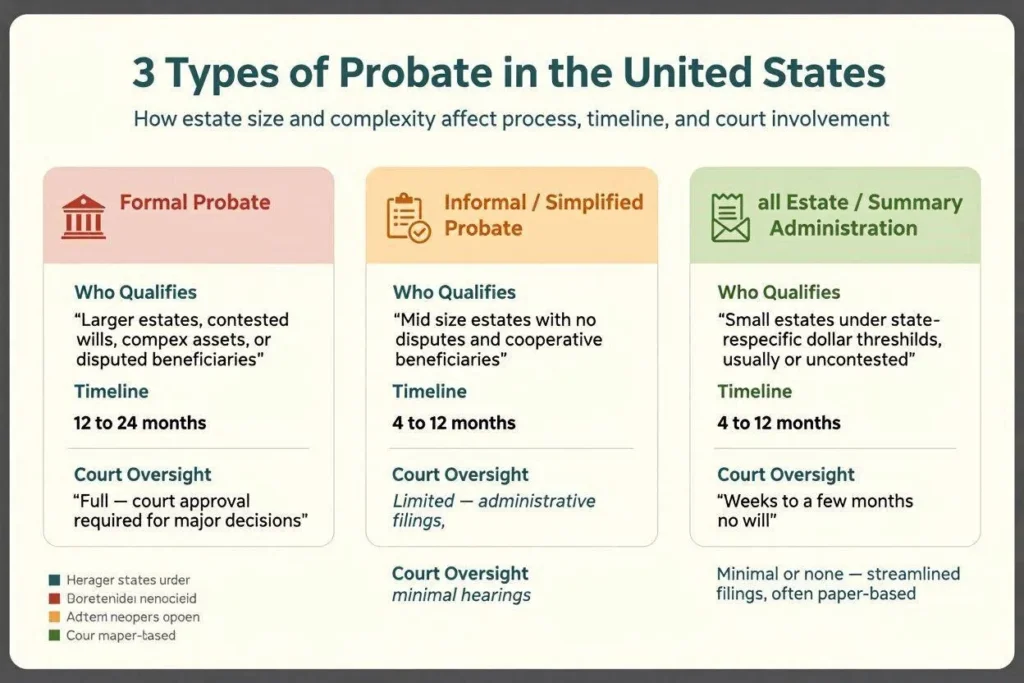
States offer 3 distinct probate processes based on estate size and complexity. The type that applies determines your timeline, cost, and level of court involvement.
| Type | Who Qualifies | Timeline | Court Oversight |
|---|---|---|---|
| Formal Probate | Larger estates, contested wills, complex assets, or disputed beneficiaries | 12 to 24 months | Full — court approval required for major decisions |
| Informal / Simplified Probate | Mid-size estates with no disputes and cooperative heirs | 6 to 12 months | Minimal — periodic reports filed, no hearing required for most actions |
| Small Estate / Affidavit Procedure | Estates below state-specific dollar threshold | 4 to 12 weeks | None — assets transferred via sworn affidavit |
The Probate Process: 9 Steps From Filing to Final Distribution
Step 1: Locate the Will and Death Certificates
The probate process cannot begin without the original will and certified death certificates. Order at least 10 certified copies of the death certificate — banks, the IRS, real estate title companies, the DMV, and financial institutions each require an original certified copy, not a photocopy.
If no will exists, the estate is intestate and state law determines who inherits. The process still requires probate court involvement — it just follows the intestacy statute rather than the deceased’s written instructions.
Documents to Gather Before Filing
- Original will and any codicils (amendments)
- Certified death certificates — order 10 or more copies
- List of all known assets with approximate values
- List of all known debts, creditors, and financial obligations
- Names and addresses of all beneficiaries named in the will
- Names and addresses of all legal heirs under state law
Step 2: File the Petition with Probate Court
File the petition for probate in the county where the deceased lived at the time of death. If the deceased owned real estate in multiple states, ancillary probate is required in each state where property is located — meaning separate filings, separate attorneys, and separate fees in each state.
The petition typically includes the original will (if one exists), the death certificate, a list of heirs and beneficiaries, and a preliminary inventory of estate assets. Court filing fees range from $50 to $1,200 depending on the state and estate value.
Step 3: Will Validation and Court Appointment
The probate court reviews the will to confirm it meets the state’s legal requirements — proper signatures, witness attestations, and compliance with state formalities. A self-proving will (notarized with a specific affidavit at signing) often skips the witness testimony requirement and accelerates validation.
Once validated, the court issues Letters Testamentary (with a will) or Letters of Administration (without a will). These documents are the executor’s legal authority to act on behalf of the estate — open estate bank accounts, access financial records, sell property, and make distributions.
Step 4: Notify Creditors and Beneficiaries
Notifying creditors is legally required in every state and starts the creditor claim period — typically 3 to 6 months. During this window, creditors file claims against the estate for payment. After the window closes, late-filed claims are generally barred.
3 Required Notification Actions
- Publish a Notice to Creditors in a local newspaper for the period required by state law — typically 4 to 8 consecutive weeks
- Send direct written notice to all known creditors via certified mail with return receipt
- Notify all named beneficiaries and legal heirs in writing that probate has been opened
The creditor notification period is the single longest phase in most probates. The estate cannot close — and assets cannot be distributed — until this period expires and all valid claims are resolved.
Step 5: Inventory and Appraise All Estate Assets
The executor must compile a complete inventory of every probate asset and establish its fair market value as of the date of death. This inventory is filed with the court and becomes the official record of what the estate contains.
What Requires Professional Appraisal
- Real estate — licensed appraiser or court-appointed probate referee (required in California and some other states)
- Business interests — business valuation expert
- Antiques, art, collectibles, jewelry — qualified appraisers in each category
- Stocks and publicly traded securities — valued at date-of-death market price
- Cryptocurrency — date-of-death spot price from major exchanges
Failing to properly inventory and appraise assets exposes the executor to personal liability. If undiscovered assets surface after distribution, the executor can be held personally responsible for losses to creditors or shortchanged beneficiaries.
Step 6: Pay Valid Debts, Taxes, and Administrative Expenses
Debts are paid in a legally mandated priority order before any distribution to beneficiaries. Paying beneficiaries before creditors is one of the most serious executor errors — it can result in personal liability for the entire amount.
| Priority Order | Debt Category | Notes |
|---|---|---|
| 1st | Secured debts (mortgages, car liens) | Must be kept current or asset may be liquidated |
| 2nd | Estate administration expenses | Court fees, attorney fees, executor compensation, appraisal costs |
| 3rd | Funeral and burial expenses | Reasonable costs — state law sets limits in some states |
| 4th | Federal and state taxes | Income tax returns for final year, estate tax return if applicable |
| 5th | Unsecured creditors | Credit cards, medical bills, personal loans |
| 6th | Beneficiaries | Only after all valid claims are fully paid |
Estate Tax Filing Requirements in 2026
- Federal estate tax: Only estates exceeding $13.61 million (individual) or $27.22 million (married couple) owe federal estate tax. Form 706 is due within 9 months of death with a 6-month extension available.
- State estate or inheritance tax: 17 states plus Washington D.C. impose their own estate or inheritance tax, many with thresholds far below the federal exemption — as low as $1 million in Oregon and Massachusetts.
- Final income tax return: The executor must file the deceased’s final Form 1040 for the year of death, covering January 1 through the date of death.
- Estate income tax return Form 1041: Required if the estate earns more than $600 in income during the probate period.
Step 7: Manage Estate Assets During Probate
The executor has a fiduciary duty to preserve and protect estate assets throughout the probate process. This is not a passive role — the executor actively manages property, makes financial decisions, and is legally accountable for losses caused by negligence or mismanagement.
10 Core Executor Duties During Active Probate
- Open a dedicated estate bank account — all estate income and expenses flow through this account
- Apply for an Estate Employer Identification Number (EIN) from the IRS — the estate is a separate tax entity
- Maintain insurance coverage on all real property until transferred or sold
- Secure personal property — change locks on the residence, inventory valuables, arrange secure storage if needed
- Collect all income owed to the estate — rent, outstanding invoices, interest, dividends
- Pay all ongoing estate expenses — mortgage, utilities, property taxes, HOA dues
- Maintain investment accounts appropriately — do not allow assets to deteriorate through inaction
- Keep detailed records of every financial transaction — required for the final accounting
- Notify Social Security Administration, the Post Office, and the deceased’s employer within days of death
- File all required tax returns on time — late penalties reduce the estate and can create personal liability
Step 8: File the Final Accounting with the Court
Before any assets are distributed, the executor must file a final accounting with the probate court showing every financial transaction that occurred during the estate’s administration. This document accounts for every dollar that came in and every dollar that went out.
What the Final Accounting Must Include
- Opening inventory value of all probate assets at date of death
- All income received by the estate during probate
- All expenses paid — debts, taxes, attorney fees, executor compensation, court costs
- All assets sold and the proceeds received
- Proposed distribution plan showing exactly what each beneficiary receives
- Executor’s fee request and all attorney fees
Beneficiaries receive a copy of the final accounting and have the right to object before the court approves it. The court’s approval of the final accounting protects the executor from future claims related to estate administration.
Step 9: Distribute Assets and Close the Estate
After the court approves the final accounting and distribution plan, the executor transfers assets to beneficiaries and petitions for discharge — the court order that formally closes the estate and releases the executor from further responsibility.
How Different Asset Types Are Transferred
- Real estate: New deed prepared, signed, and recorded with the county recorder’s office
- Bank accounts: Letters Testamentary presented to the bank; funds transferred to beneficiary accounts
- Vehicles: Title transferred at the DMV with Letters Testamentary and death certificate
- Stocks and investments: Brokerage accounts retitled per court order
- Personal property: Physical delivery with signed receipt documentation
Keep all probate court documents, the final accounting, and distribution receipts for at least 7 years after the estate closes. Tax authorities can audit estate returns within that window, and distribution records protect both the executor and beneficiaries.
Probate Without a Will — Intestate Succession
When someone dies without a valid will, they die intestate. State intestacy laws determine who inherits — not the deceased’s wishes, conversations, or family expectations. Intestate succession follows a rigid hierarchy that distributes assets to legal relatives in order of closeness.
| Heir Category | Typical Intestate Share | Notes |
|---|---|---|
| Surviving spouse only (no children) | 100% in most states | Some states split with parents of the deceased |
| Surviving spouse + children of the marriage | Split between spouse and children | Exact split varies significantly by state |
| Children only (no surviving spouse) | Equal shares among all children | Biological and legally adopted children included |
| No spouse or children — parents survive | 100% to surviving parents | Split equally if both parents survive |
| No spouse, children, or parents | Siblings and their descendants | Equal shares per state’s anti-lapse rules |
| No identifiable heirs | Escheats to the state | State treasury receives the estate |
Unmarried partners, stepchildren, friends, and charities receive nothing under intestate succession regardless of how long the relationship lasted or what the deceased verbally promised. Only a valid will or beneficiary designation protects these relationships.
Probate Costs — What You Will Actually Pay in 2026
Probate costs 3% to 7% of the gross estate value on average in the United States. Gross value means the total value of assets before subtracting debts and mortgages — not equity.
| Estate Value | Low Estimate (3%) | Mid Estimate (5%) | High Estimate (7%) |
|---|---|---|---|
| $250,000 | $7,500 | $12,500 | $17,500 |
| $500,000 | $15,000 | $25,000 | $35,000 |
| $750,000 | $22,500 | $37,500 | $52,500 |
| $1,000,000 | $30,000 | $50,000 | $70,000 |
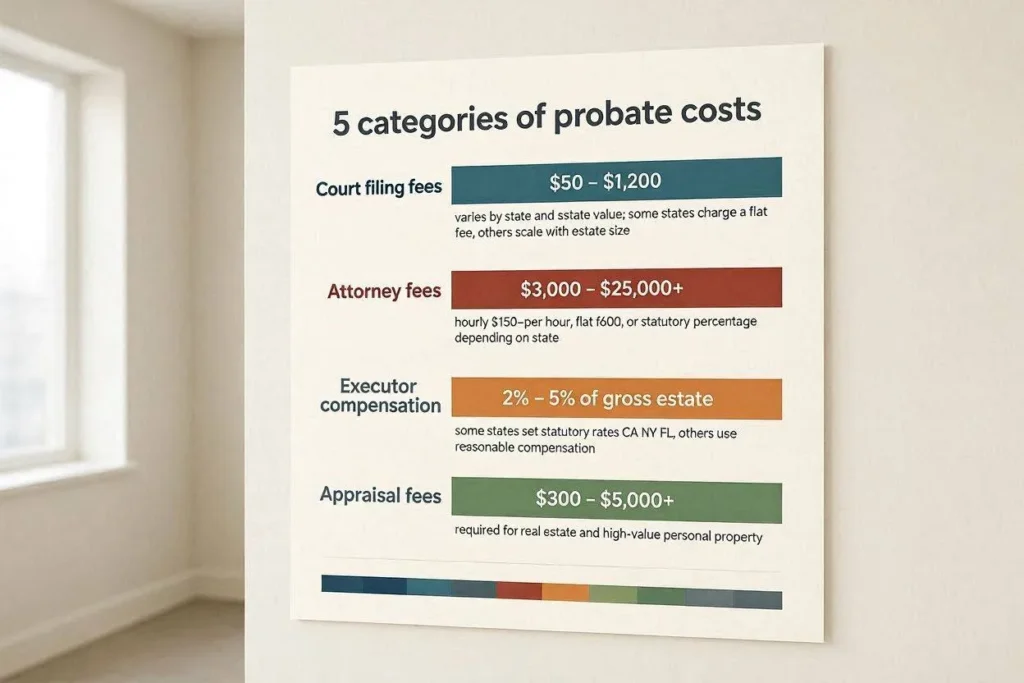
5 Categories of Probate Costs
| Cost Category | Typical Range | Notes |
|---|---|---|
| Court filing fees | $50 – $1,200 | Varies by state and estate value; some states charge a flat fee, others scale with estate size |
| Attorney fees | $3,000 – $25,000+ | Hourly ($150–$600/hr), flat fee, or statutory percentage depending on state |
| Executor compensation | 2% – 5% of gross estate | Some states set statutory rates (CA, NY, FL); others use ‘reasonable compensation’ |
| Appraisal fees | $300 – $5,000+ | Required for real estate, business interests, antiques, art; multiple appraisers if multiple asset types |
| Publication and miscellaneous | $200 – $600 | Newspaper notice, certified mail, certified copies, bond premiums if required |
Attorney Fee Structures by State Type
| State Type | How Fees Are Set | Key States | Example on $500K Estate |
|---|---|---|---|
| Statutory percentage | Set by state law based on gross estate value | California, Florida, Wyoming | $13,000–$17,000 (statutory rate applied to gross value) |
| Reasonable compensation | Court-approved based on hours, complexity, and results | Texas, Illinois, Washington | $5,000–$20,000 (wide variation by case) |
| Hybrid (caps + reasonable) | Percentage cap with court discretion above or below | Missouri, North Carolina, Pennsylvania | $6,000–$15,000 |
Executor Compensation — Statutory Rates for Key States (2026)
| State | Fee Structure | Rate |
|---|---|---|
| California | Statutory sliding scale | 4% on first $100K, 3% on next $100K, 2% on next $800K, 1% on next $9M |
| New York | Statutory sliding scale | 5% on first $100K, 4% on $100K–$300K, 3% on $300K–$1M, 2.5% on $1M–$5M, 2% above $5M |
| Florida | Statutory rate | 3% on first $1M, 2.5% on $1M–$5M, 2% on $5M–$10M |
| Texas | Reasonable compensation | Typically 2%–3% of estate value, court-approved |
| Illinois | Reasonable compensation | Typically 2%–3%, based on hours and complexity |
| Most other states | Reasonable compensation | 1.5%–3% is typical; court reviews for reasonableness |
Executor fees are taxable income. Fees are treated as earned income subject to federal income tax at rates up to 37%, plus state income tax. Family member executors who are also primary beneficiaries often waive their executor fee because inheriting the same assets as a beneficiary produces a better after-tax outcome.
Probate Timeline — How Long Each Stage Takes
| Stage | Typical Duration | What Happens |
|---|---|---|
| Pre-filing preparation | 2 to 6 weeks | Locate will, obtain death certificates, identify assets and debts, select probate attorney |
| File petition and court appointment | 2 to 8 weeks after filing | Court reviews will, appoints executor, issues Letters Testamentary |
| Creditor notification period | 3 to 6 months | Publish notice, notify known creditors, wait for claim period to expire |
| Asset inventory and appraisal | 1 to 4 months | Compile inventory, hire appraisers, file inventory with court |
| Debt payment and tax filing | 1 to 4 months | Pay valid claims, file final income tax return, file estate tax if required |
| Final accounting and court hearing | 1 to 3 months | Prepare accounting, obtain court approval of distribution plan |
| Asset distribution | 2 to 6 weeks after approval | Transfer deeds, accounts, vehicles, personal property to beneficiaries |
| Estate closure | 2 to 4 weeks after distribution | File petition for discharge, receive court order closing estate |
Factors That Extend the Probate Timeline
- Contested will — any heir or beneficiary challenging validity extends the process by 12 to 36 additional months
- Out-of-state property — ancillary probate in each additional state adds 6 to 18 months per state
- Business interests — valuing and managing a business during probate adds complexity and time
- Missing heirs — the court requires a diligent search before closing the estate if heirs cannot be located
- IRS audit or estate tax dispute — federal audits can delay estate closure by 12 to 24 months
- Insolvent estate — more debts than assets triggers creditor priority disputes and extended proceedings
Probate Process by State — Key Differences
Probate law is state law. The procedural requirements, timelines, costs, and available shortcuts differ significantly from state to state. These are the key variations affecting most families.
| State | Small Estate Threshold | Typical Timeline | Fee Structure | Notable Feature |
|---|---|---|---|---|
| California | $208,850 | 12–18 months | Statutory (gross value) | Probate referee required for all non-cash assets; IAEA authority available |
| Florida | $75,000 | 6–12 months | Statutory | Summary administration for estates under $75K or if deceased died 2+ years ago |
| Texas | $75,000 | 6–12 months | Reasonable compensation | Independent administration available — minimal court oversight after opening |
| New York | $50,000 | 12–24 months | Statutory sliding scale | High court involvement; NYC courts add significant processing time |
| Illinois | $100,000 | 9–18 months | Reasonable compensation | Small estate affidavit for personal property only; real estate excluded |
| Arizona | $75,000 | 6–12 months | Reasonable compensation | UPC state — informal probate available with minimal court hearings |
| Colorado | $82,000 | 6–12 months | Reasonable compensation | UPC state — one of the simplest formal probate systems in the US |
| Iowa | $200,000 | 6–9 months | Reasonable compensation | Very high affidavit threshold — most estates skip formal probate entirely |
Uniform Probate Code (UPC) states have adopted standardized probate rules that typically offer faster, less expensive probate with informal options that minimize court hearings. UPC states include Arizona, Colorado, Montana, Nebraska, and about 16 others. Non-UPC states have their own unique procedural requirements that often require more court involvement.
5 Strategies to Avoid Probate
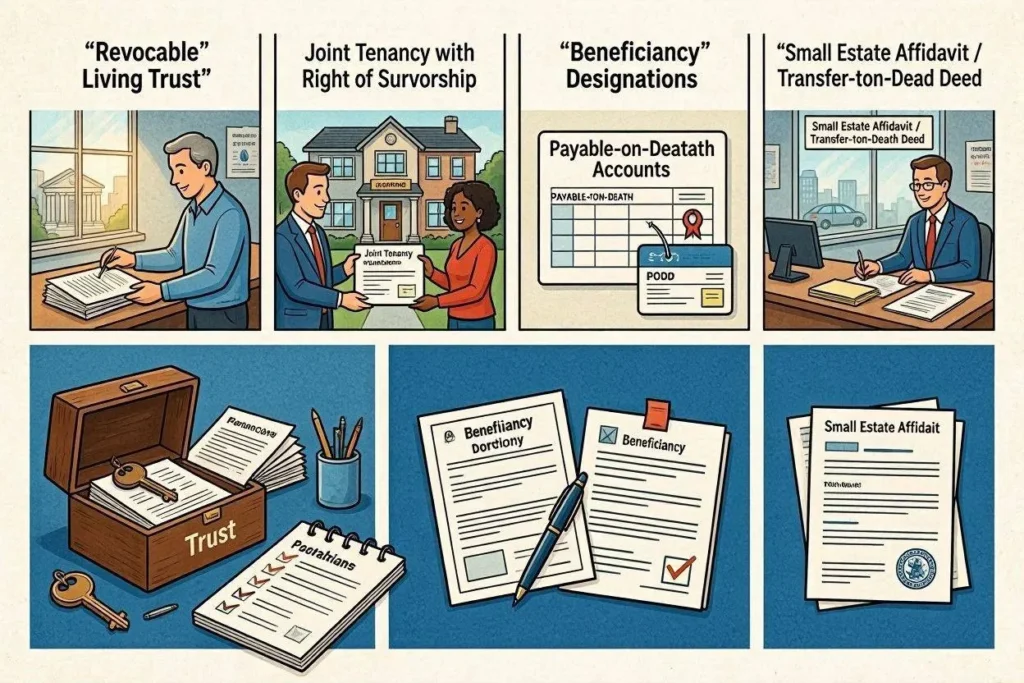
Probate is avoidable for most estates with proper planning. These 5 strategies transfer assets directly to beneficiaries without court involvement.
1. Revocable Living Trust
A revocable living trust is the most comprehensive probate avoidance tool for estates of any size. You transfer ownership of assets into the trust during your lifetime. At death, the successor trustee distributes assets per the trust terms — no court filing, no creditor waiting period, no public record.
- Assets transfer within days to weeks — not months or years
- No court filing fees or probate attorney required for trust administration
- Private — trust terms are not part of the public court record
- Works across multiple states — eliminates ancillary probate for out-of-state property in the trust
- Estimated cost: $1,500 to $5,000 to establish vs. $15,000 to $35,000 or more in probate fees
2. Beneficiary Designations on Financial Accounts
Payable-on-death (POD) designations on bank accounts and transfer-on-death (TOD) designations on brokerage accounts pass those assets directly to named beneficiaries at death — completely outside probate.
Life insurance policies and retirement accounts (401(k), IRA, pension) already require beneficiary designations. Update these after every major life event — marriage, divorce, birth of a child, or death of a named beneficiary. A retirement account with a deceased person listed as beneficiary forces those funds through probate.
3. Joint Tenancy with Right of Survivorship
Property held in joint tenancy with right of survivorship passes automatically to the surviving co-owner at death — no probate required. This is common for married couples who hold real estate jointly.
The risk: joint tenancy bypasses the estate plan entirely. If both owners die simultaneously or the surviving owner later needs to transfer the property, the planning advantage is lost. Joint tenancy also exposes the property to the co-owner’s creditors and tax issues during their lifetime.
4. Transfer-on-Death Deeds for Real Estate
Transfer-on-death (TOD) deeds — also called beneficiary deeds — allow real estate to pass directly to a named beneficiary at death without probate. The deed is recorded during the owner’s lifetime but has no effect until death. The owner retains full control of the property during their lifetime.
TOD deeds are available in about 30 states. They do not protect property from the owner’s creditors during their lifetime and do not provide the same level of control as a living trust.
5. Small Estate Affidavit Procedures
When the total probate estate falls below your state’s threshold, heirs can collect assets using a simple sworn affidavit — no court filing, no attorney, no waiting period beyond the required number of days after death.
The affidavit is presented directly to banks, the DMV, and other asset holders along with a certified death certificate. The entire process takes 4 to 12 weeks and costs under $25 in notary fees. Check your state’s current threshold — California’s $208,850 threshold means most middle-class estates in the state qualify.
| Strategy | Avoids Probate? | Best For | Estimated Cost |
|---|---|---|---|
| Revocable living trust | Yes — completely | Most estates; multiple assets; out-of-state property | $1,500–$5,000 to establish |
| POD/TOD beneficiary designations | Yes — for designated accounts | Bank accounts, brokerage accounts, retirement accounts | $0 — free at any bank or broker |
| Joint tenancy with survivorship | Yes — for that property only | Married couples; real estate with one co-owner | $0–$300 for deed recording |
| Transfer-on-death deed | Yes — for real estate | Homeowners in states that allow TOD deeds | $200–$500 for deed preparation and recording |
| Small estate affidavit | Yes — if below threshold | Small estates below state threshold | Under $25 in notary fees |
Executor Checklist — 30 Essential Duties
Immediately After Death (Days 1–14)
- Obtain the original death certificate and order 10+ certified copies
- Locate the original will and any codicils — do not act on photocopies
- Secure all real property — change locks, maintain insurance, notify homeowner’s insurer
- Notify Social Security Administration to stop benefit payments
- Contact the deceased’s employer about final paycheck and benefits
- Set up mail forwarding to the estate address
- Secure all valuable personal property — jewelry, collectibles, cash, firearms
- Notify banks and financial institutions of the death without yet requesting account access
Weeks 2–8 (Opening the Estate)
- Hire a probate attorney if the estate requires formal probate
- File the probate petition with the county court and submit the original will
- Apply for Letters Testamentary from the court once the will is validated
- Apply for an Estate EIN from the IRS at irs.gov
- Open a dedicated estate bank account in the name of the estate
- Notify all known creditors by certified mail
- Publish the creditor notice in the required local newspaper
- Notify all named beneficiaries and heirs that probate has been opened
Months 1–6 (Active Administration)
- Complete the full asset inventory — all probate assets with date-of-death values
- Hire qualified appraisers for real estate, business interests, and personal property
- File the inventory and appraisal with the probate court
- Review and pay all valid creditor claims in priority order
- File the deceased’s final Form 1040 for the year of death
- File Form 706 (federal estate tax return) if the estate exceeds $13.61 million
- File Form 1041 (estate income tax return) if the estate earns over $600 during probate
- Research and pay any state estate or inheritance taxes due
Final Phase (Closing the Estate)
- Prepare the final accounting showing all income, expenses, and proposed distributions
- File the final accounting with the probate court and serve copies on all beneficiaries
- Obtain court approval of the final accounting and distribution plan
- Transfer all assets to beneficiaries per the court-approved plan
- File the petition for discharge and obtain the court order closing the estate
- Retain all court documents and distribution records for at least 7 years
7 Executor Mistakes That Create Personal Liability
- Paying beneficiaries before all creditor claims are resolved. This is the most serious executor error. If estate funds are distributed and a legitimate creditor later files a claim, the executor is personally liable for the unpaid amount.
- Commingling estate funds with personal accounts. Every dollar that flows through the estate must pass through the dedicated estate bank account. Using your personal account for estate expenses creates accounting problems and potential liability.
- Selling estate property below fair market value. Selling a home to a family member at a discount or liquidating assets quickly at below-market prices breaches fiduciary duty. All asset sales must be at or near appraised value.
- Missing tax filing deadlines. The final income tax return, estate tax return (Form 706), and estate income tax return (Form 1041) each have separate deadlines. Late filing penalties reduce the estate and can create personal liability for the executor.
- Failing to notify all creditors. Skipping the creditor notification process — or notifying only creditors you know about — does not protect the estate from unknown creditors. Known creditors must receive direct written notice; unknown creditors are addressed through the published notice.
- Acting without court approval when required. In formal probate, selling real estate, making large distributions, or settling legal disputes without court approval invalidates the action and exposes the executor to liability.
- Distributing assets before the estate tax return is closed. The IRS has 3 years to audit an estate tax return and assess additional tax. Distributing all assets before the IRS closes the return leaves no estate funds to cover a tax deficiency — and the executor can be held personally liable.
Is Probate Always Necessary — and Is It Worth Trying to Avoid?
Probate serves a legitimate function: it protects creditors, resolves disputes among heirs, and creates a legal record of asset transfers. For estates with contested assets, unclear title to real property, or creditor disputes, court supervision is often the only effective resolution mechanism.
But for most families, probate is a slow, expensive, and unnecessary process that consumes 3% to 7% of an estate before beneficiaries receive anything. It delays distributions for 6 to 24 months during which families are often managing grief without access to the resources the deceased intended for them.
Frequently Asked Questions

Amanda Brooks
Amanda Brooks leads JusticeInTown’s legal, justice, and community advocacy content division. She holds a background in legal research and public policy and specializes in topics related to civil rights, access to justice, legal awareness, and community issues. With years of experience researching legal and social justice topics, Amanda brings a careful, research-driven approach to complex legal information and public-interest issues. She is the primary author of JusticeInTown’s legal guides, justice-related resources, and community-focused content, helping readers better understand their rights, legal options, and the issues affecting their communities.
Related Posts