
How to Find a Good Lawyer: 9 Proven Steps (2026 Guide)
To find a good lawyer, match the attorney’s specialization to your exact legal issue, verify active bar membership, check disciplinary records, and interview at least 3 candidates before signing anything. That is the short answer. The longer one — which this guide covers — shows you exactly how to do each of those steps without wasting time or money.
Most people hire the first lawyer they find through a Google search or a friend’s vague recommendation. That approach fails more often than it should. The right attorney for a divorce case is completely different from the right attorney for a business dispute. This guide gives you a clear, step-by-step process to find a good lawyer for your specific situation.
Step 1: Identify the Type of Lawyer You Actually Need
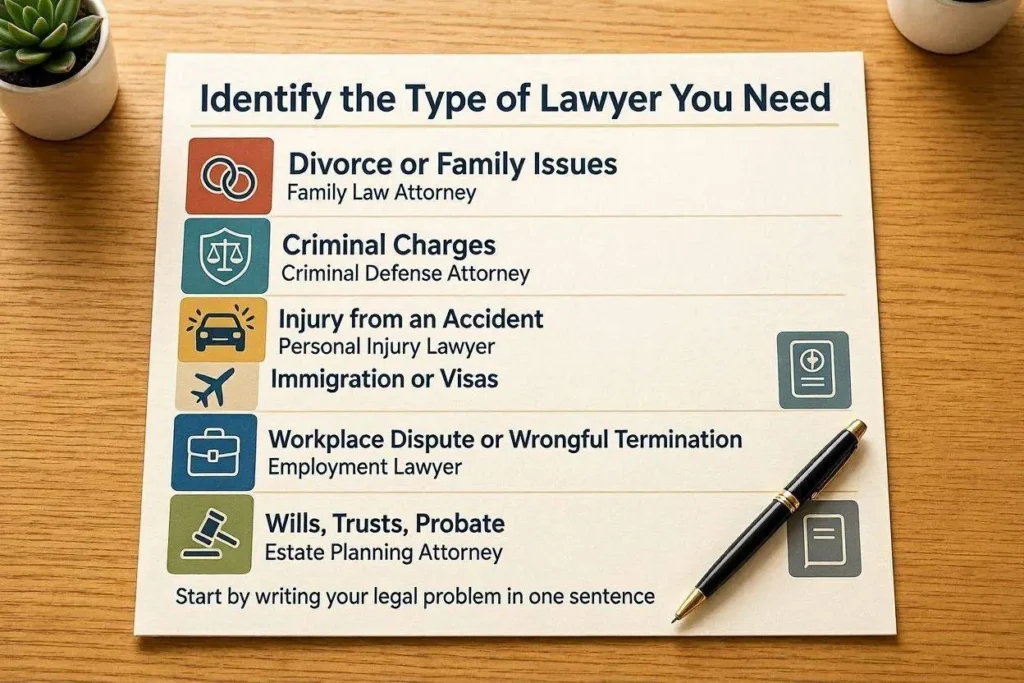
Law has over 30 recognized practice areas — family law, criminal defense, personal injury, immigration, employment, business law, estate planning, and more. A lawyer who handles divorces every day will not serve you well in a criminal defense case.
Start by writing down your legal problem in one sentence. That sentence tells you the practice area you need. Here are 6 common situations and the matching attorney type:
- Divorce or child custody: Family law attorney
- Car accident or injury: Personal injury attorney
- Criminal charge or arrest: Criminal defense attorney
- Fired unfairly or workplace harassment: Employment law attorney
- Starting a business or contract dispute: Business or commercial law attorney
- Buying a home or landlord dispute: Real estate attorney
Never hire a general practitioner for a specialized problem. Of the roughly 1.3 million licensed lawyers in the United States, fewer than 50,000 have deep enough experience in any single specialty to handle complex cases effectively.
Step 2: Use Trusted Sources to Build Your Lawyer List
Start with your state bar association’s referral service — it connects you with licensed, screened attorneys in the exact practice area you need. Every U.S. state operates one. Find your state bar at americanbar.org.
Beyond the bar referral, 4 other reliable sources exist:
- State and local bar referral services: Bar associations screen attorneys for minimum experience standards. First consultations through these services often cost $25 or less.
- Avvo and LegalMatch: Online platforms where attorneys list profiles, client reviews, and disciplinary records. Avvo covers nearly every licensed attorney in the country.
- Martindale-Hubbell and Best Lawyers: Peer-review directories where attorneys rate each other. High peer ratings signal professional respect, not just good marketing.
- Personal referrals from people with the same legal problem: Ask someone who went through a similar situation — a divorce, a personal injury claim, a business dispute — who their attorney was and what the outcome was.
- Nonprofit legal organizations: Groups focused on civil liberties, housing discrimination, or elder law often have attorney networks in their specific area.
Do not build your entire list from Google ads or television commercials. Advertisements tell you nothing about an attorney’s track record, communication style, or real success rate.
Step 3: Verify the Lawyer’s License and Disciplinary Record
Before you speak to any attorney, confirm the lawyer holds an active license in your state. An unlicensed person claiming to practice law commits a crime. Licensing verification takes under 2 minutes and is free.
Here is how to verify in 3 steps:
- Go to your state bar association’s website (e.g., calbar.ca.gov for California, floridabar.org for Florida).
- Search the attorney’s full name in the member directory.
- Check 3 things: current license status, bar number, and any disciplinary actions on record.
A disciplinary record does not automatically disqualify an attorney — minor administrative violations differ from ethics violations. But a history of client complaints, suspension, or disbarment proceedings should end your consideration of that attorney immediately.
Step 4: Check Experience in Cases Identical to Yours
Why Specialization Matters More Than Years of Practice
An attorney with 3 years focused exclusively on personal injury cases will outperform a 20-year generalist in that same case. Depth beats breadth when your case depends on knowing specific judges, local court procedures, and opposing counsel tactics.
Ask every attorney you consider these 3 direct questions:
- How many cases like mine have you handled in the last 2 years?
- What were the typical outcomes — settlements, verdicts, case dismissals?
- Do you currently have active cases in this practice area?
A credible attorney answers these questions specifically. Vague answers like “I handle a variety of cases” signal a lack of focus in your area.
Board Certification: What It Means
Board certification means an attorney passed a specialty exam, submitted peer reviews, and maintained active caseload in a specific area for a minimum of 5 years. Not every good lawyer is board certified, but certification adds a verified layer of expertise. Many states run certification programs — Florida, Texas, and California each have extensive specialty certification boards.
Step 5: Understand Lawyer Fee Structures Before the First Call
Lawyers charge in 5 main ways. Knowing each structure prevents financial surprises after you sign a retainer agreement.
Lawyer Fee Structures at a Glance
| Fee Type | How It Works | Typical Cost | Best For |
|---|---|---|---|
| Hourly Rate | You pay per hour of work | $150–$500/hr (£120–£400) | Complex ongoing cases |
| Flat Fee | One fixed price for the whole service | $500–$5,000 (£400–£4,000) | Simple wills, contracts |
| Contingency Fee | Lawyer gets 25–40% only if you win | No upfront cost | Personal injury, lawsuits |
| Retainer | Upfront deposit; hours billed against it | $1,000–$10,000+ (£800–£8,000) | Business or long-term needs |
| Legal Aid / Pro Bono | Free service for qualifying clients | $0 | Low-income individuals |
Contingency fees work only for cases where money damages are recoverable — personal injury, wrongful termination, medical malpractice. Criminal defense and immigration cases never use contingency fees.
Always ask the attorney to put the fee agreement in writing as a retainer agreement before work begins. A retainer agreement specifies what services the fee covers, who handles each task, and how billing disputes are resolved.
Step 6: Conduct Initial Consultations — Interview at Least 3 Lawyers
Interview a minimum of 3 attorneys before deciding. Most initial consultations are free or cost $25–$75 (£20–£60). Treat the consultation as a job interview — you are the employer.
Bring these items to every consultation:
- All documents related to your case — contracts, police reports, medical records, correspondence
- A written timeline of key events
- A list of questions prepared in advance
Ask these 7 questions at every consultation:
- “How many cases like mine have you handled, and what were the outcomes?” — Tests case-specific experience.
- “Who in your firm will actually work on my case?” — Confirms whether you get the senior attorney or a junior associate.
- “What is your honest assessment of my case’s strengths and weaknesses?” — Tests candor. Good attorneys identify problems early.
- “What is your fee structure and what does it include?” — Avoids billing surprises.
- “How do you communicate with clients — email, phone, or portal?” — Sets communication expectations.
- “What is a realistic timeline for my case?” — Manages your expectations accurately.
- “Are you carrying malpractice insurance?” — Protects you if the attorney makes errors that damage your case.
Walk away immediately from any attorney who guarantees a specific outcome. No lawsuit is certain. An attorney who promises a win prioritizes signing you over serving you.
Step 7: Evaluate Communication Style and Comfort Level
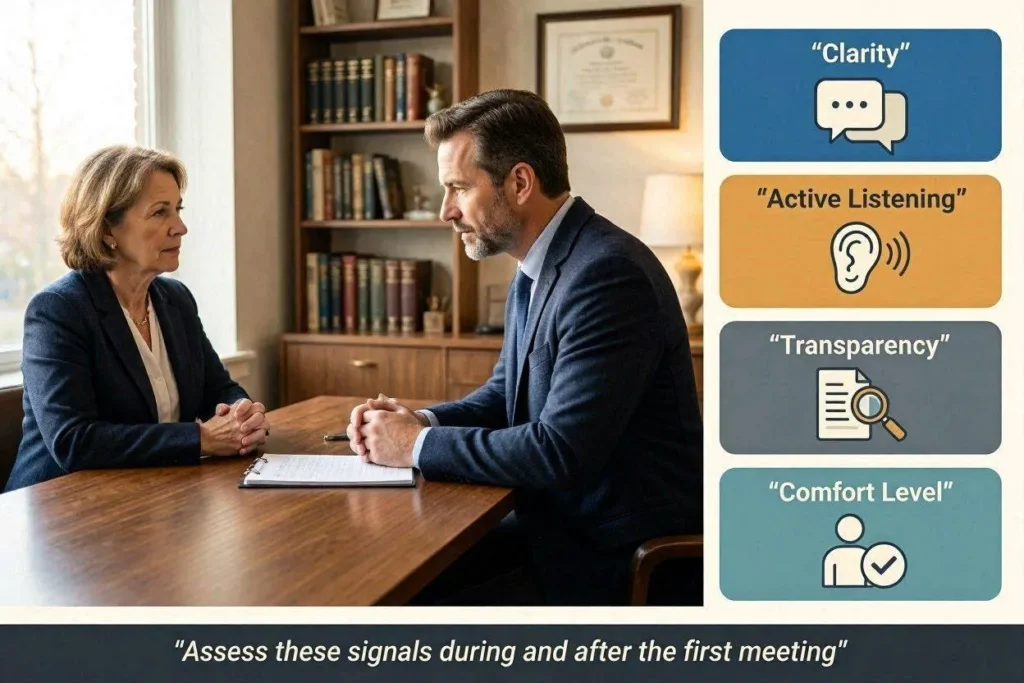
You need an attorney you can speak with honestly and completely. The attorney-client relationship requires full disclosure of every fact in your case — including facts that may be embarrassing or unfavorable to you. An attorney who makes you uncomfortable will not get the complete picture.
Assess these 4 signals during and after the first meeting:
- Clarity: The attorney explains legal concepts in plain language without condescending to you.
- Responsiveness: The attorney or the attorney’s staff responds to your inquiry within 24 hours.
- Organization: The office appears orderly. Disorganized offices often mean disorganized case management.
- Listening: The attorney listens to your full situation before suggesting a strategy.
Your relationship with a litigation attorney can last 1–3 years. Personality fit matters as much as credentials for a working relationship that long.
Step 8: Know the 7 Red Flags That Signal a Bad Lawyer
Avoid any attorney who shows even 1 of these 7 warning signs:
- Guarantees results — No legitimate attorney promises a win.
- Cannot name similar cases handled — Lack of specific experience in your practice area.
- Refuses to put fees in writing — Transparency problems will get worse after you hire.
- Pressures you to sign immediately — High-pressure tactics signal desperation for clients, not confidence in the case.
- Gives only vague answers to direct questions — Evasiveness in consultation reflects evasiveness throughout representation.
- Has not actively practiced your type of law in the last 2 years — Laws change. Dormant experience becomes outdated experience.
- Has unresolved disciplinary actions on the state bar record — Past ethics violations predict future problems.
Step 9: Explore Free and Low-Cost Legal Help Options
If you cannot afford a private attorney, 4 legitimate no-cost or reduced-cost paths exist.
- Legal Aid Societies: Nonprofit organizations provide free legal services to individuals who meet income thresholds. Most U.S. counties have a legal aid office. Search at lawhelp.org.
- Public Defenders: If you face criminal charges and cannot afford an attorney, the court appoints a public defender at no charge. Qualification is income-based.
- Law School Clinics: Law schools run supervised legal clinics staffed by third-year students under licensed attorney oversight. Clinics handle real cases in areas like immigration, family law, and housing.
- Pro Bono Programs: Bar associations organize pro bono (free) representation rosters. Attorneys contribute a minimum number of pro bono hours annually. Contact your state bar to request a pro bono referral.
Servicemembers and veterans can access free legal assistance through JAG Legal Assistance offices — the Judge Advocate General’s Corps operates legal offices on most military installations.
5 Common Mistakes People Make When Hiring a Lawyer
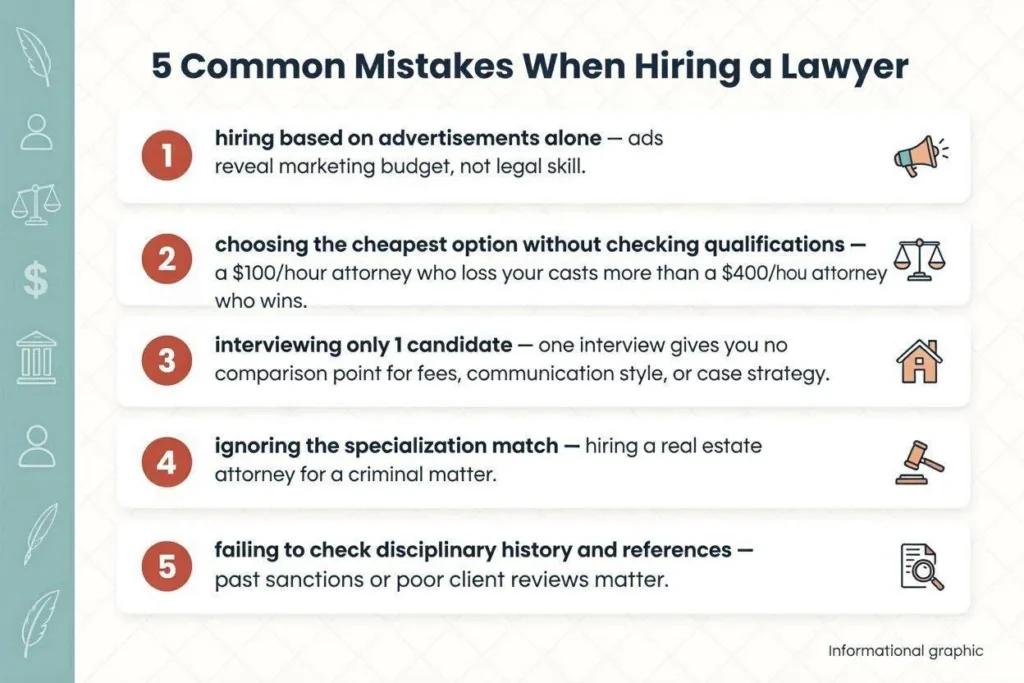
- Hiring based on advertisements alone — Ads reveal marketing budget, not legal skill.
- Choosing the cheapest option without checking qualifications — A $100/hour attorney who loses your case costs more than a $400/hour attorney who wins.
- Interviewing only 1 candidate — One interview gives you no comparison point for fees, communication style, or case strategy.
- Ignoring the specialization match — Hiring a real estate attorney for a criminal case is like hiring a dentist for heart surgery.
- Skipping the bar record check — It takes 2 minutes online and reveals disciplinary history that attorneys will not volunteer.
Final Thoughts: The Right Lawyer Makes a Real Difference
Finding a good lawyer takes effort, but the steps are straightforward. Match the specialization. Verify the license. Interview at least 3 candidates. Understand the fee structure before you sign. Those 4 actions separate a good legal outcome from a costly mistake.
The attorney-client relationship works best when you feel comfortable being completely honest with your attorney, and when the attorney is honest with you about the realistic strengths and weaknesses of your case. Any attorney who tells you only what you want to hear is not serving your interests.
Use the resources in this guide — state bar referral services, Avvo, LegalMatch, legal aid societies — to build your candidate list. Interview with the questions in Step 6. Trust your assessment of the attorney’s communication style. Then commit.
Frequently Asked Questions

Amanda Brooks
Amanda Brooks leads JusticeInTown’s legal, justice, and community advocacy content division. She holds a background in legal research and public policy and specializes in topics related to civil rights, access to justice, legal awareness, and community issues. With years of experience researching legal and social justice topics, Amanda brings a careful, research-driven approach to complex legal information and public-interest issues. She is the primary author of JusticeInTown’s legal guides, justice-related resources, and community-focused content, helping readers better understand their rights, legal options, and the issues affecting their communities.
Related Posts