How a Bill Becomes a Law: 8 Clear Steps Explained (2026 Guide)
A bill becomes a law when both chambers of Congress pass it and the President signs it into law. That process takes 8 distinct steps — and most bills never make it through all of them.
Understanding how the U.S. legislative process works is essential for every citizen, student, and voter. This guide explains every step — from the first draft to the final signature — in plain language.
Congress passes roughly 200 to 400 laws per two-year term out of the thousands of bills introduced. Knowing why most bills fail, and what it takes for one to succeed, gives you a complete picture of how American democracy works.
What Is a Bill?
A bill is a written proposal for a new law or a change to an existing law. Only members of Congress — senators and representatives — can formally introduce a bill. But the idea behind a bill can come from many places.
Bills originate from:
- Members of the U.S. Senate or House of Representatives
- Campaign proposals made during congressional elections
- Petitions by citizens or citizen groups submitted to their representatives
- Executive branch agencies requesting new legislation
- Lobbying organizations drafting model legislation
Once introduced, a bill is assigned a number. House bills start with “H.R.” and Senate bills start with “S.” — for example, H.R. 1024 or S. 312. That number follows the bill through its entire journey.
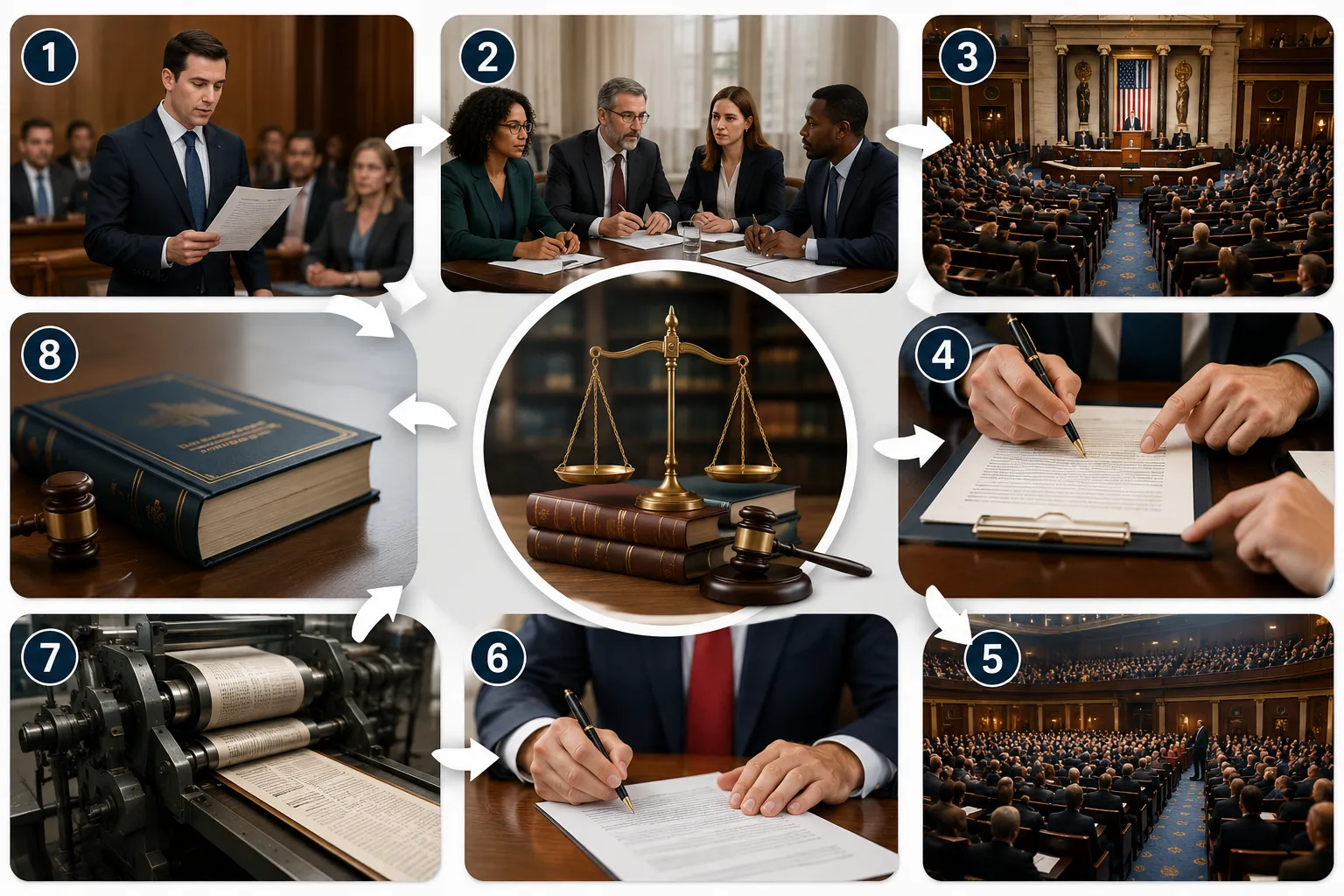
The 8 Steps: How a Bill Becomes a Law
Every federal bill in the United States follows this path from idea to enacted law.
Step 1: Introduction in the House or Senate
A member of Congress introduces the bill by submitting it to the clerk of the chamber. In the House, this means placing it in a box called “the hopper” at the Speaker’s platform. In the Senate, the bill is placed on the presiding officer’s desk or formally introduced on the Senate floor.
What happens next:
- The bill clerk assigns a bill number (H.R. or S.)
- The bill is labeled with the sponsor’s name
- Copies are printed by the Government Printing Office (GPO)
- The bill is posted publicly on Congress.gov
- Senate bills can have multiple co-sponsors from the start
Any citizen can draft a bill, but only a sitting member of Congress can introduce it. The sponsor — the person who submits it — is responsible for building support.
Step 2: Committee Assignment and Review

The Speaker of the House or the Senate presiding officer assigns the bill to the appropriate committee. This decision is typically made by the House or Senate parliamentarian based on the bill’s subject matter.
The U.S. Congress has 20 standing House committees and 16 Senate committees, each covering a specific policy area — from agriculture to foreign relations to judiciary. The bill goes to whichever committee holds jurisdiction over its topic.
What the Committee Does
The committee is where most bills die. The committee can:
- Hold public hearings with expert witnesses and stakeholders
- Request reports from government agencies on the bill’s likely impact
- Mark up the bill — meaning revise, amend, or rewrite it
- Vote to send the bill to the full chamber (“report the bill”)
- Table the bill — effectively killing it by doing nothing
If the committee votes not to report the bill, it dies. Bills rarely advance from committee without the committee chair’s support.
Subcommittee Review
Many bills go to a subcommittee first. The subcommittee studies it, may hold hearings, and sends recommendations back to the full committee. If the subcommittee votes against the bill, it can die there.
Step 3: Floor Scheduling
After a committee votes to advance a bill, the bill is placed on the legislative calendar. In the House, the Rules Committee determines when and how a bill reaches the floor for debate. In the Senate, there is only 1 legislative calendar.
In the House:
- The Speaker and Majority Leader decide the order bills reach the floor
- The Rules Committee sets the time limits and rules for debate
- Riders (unrelated amendments) are not allowed in the House
In the Senate:
- Debate is unlimited unless cloture is invoked — which requires 60 votes
- Senators can speak as long as they want (this is the basis of the filibuster)
- Amendments do not need to relate to the bill (riders are permitted)
Step 4: Floor Debate and Amendments
The full chamber debates the bill on the floor. Debate allows members to voice support or opposition, propose changes, and shape public opinion.
Key differences between House and Senate floor debate:
| Factor | House of Representatives | Senate |
| Debate time | Limited by Rules Committee | Unlimited (unless cloture invoked) |
| Amendments | Must be germane (related) | Can be unrelated (riders allowed) |
| Votes to end debate | Majority vote | 60 votes for cloture |
| Quorum required | 218 of 435 members | 51 of 100 senators |
| Who controls floor time | Sponsoring Committee | Majority and Minority Leaders |
After debate, members vote on any proposed amendments individually. Each amendment is voted up or down before the final vote on the bill. In the House, members vote electronically. In the Senate, votes are taken by roll call — each senator’s vote is spoken aloud and recorded.
Step 5: Voting in the First Chamber
The chamber votes on final passage. A simple majority — more than half of members present — is required to pass the bill.
Voting options for each member:
- Yea — vote in favor of the bill
- Nay — vote against the bill
- Present — recorded as attending but choosing not to vote
If the bill passes, it is sent to the other chamber. If it fails, the bill dies. A bill that passes the House goes to the Senate, and vice versa.
Step 6: The Other Chamber Repeats the Process
The second chamber runs the bill through the same process: committee assignment, markup, floor debate, and a vote. The other chamber can:
- Pass the bill without changes — it then goes directly to the President
- Pass the bill with changes — which triggers the conference committee process
- Reject the bill — and it dies
- Take no action — and the bill dies when the congressional session ends
If the second chamber passes a different version of the bill, both versions must be reconciled before the bill can advance.
Conference Committee: Resolving Differences
A conference committee is formed when the House and Senate pass different versions of the same bill. Both chambers appoint members to negotiate a single, unified version.
The conference report — the agreed unified text — must pass both the full House and the full Senate with a majority vote. If either chamber rejects the conference report, the bill dies.
Step 7: Presidential Action
Once both chambers pass an identical bill, it goes to the President. This is called the enrolled bill stage. The President has 4 options:
| Presidential Action | Result |
| Sign the bill | Bill becomes law immediately |
| Take no action (Congress in session) | Bill automatically becomes law after 10 days |
| Veto the bill | Bill is returned to Congress with written objections |
| Take no action (Congress adjourned) | Pocket veto — bill dies and cannot be overridden |
Understanding the Pocket Veto
A pocket veto occurs when the President takes no action on a bill and Congress adjourns before the 10-day window expires. The bill automatically fails and cannot be brought back for an override vote — Congress must start the entire process again from scratch.
This is a powerful tool. Congress has adjourned, so the President cannot technically “return” the bill with objections. The result is the same as a veto, but it cannot be challenged.
Step 8: Veto Override (If Applicable)
If the President vetoes a bill, Congress can override the veto with a two-thirds majority vote in both the House and the Senate. This is intentionally difficult — the supermajority requirement ensures broad consensus.
How the override process works:
- The President returns the bill with written objections to the chamber that originated it
- The originating chamber votes first on the question of override
- Two-thirds of members present (not total seats) must vote “Yea”
- If the originating chamber succeeds, the bill goes to the other chamber
- The second chamber must also pass the bill by two-thirds
- If both chambers reach two-thirds, the bill becomes law without the President’s signature
Congress has overridden roughly 7% of all presidential vetoes in U.S. history. Most vetoes are sustained.
What Happens After a Bill Becomes Law?
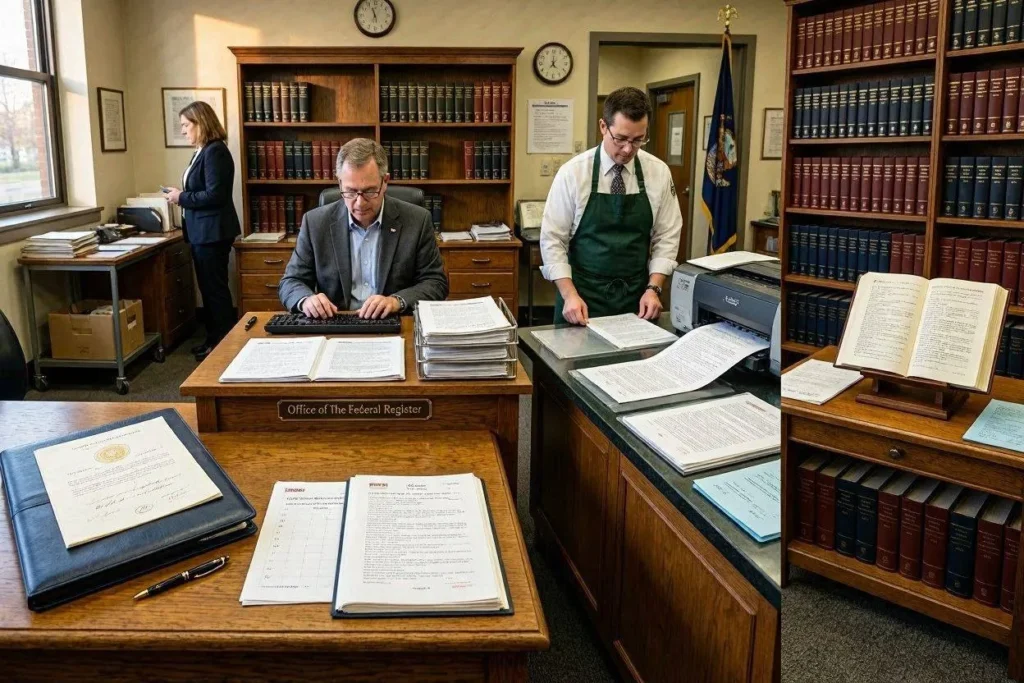
Once signed into law, a bill becomes a Public Law and is assigned a number — for example, P.L. 117-58. The number identifies the congressional session (117th Congress) and the sequential order it was enacted (58th law of that session).
After enactment:
- The Office of the Federal Register assigns the Public Law number
- The Government Printing Office (GPO) publishes the law in slip form
- Laws are eventually codified into the U.S. Code — organized by subject matter
- The law takes effect immediately unless a future effective date is specified
- Federal agencies may need to create regulations to implement the law
Key Differences: House vs. Senate Procedures
The two chambers have distinct powers that shape which chamber originates which bills.
| Power / Procedure | House of Representatives | Senate |
| Tax and revenue bills | Must originate here | Cannot originate here |
| Presidential nominations | No role | Must confirm |
| Treaties | No role | Must ratify (67 votes) |
| Impeachment | Initiates with simple majority | Tries with 67-vote conviction threshold |
| Debate rules | Strictly limited | Unlimited (filibuster possible) |
| Members | 435 representatives | 100 senators |
| Term length | 2 years | 6 years |
Why Most Bills Fail

Only 3% to 5% of bills introduced in any session of Congress become law. Bills die at every stage, but most fail in committee.
6 most common reasons a bill dies:
- Tabled in committee — the committee chair simply never schedules a hearing
- Failed committee vote — the committee votes “do not pass”
- Never scheduled for floor debate — leadership blocks it from reaching a vote
- Failed floor vote — the full chamber votes it down
- The other chamber takes no action before the session ends
- Presidential veto that Congress cannot override
Awareness of these failure points helps citizens understand where to focus advocacy efforts. Contacting the committee chair or your representative before a bill reaches the floor is often the most effective action.
Frequently Asked Questions

Amanda Brooks
Amanda Brooks leads JusticeInTown’s legal, justice, and community advocacy content division. She holds a background in legal research and public policy and specializes in topics related to civil rights, access to justice, legal awareness, and community issues. With years of experience researching legal and social justice topics, Amanda brings a careful, research-driven approach to complex legal information and public-interest issues. She is the primary author of JusticeInTown’s legal guides, justice-related resources, and community-focused content, helping readers better understand their rights, legal options, and the issues affecting their communities.
Related Posts