
Mediation vs Litigation: Which Path Saves You Time and Money in 2026
Mediation is faster, cheaper, and private. Litigation gives you a court-enforceable judgment and formal legal protection. Choosing between mediation vs litigation depends on 5 factors: case complexity, the relationship between parties, cost tolerance, need for confidentiality, and whether the other party cooperates.
Most civil disputes never reach a verdict. Settlement rates for court-sponsored mediation programs range from 27% to 63%, according to a study by Roselle L. Wissler of Arizona State University College of Law. Understanding both processes helps you pick the right path before you spend time or money going the wrong direction.
What Is Mediation vs Litigation: 2 Core Definitions
How Mediation Works as a Dispute Resolution Process
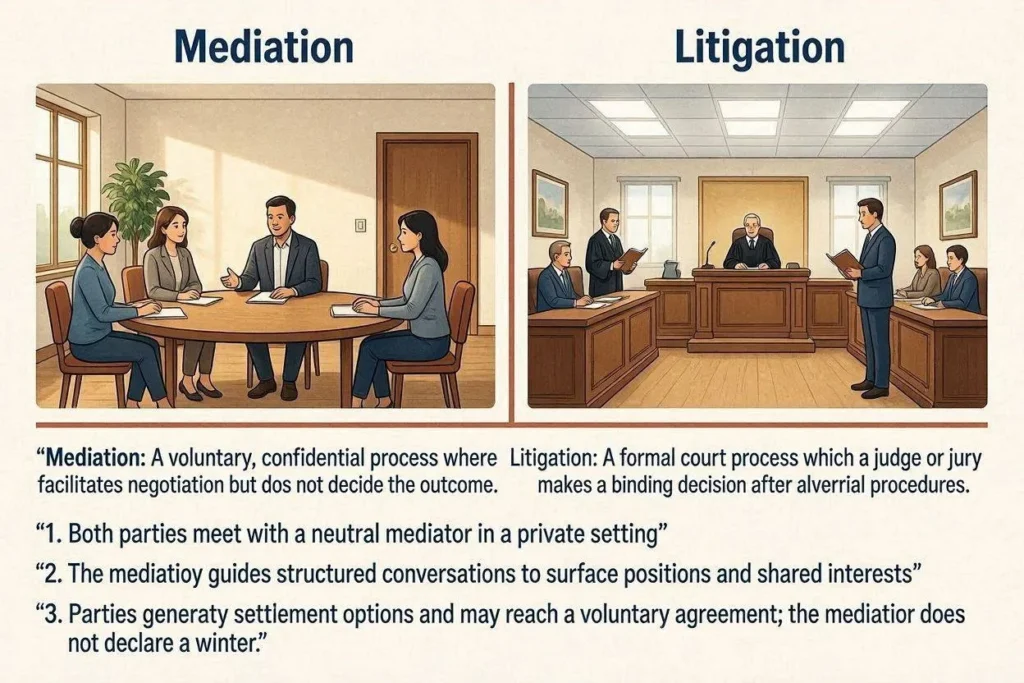
To resolve a dispute through mediation, both parties meet with a neutral third party — called a mediator — who guides structured conversations toward a voluntary agreement. The mediator does not decide who wins. The mediator helps each side hear the other’s position, identify shared interests, and generate settlement options. Sessions take place in a private setting. The mediator often meets separately with each party in a private caucus to carry offers and concerns between rooms.
Mediation is a form of alternative dispute resolution (ADR) — the umbrella term for methods that resolve disputes outside the formal court system. Other ADR methods include arbitration, mini-trials, and summary jury trials.
How Litigation Works as a Formal Court Process
To resolve a dispute through litigation, 1 party files a lawsuit against another in civil court. The process follows a fixed sequence: complaint filing, the defendant’s response, discovery (the exchange of evidence), pre-trial motions, trial, and judgment. A judge — or a judge and jury — reviews evidence and issues a binding ruling. Both sides typically hire attorneys. Court records become public documents.
Civil litigation takes a minimum of 12 months for straightforward cases. Complex cases involving business disputes, multiple parties, or extensive discovery can run 3 to 5 years. Every stage of litigation generates attorney fees billed at $150 to $500 per hour (£120 to £400 per hour) in most U.S. markets.
Mediation vs Litigation Cost: What You Actually Pay
Mediation costs $3,000 to $8,000 total for most disputes. Litigation costs $15,000 to $100,000 or more for cases that reach trial. The gap exists because mediation compresses the timeline and eliminates discovery, court filing fees, expert witnesses, and trial preparation costs.
A single day of mediation — typically 8 hours (about 0.3 meters of time on a Gantt chart) — produces a result that litigation takes years to reach. Mediators charge $200 to $500 per hour (£160 to £400 per hour), split evenly between parties. Retired judges and senior attorneys who specialize in mediation — such as those at JAMS (Judicial Arbitration and Mediation Services) or the American Arbitration Association — charge up to $800 per hour (£640 per hour).
Court filing fees alone run $400 to $1,000 in most U.S. jurisdictions. Depositions cost $500 to $2,500 each. Expert witnesses charge $200 to $600 per hour. A trial that runs 5 days can add $30,000 to $80,000 in attorney fees before any judgment.
Choosing the right attorney matters as much as choosing the right process. The guide on how to find a good lawyer walks through 9 steps for evaluating candidates, fee structures, and red flags before you sign anything.
Mediation vs Litigation Timeline: How Long Each Process Takes
Mediation resolves most disputes in 1 day to 3 months. Litigation takes 12 months at minimum and often runs 2 to 3 years for contested civil cases. 4 factors drive litigation delays: court docket backlog, case complexity, discovery disputes, and pre-trial motions practice.
Court-ordered mediation — required by many judges before trial — can often be scheduled within 30 to 60 days of filing a lawsuit. By contrast, a trial date in a busy urban court like Los Angeles Superior Court or the Southern District of New York can sit 18 to 36 months away from the date of filing.
Mediation fails to reach agreement in 37% to 73% of cases, depending on the dispute type and jurisdiction. When mediation fails, parties return to litigation — paying both the mediation cost and the full litigation cost. Budget for that possibility before choosing mediation alone as your strategy.
Mediation vs Litigation Comparison: 7-Factor Quick Reference
The table below compares mediation and litigation across 7 critical factors so you can match the process to your case’s specific needs.
| Factor | Mediation | Litigation | Difficulty | Recommended For |
| Average Cost | $3,000–$8,000 total | $15,000–$100,000+ | Low cost | Budget-conscious parties |
| Average Timeline | 1 day to 3 months | 12 months to 3+ years | Fast vs. Slow | Time-sensitive disputes |
| Outcome Control | Parties decide | Judge or jury decides | High control | Parties valuing autonomy |
| Confidentiality | Fully private | Public court record | Private | Sensitive business or family |
| Enforceability | Signed agreement needed | Court order, auto-binding | Stronger in court | When compliance risk is high |
| Relationship Impact | Preserves relationship | Damages relationship | Better outcome | Ongoing business partners |
| When It Fails | No agreement reached | Rarely — judge rules | Mediation has more risk | High-conflict cases |
When Mediation Works Better Than Litigation: 6 Scenarios
Mediation outperforms litigation in 6 specific scenarios:
- Ongoing relationships — business partners, co-parents, neighbors, and family members benefit from mediation because the process preserves communication rather than destroying it through adversarial proceedings.
- Cost-sensitive disputes — claims worth $10,000 to $50,000 rarely justify $40,000+ in litigation costs. Mediation caps costs at a fraction of the claim’s value.
- Confidential matters — business trade secrets, private financial disclosures, and family financial information stay out of public court records when parties choose mediation.
- Speed-critical cases — disputes over contracts with deadlines, time-sensitive property transactions, or employment matters where delay causes real harm resolve faster through mediation.
- Both parties cooperate — mediation only works when both sides voluntarily participate and negotiate in good faith. Cooperative parties reach settlements 63% of the time in court-sponsored programs.
- Creative solutions needed — mediation allows outcomes that courts cannot order. Parties in business disputes, for example, can agree to payment structures, future contracts, or public apologies that no judge can impose.
When Litigation Is the Right Choice Over Mediation
Litigation beats mediation in 5 situations:
- One party refuses to cooperate or participate in good faith.
- The dispute involves a constitutional question, a new interpretation of law, or a legal precedent that affects others beyond the 2 parties.
- Hidden assets, fraud, or significant power imbalances make voluntary agreement unsafe — a judge’s authority to compel discovery and subpoena records is essential.
- The dispute involves domestic violence — Maryland Rules of Procedure Rule 9-205(b)(2) explicitly exempts domestic violence cases from court-ordered mediation requirements, and most jurisdictions follow similar protections.
- You need a court-enforceable judgment immediately, such as an injunction, asset freeze, or contempt enforcement against a party who has already violated an agreement.
Criminal cases never use mediation as a substitute for prosecution. Mediation is a civil dispute resolution tool. If your situation involves criminal charges — for example, a workplace assault that also carries criminal liability — read the guide on
Criminal charges require a different legal path entirely. The guide on getting a criminal record expunged covers the formal court process, eligibility requirements, and state-by-state rules for clearing past criminal records.
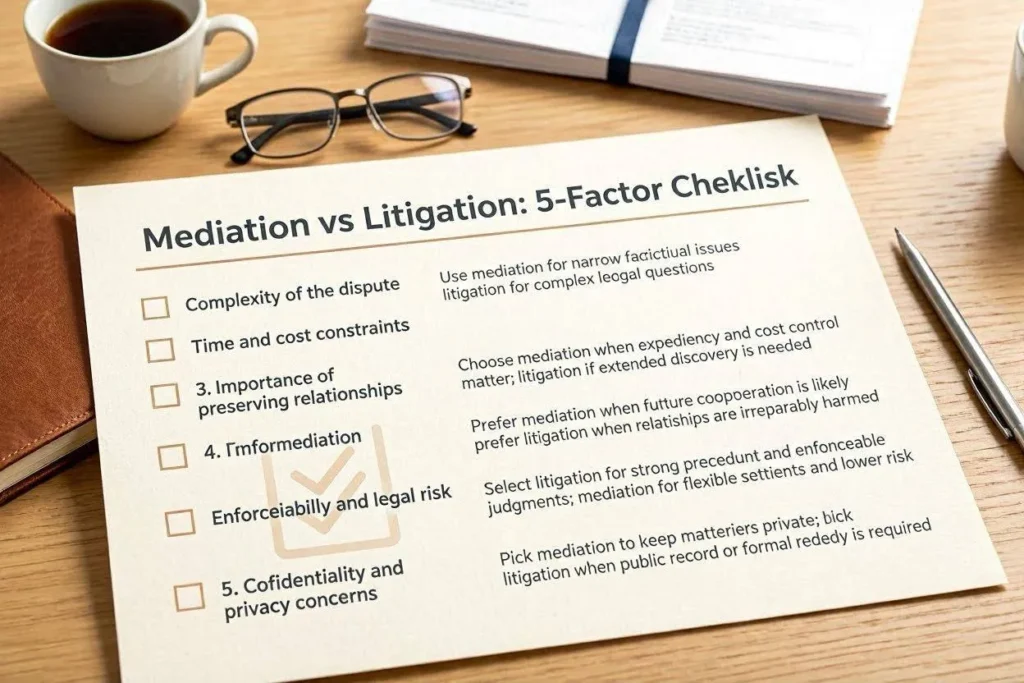
How to Choose Between Mediation vs Litigation: 5-Factor Decision Checklist
How to Assess Whether Your Case Fits Mediation
To assess mediation fit, answer these 5 questions before choosing a process:
- Does the other party communicate and show willingness to negotiate? — If no, mediation wastes time and money.
- Does your dispute involve an ongoing relationship worth preserving? — If yes, mediation protects the relationship. Litigation almost always ends it.
- Is your claim’s value under $50,000? — If yes, litigation costs frequently exceed the claim’s worth.
- Does your case involve sensitive financial or personal information? — If yes, mediation keeps the record private. Court records are public.
- Do you need a creative outcome beyond what a court can order? — If yes, only mediation gives you that flexibility.
Score 3 or more “yes” answers and mediation is the stronger choice. Score 2 or fewer and litigation — or a combination of early mediation followed by litigation preparation — fits your situation better.
How to Prepare for Mediation to Maximize Settlement Chances
To prepare for mediation, complete 4 steps before the session date:
- Gather all relevant documents — contracts, invoices, correspondence, photographs, and financial records. Bring complete copies for the mediator and the opposing party.
- Write a clear statement of your position, your interests, and your minimum acceptable outcome. Knowing your floor prevents you from accepting a bad deal under time pressure.
- Identify the opposing party’s likely interests — not just their stated position. Mediators who understand both sides’ real needs reach settlement faster.
- Consult an attorney before the mediation session. An attorney reviews your legal rights, the strength of your case, and whether any proposed settlement terms are fair and enforceable. Attorneys do not need to attend mediation, but pre-mediation advice is valuable.
Reviewing all your legal options before choosing a path protects your rights. The explore practice areas page covers 50+ areas of law — including family law, employment disputes, personal injury, and business conflicts — where mediation or litigation strategies differ significantly.
What Happens When Mediation Fails: 3 Next Steps
When mediation fails to reach a signed agreement, 3 paths remain:
- Resume or initiate litigation — parties return to the court process. Nothing said during mediation can be used as evidence in court. Confidentiality protects all mediation communications from disclosure in any subsequent legal proceeding.
- Schedule a second mediation session — complex disputes with multiple issues sometimes require 2 to 3 sessions. A failed first session does not permanently close mediation as an option.
- Try arbitration — arbitration (ADR) sits between mediation and litigation. An arbitrator hears evidence and issues a binding decision, similar to a judge, but the process is private, faster, and less formal than court.
Court-ordered mediation programs typically allow parties to report impasse and return to the litigation track within 30 days. Private mediation agreements have no mandatory timeline — parties renegotiate or file.
The Right Dispute Resolution Path Depends on Your Specific Situation
Mediation vs litigation is not a universal choice. Mediation saves time and money in cooperative disputes with confidential facts and ongoing relationships. Litigation protects rights when the other party refuses to negotiate, when assets are hidden, or when a court-enforceable judgment is the only acceptable outcome.
Use the 5-factor checklist in this guide to assess your case before committing to either path. Consult an attorney before mediation begins and before litigation costs accelerate past the point of practical settlement.
Connect with a licensed U.S. attorney through Justice In Town’s free consultation — attorneys across all 50 states are available to assess your dispute, recommend the right process, and represent you in mediation or court.
Frequently Asked Questions About Mediation vs Litigation

Amanda Brooks
Amanda Brooks leads JusticeInTown’s legal, justice, and community advocacy content division. She holds a background in legal research and public policy and specializes in topics related to civil rights, access to justice, legal awareness, and community issues. With years of experience researching legal and social justice topics, Amanda brings a careful, research-driven approach to complex legal information and public-interest issues. She is the primary author of JusticeInTown’s legal guides, justice-related resources, and community-focused content, helping readers better understand their rights, legal options, and the issues affecting their communities.
Related Posts