Lawyer vs. Attorney: 7 Real Differences You Need to Know (2026)
A lawyer holds a law degree. An attorney passed the bar exam and holds a license to practice law. That is the core difference — and it decides who can legally walk into a courtroom and represent you.
Most people use the two words without thinking. So do many legal professionals, courts, and even the American Bar Association (ABA) in everyday writing. But when money, property, or freedom is on the line, the distinction is not trivial.
This guide covers 7 specific differences between a lawyer and an attorney — plus exactly when that difference changes your outcome.
The Core Difference in One Sentence
Direct Answer
A lawyer completed law school (Juris Doctor / J.D. degree). An attorney completed law school AND passed the state bar exam AND holds an active license to practice law. All attorneys are lawyers. Not all lawyers are attorneys.
The word lawyer comes from Middle English — it simply means someone educated in law. The word attorney comes from Old French attorner, meaning ‘to act on behalf of another.’ That etymology is the clue. An attorney is someone authorized to act for you. A lawyer is someone trained in law — but not necessarily authorized to act on your behalf in court.
The bar exam is what separates the two. Passing it — along with a background check called character and fitness evaluation — converts a lawyer into a licensed attorney.
7 Key Differences: Lawyer vs. Attorney
Difference 1: Education vs. Licensure
A lawyer earns a Juris Doctor (J.D.) degree after 3 years at an accredited law school, following a 4-year undergraduate degree. That education qualifies them to advise on legal matters.
An attorney does everything a lawyer does — plus passes the bar examination in at least one U.S. state and satisfies that state’s character and fitness requirements. That license is what grants legal authority to practice.
A law school graduate who never sits for the bar exam is still a lawyer. Legally, though, that person cannot represent clients in court, file documents on a client’s behalf, or give formal binding legal advice.
Difference 2: Courtroom Authority
Only a licensed attorney can represent a client in court. That means arguing before a judge, cross-examining witnesses, filing motions, and negotiating plea deals or settlements on someone else’s behalf.
A lawyer without bar admission cannot appear in court on your behalf. This is not a technicality — providing courtroom representation without a license constitutes the unlicensed practice of law, which is illegal in every U.S. state.
Difference 3: Attorney-Client Privilege
Attorney-client privilege is a legal protection that keeps communications between you and your attorney confidential. A court cannot compel a licensed attorney to disclose what you told them in confidence.
This protection applies to licensed attorneys. Communications with a lawyer who holds only a law degree — without bar admission — may not carry the same legal protection, depending on the state and the context.
For sensitive legal matters — criminal charges, personal injury claims, business disputes — attorney-client privilege is not optional. It shapes what you can say, what gets recorded, and what can be used against you.
Difference 4: Scope of Legal Work
| Lawyer | Attorney |
| Provides general legal advice
Drafts contracts and documents Conducts legal research Works in compliance and policy Consults in academic or advisory roles Cannot represent clients in court Cannot file court documents on your behalf May or may not hold a bar license | Does everything a lawyer does
Represents clients in court proceedings Files motions and legal documents Negotiates settlements on your behalf Cross-examines witnesses at trial Holds active state bar license Bound by professional ethics code Protected by attorney-client privilege |
Difference 5: Professional Ethics and Accountability

Licensed attorneys are subject to the rules of professional conduct enforced by their state bar association. Violating those rules — through dishonesty, conflicts of interest, or neglect — can result in formal discipline, suspension, or disbarment.
That accountability system protects clients. You can verify an attorney’s standing, check for disciplinary actions, and file a complaint if the attorney acts improperly. Every state bar association maintains a public record searchable by name.
Lawyers without bar admission are not subject to bar discipline. That does not mean they operate without any ethical obligations — but it does mean the formal enforcement mechanism that protects you as a client does not apply to them in the same way.
Difference 6: Jurisdiction Limitations
An attorney’s license is state-specific. Passing the bar exam in New York licenses that attorney to practice in New York — not California, not Texas, not any other state by default.
Representing a client across state lines requires one of 3 options:
- Reciprocity agreements — some states honor licenses from other states without requiring a new exam
- Pro hac vice admission — temporary permission to appear in a specific case in a state where the attorney is not licensed, typically granted by the court and requiring association with a local attorney
- Separate bar admission — passing the bar examination in the second state
This matters practically: an attorney licensed only in Florida cannot file your lawsuit in Georgia without additional authorization.
Difference 7: How the Terms Are Used in Practice
In everyday conversation — and even in many court documents, law firm names, and legal directories — ‘lawyer’ and ‘attorney’ are used interchangeably. The ABA itself uses both terms without distinction in most of its publications.
Where the distinction still carries weight:
- When hiring someone to represent you in court — ask whether they hold active bar admission in your state
- When a firm markets some staff as ‘lawyers’ and others as ‘attorneys’ — this often signals that some staff members have law degrees but are not yet licensed
- When verifying credentials — the state bar’s public directory lists licensed attorneys, not all law school graduates
Other Legal Titles That Cause Confusion
Several other titles appear alongside lawyer and attorney. Each has a specific meaning.
| Title | Definition | Licensed? | Common Context |
|---|---|---|---|
| Attorney-at-Law | Lawyer who passed the bar exam and holds an active state license | Yes | Courts, law firms, formal proceedings |
| Lawyer | Person who earned a J.D. degree; may or may not be bar-admitted | Not always | General reference; advisory roles |
| Counselor / Counsel | Licensed attorney; used formally in court settings or for in-house corporate work | Yes | Courtrooms, corporate legal departments |
| Esquire (Esq.) | Courtesy title placed after a licensed attorney’s name | Yes | Business cards, legal letterheads, filings |
| Paralegal | Legal professional who assists attorneys; cannot practice law independently | No | Law firms, corporate legal teams |
| Public Defender | Licensed attorney representing defendants who cannot afford private counsel | Yes | Criminal court proceedings |
| In-House Counsel | Licensed attorney employed by a company rather than a law firm | Yes | Corporate legal departments |
| Solicitor / Barrister | UK and Australian legal titles; not used in the United States | N/A (UK/AU) | UK, Australia, and Commonwealth countries |
When the Difference Actually Matters for You
The distinction is irrelevant in these situations:
- Getting general legal advice from a law firm — everyone you speak with at a licensed firm is almost certainly both a lawyer and attorney
- Having a contract reviewed — licensed attorneys and qualified lawyers handle this equally
- Estate planning basics — standard wills and powers of attorney are handled by licensed attorneys at firms where the title distinction is moot
The distinction matters in these situations:
- Criminal charges — you need a licensed attorney who can appear in court, negotiate with prosecutors, and represent you at trial
- Civil lawsuits — filing or defending a lawsuit requires bar-admitted representation in the relevant state
- Divorce and custody proceedings — courtroom advocacy requires bar admission; family court is formal legal process
- Immigration hearings — deportation defense and visa appeals require a licensed attorney who can appear before immigration courts and the Board of Immigration Appeals (BIA)
- When someone calls themselves a ‘lawyer’ but cannot confirm bar admission — ask directly, then verify through the state bar
What Lawyers Without Bar Admission Actually Do
Not every law school graduate pursues bar admission. Many choose careers that use their legal education without requiring a license to practice. These roles are legitimate, valuable, and common.
6 common roles for lawyers without bar admission:

- Legal researcher — analyzes case law, statutes, and regulations for law firms or academic institutions
- Compliance officer — ensures businesses follow applicable laws and regulations
- Contract specialist — drafts and reviews contracts in a business setting under attorney supervision
- Legal writer or editor — produces legal publications, treatises, or educational materials
- Law clerk — supports judges or licensed attorneys with research and case preparation
- Policy analyst — works in government or nonprofit sectors advising on legislation and regulations
What these roles have in common: the person provides legal knowledge and analysis, but does not represent clients in court, give binding legal advice as a licensed professional, or enter into the formal attorney-client relationship that triggers privilege and bar accountability.
Common Misconceptions — Corrected
| Misconception | Reality |
|---|---|
| Lawyer and attorney mean exactly the same thing | Technically wrong — a lawyer holds a degree; an attorney also holds a bar license. In practice, most legal professionals are both. |
| All lawyers can represent you in court | False — only bar-admitted attorneys can provide courtroom representation. A lawyer without bar admission cannot legally appear before a judge on your behalf. |
| The ABA says they’re identical | Partially true — the ABA uses the terms interchangeably in everyday usage, but the underlying legal distinction (degree vs. license) still exists and matters in formal contexts. |
| ‘Attorney’ is a more senior or prestigious title | Not accurate — it indicates licensure, not seniority. A first-year licensed attorney is an attorney; a senior law professor without bar admission is a lawyer. |
| Hiring an attorney guarantees a good outcome | False — no attorney can promise results. Outcomes depend on facts, evidence, jurisdiction, the opposing party, and the judge. Any guarantee is a red flag. |
| An attorney licensed in one state can practice anywhere | Wrong — bar admission is state-specific. Cross-state practice requires reciprocity, pro hac vice admission, or separate bar admission in the second state. |
The Etymology: Why Two Words Exist for the Same Job
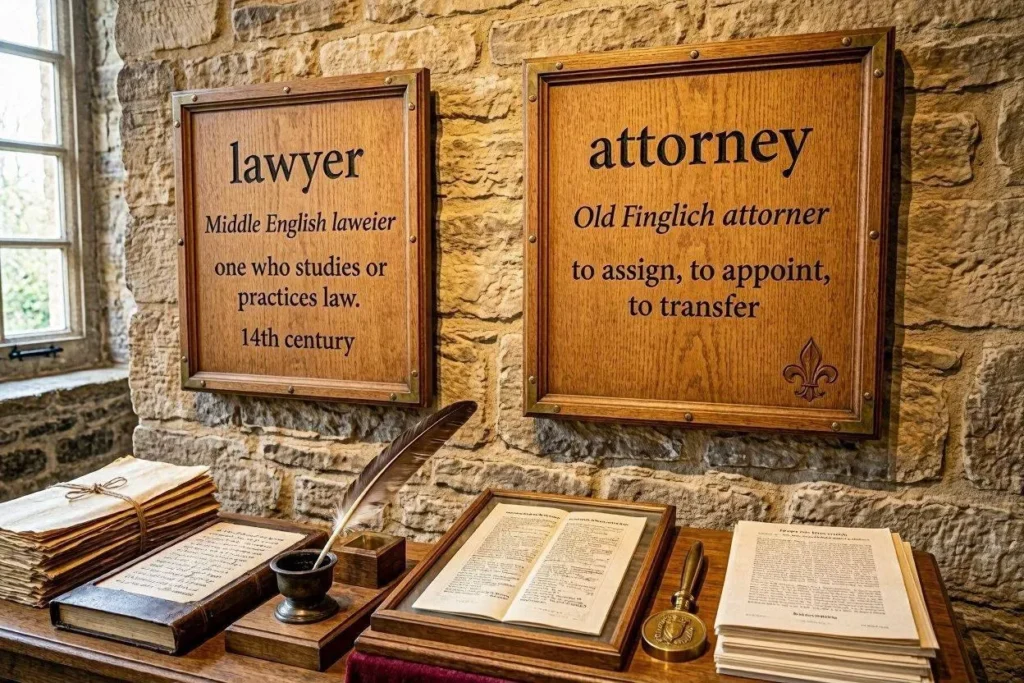
The two terms survived because they entered English from different sources at different times.
Lawyer traces to Middle English laweier — ‘one who studies or practices law.’ The word emerged around the 14th century when legal education began to formalize in England. It described anyone who knew the law, whether or not they held a formal position.
Attorney comes from Old French attorner — ‘to assign, to appoint, to transfer.’ It entered legal usage to describe someone formally appointed to act on another’s behalf. The full title attorney-at-law distinguished a formally appointed court representative from an ‘attorney in fact’ — someone given power of attorney to manage affairs without practicing law.
Over time, as the American legal system developed its own bar admission requirements, attorney became the term for a licensed practitioner and lawyer became the broader, informal label. The distinction mattered more in centuries past, when apprenticeship — not law school — was the path to legal practice, and the line between who had legal authority and who did not was less standardized.
Today, both words describe the same person in most contexts. The credential gap that once separated them — bar admission — is still real, but most working legal professionals hold both the degree and the license.
Content Gaps This Article Covers — What Competitors Miss
Most competitor articles on this topic cover the basic definition but stop there. The following topics are missing from the majority of top-ranking content:
- Attorney-client privilege as a concrete practical difference — not just a footnote
- Jurisdiction limitations — a licensed attorney in one state cannot automatically practice in another
- What lawyers without bar admission actually do in the real working world
- The specific etymology of both words and why 2 terms exist for what appears to be the same job
- The misconceptions table with corrections for each common error
- A clear breakdown of when the distinction is irrelevant vs. when it changes your legal outcome
Bottom Line
Lawyer = law degree. Attorney = law degree + bar license. In everyday use, the terms overlap almost completely because most practicing legal professionals hold both credentials.
The distinction matters the moment you need someone in a courtroom. Only a bar-admitted attorney can represent you before a judge, file motions on your behalf, and protect your communications under attorney-client privilege.
Before hiring anyone for legal representation: verify bar admission status at your state bar association’s public directory. Search by name, confirm the license is active, and check for any disciplinary history. It takes 2 minutes. It is always worth doing.
FAQs — Lawyer vs. Attorney Difference

Amanda Brooks
Amanda Brooks leads JusticeInTown’s legal, justice, and community advocacy content division. She holds a background in legal research and public policy and specializes in topics related to civil rights, access to justice, legal awareness, and community issues. With years of experience researching legal and social justice topics, Amanda brings a careful, research-driven approach to complex legal information and public-interest issues. She is the primary author of JusticeInTown’s legal guides, justice-related resources, and community-focused content, helping readers better understand their rights, legal options, and the issues affecting their communities.
Related Posts